

“A Thoroughly Corrupt World”
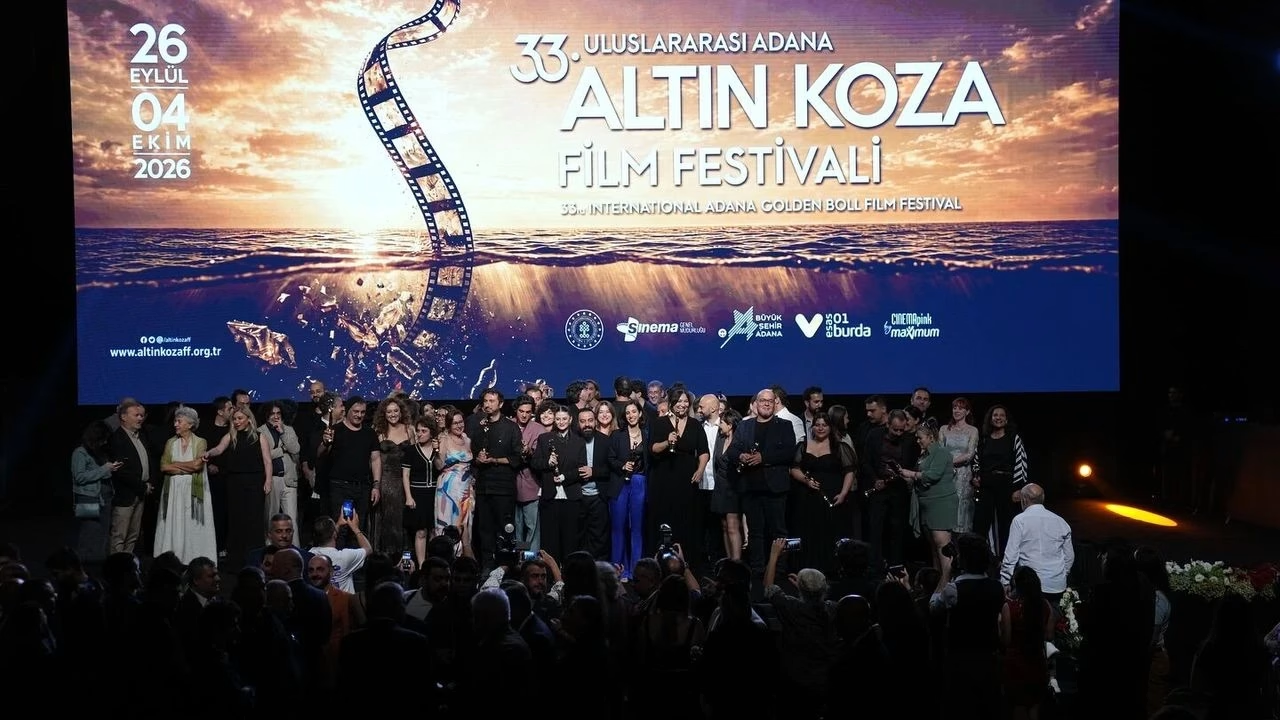
Written and directed by Nuri Cihan Özdoğan, Dead Dogs Don’t Bite (Ölü Köpekler Isırmaz) made its world premiere at the 55th International Film Festival Rotterdam before screening for audiences at the Adana Golden Boll Film Festival. We sat down with actor Abdullah Koç to discuss his role as Nevzat and his experience working on the film…
— Dead Dogs Don’t Bite plunges into a deeply uncompromising world. When you first encountered your character, what was it that immediately clicked or made you feel, “I have to play this role”?
Abdullah Koç: In our very first conversation about the project, director Nuri Cihan Özdoğan told me, “When I started writing this character, you immediately came to mind.” I was both honored and intrigued—the character suddenly took on a far richer dimension. The film depicts a world thoroughly corrupted, interwoven with legal and illegal spheres locked in power struggles, against which a hopeless younger generation is brought into focus. Through the eyes of President Nevzat—amidst this scramble for money and dominance—we convey how an entire society’s future stands to be squandered, a theme captured vividly in the scene featuring the youth. Having my real-life son, Fatih Koç, share that scene made tapping into those emotional depths particularly special for me. Ultimately, that overarching thematic weight was what truly convinced me I had to take the role.
— In the film, we witness two close friends morphing as they sink deeper into the criminal underworld, their bond irrevocably transformed. How would you describe who your character was at the start, and who he becomes by the end?
Abdullah Koç: President Nevzat is a trade union presidential candidate who operates, nominally, within a legal framework—though he is backed by one of two factions sustained by illegal dynamics. Unfortunately, reality on the ground paints a much darker picture. Following a distressing turn of events with his family, we watch a man realize that the toxic elements he courted to secure his own modest power could eventually come back to haunt his own life.
— Ambition, money, power, and the desire for a better life drive the choices of the characters in this film. While portraying Nevzat, were there moments where you found yourself empathizing with his actions or feeling that he was justified?
Abdullah Koç: There is an adage I am quite fond of: “If one does not live by what one believes, one ends up believing in how one lives.” In a way, Nevzat is justified, as are all the others—everyone feels justified. Whatever situation people find themselves in, they rationalize their own truths to survive and maintain their reality, aligning completely with the ground they stand on and accepting it as absolute. That is, until a sudden shift shatters it. Isn’t that precisely where self-deception begins?
— In crime cinema, avoiding simple dichotomies of ‘good’ and ‘evil’ is as vital as exposing a character’s darker nature. Would you rather audiences understand your character, or question him?
Abdullah Koç: Understanding is inherently subjective; it shifts depending on an individual’s perspective and perception. For me, it is far more crucial that audiences interrogate these characters rather than merely empathize with them. A society that builds a habit of questioning—rather than passively complaining—will ultimately arrive at understanding. After all, this social milieu is hardly unfamiliar to any of us, is it?
— The film was shot entirely on location in Adana. How did the city’s streets, dialect, people, and overall atmosphere inform your performance? Would the character have been the same person if set elsewhere?
Abdullah Koç: Given that Adana is a geography I know like the back of my hand, channeling that atmosphere came naturally. Had it been set in another city, would he still be the same person? I believe so, yes.
— The industrial waste scattered throughout the environment serves as more than a background to crime; it functions as a metaphor for the moral decay consuming the characters. As an actor, how did you embody this sense of rot within Nevzat?
Abdullah Koç: In a sense, isn’t President Nevzat trying to build his power by leaning against dirty walls? Yes, physical garbage is a local reality here, but we can substitute trash with various other aspects of modern life, can’t we? When we reflect quietly, we start to see it. Director Özdoğan layered these metaphors into the project with incredible aesthetic precision. In Nevzat, this internal decay crystallizes in his insistence on phrasing: “We don’t call it trash; we call it waste.” What, ultimately, is the point of this delusion?
— Inhabiting a dark and tense narrative over an extended period can be demanding for an actor, often lingering into daily life. Which scene or emotion proved the most challenging for you during production?
Abdullah Koç: I didn’t personally find any particular scene for my character difficult, as these were atmospheres I had already observed in real life. Where I found myself deeply engaging was empathizing with the other characters—specifically, the gradual unraveling of the friendship between the two leads.
— From Rotterdam to the Golden Boll, the film has engaged with diverse audiences across its festival run. What core emotion or lingering question do you hope viewers take with them when they leave the theater?
Abdullah Koç: A single sentence kept coming back to me: “Searching for hope amidst the refuse left behind by others in our intertwined lives is the ultimate self-deception.” I would love for audiences to carry that reflection with them as a guiding principle in every corner of their lives.