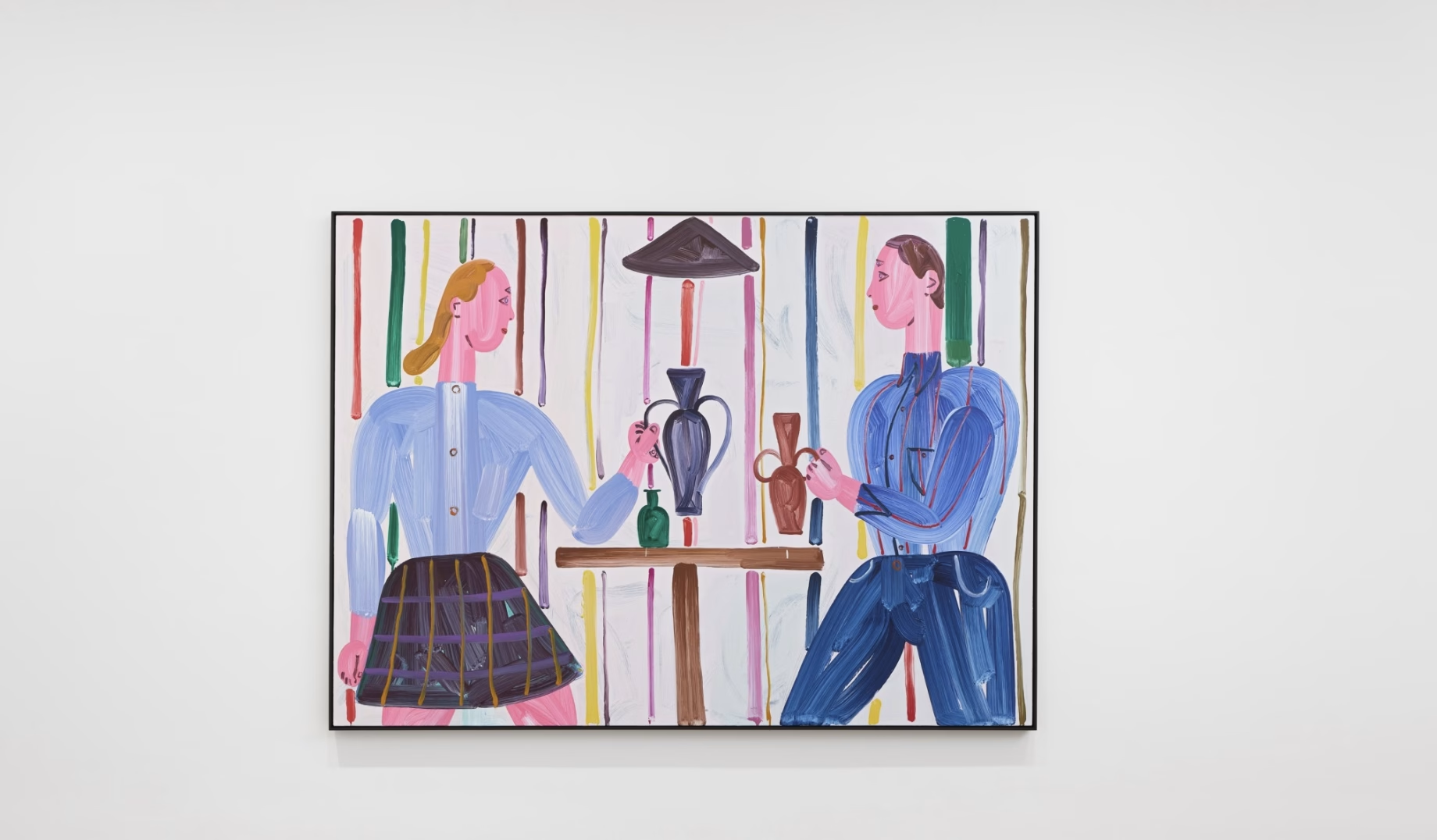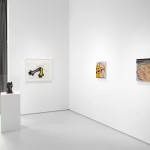


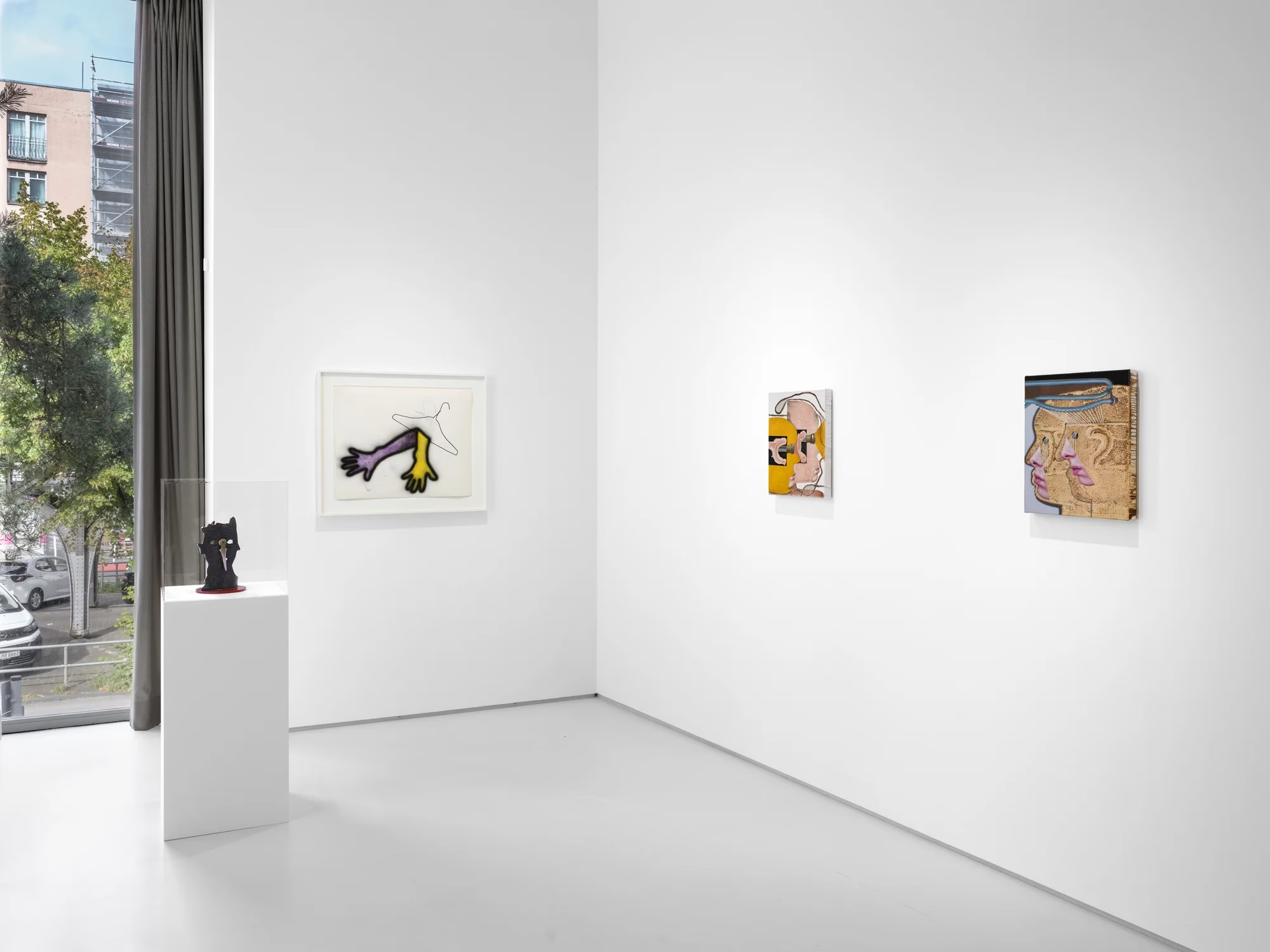
Striking a vivid contrast against Berlin’s autumnal grey, an almost electric brilliance seeps through the raw walls of Die Tankstelle at Bülowstraße 18. Running through 1 November at Pace Gallery’s unorthodox industrial venue, Exquisite Corpse confronts the viewer from the threshold with the pulsating energy of razor-sharp contours, taut surfaces, and distorted anatomies.
The exhibition stems from artist-curator Loie Hollowell’s deep affinity for the pioneering Austrian-American artist Kiki Kogelnik (1935–1997). In dialogue with two formidable contemporaries, Sascha Braunig and Veronika Pausova, Hollowell discovered how persistently Kogelnik’s mark had filtered into each of their studio practices. The result gathers four women artists across continents and generations under one roof, their works coalescing into fragments of a shared visual lineage.
Folds of a Surrealist Legacy
Serving as the exhibition’s conceptual spine, the title invokes the cadavre exquis—the iconic collective parlour game devised by the Surrealists in 1925, in which players fold a sheet of paper to add an anatomical section, guided only by the lingering edges of the preceding sketch. In Hollowell’s hands, this device becomes an astute metaphor for artistic cross-pollination across temporal and geographic divides: Kogelnik folded the paper decades ago; today, three contemporary painters unfold it, carrying the line forward in their own vernaculars.
Across painting, sculpture, and works on paper, the human figure—and the female body in particular—flatly refuses docility or fixity. Here, the body operates as contested terrain: pulled taut, compressed, severed, and reassembled. Shaped by technological friction, labour, and scientific mutation, these figures read less as organic entities than as modular apparatuses.
This gives the exhibition’s feminist undercurrent a nuanced dimensionality. Tracing a trajectory from Kogelnik—who resisted being pigeonholed as a “feminist” during her lifetime—to three contemporary artists who tackle gendered cultural constraints head-on, one senses the shifting yet relentless momentum of feminist struggle.
Pushing the Margins: Four Distinct Visions
Moving through the gallery, a striking kinship emerges in the artists’ consummate technical discipline and audacious chromatic register.
Though Kogelnik shared studio proximity and artistic oxygen with Warhol and Lichtenstein during Pop Art’s New York heyday, her treatment of the corporeal set her resolutely apart. Works such as Cold Passage (1964) deploy an icy, detached visual lexicon where body and machine coalesce into hybrids. Kogelnik’s stencil-like silhouettes and flat color planes read today as an early, singularly daring critique of the mechanization of the human form.
This lineage reverberates across Sascha Braunig’s canvases. Having absorbed Kogelnik’s stark contours into her own repertoire, Braunig charges them with an entirely different psychological tension. In works like Possession (2024), hyper-corseted waists, spined appendages, and spectral entities warp under the oppressive weight of technicolor backdrops; Braunig stages the social conditioning and discipline imposed upon the female form with surgical acuity.
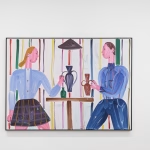
Adjacent, Veronika Pausova’s uncanny wit disrupts the rhythm. Pausova’s paintings operate as theatrical montages peopled by an idiosyncratic cast: shellacked fruit flies, dusty moths, disembodied hands gripping their own stretchers, and a nipple tethered to the canvas by a solitary thread. Merging hyper-realist brushwork with experimental staining and sponging techniques, Pausova orchestrates an unsettling narrative—a visual gambit that disarms the viewer with dark humour only to disturb them with quiet unease.
Curator Loie Hollowell anchors the presentation with her signature hypnotic depth, reconstituting the body through the language of abstract geometry. In Mother Radar in green and orange (2026), layers of resin, sawdust, and paint over wood panels rupture the two-dimensional surface into a bas-relief topography. Hollowell’s earlier explorations of bodily fluids and intimate architecture here mature into pulsating circular forms and radiant chromatic detonations. Flesh ceases to be mere tissue; it transforms into a luminous, fecund, and geometric field of power.
Traces on the Wall
At Pace’s Berlin space, Exquisite Corpse renders visible not merely a formal affinity, but a tacit intergenerational dialogue—one conducted by women artists looking intently over each other’s shoulders. Beneath the saturated colour blocking, millimetric draughtsmanship, and fractured bodily motifs lies a shared defiance, an unwillingness to shy away from formal transgression or the disquieting. If in Berlin, one would be well advised to make the trip to Bülowstraße before this visual relay draws to a close.