

What Stanley Kubrick truly envisioned for Eyes Wide Shut has remained one of cinema’s greatest mysteries ever since the film was released in 1999. Kubrick’s perfectionism was legendary; he could spend days agonizing over the slightest shift in lighting tone in a single scene. That’s why the version that hit theaters just days after his death has always been the subject of debate—was it really his “final cut”?
Now, nearly 30 years later, a new 4K Criterion restoration supervised by the film’s cinematographer Larry Smith opens a new door to the decades-old question: “Was Eyes Wide Shut ever truly finished?”
Kubrick’s Final Days and the Feeling of an Unfinished Film
After a shoot that lasted more than 400 days, Kubrick sent a copy of the film to Warner Bros. in March 1999. Tom Cruise, Nicole Kidman, and studio executives watched it; a few days later, a screening was held at Kubrick’s home in England.
Two days after that, the director died of a heart attack.
From that moment on, how much of the released version was actually Kubrick’s has remained unclear. Color grading, certain fixes, and final touches were completed in his absence. His longtime assistant Leon Vitali was involved in the process, but “finishing” a Kubrick film without Kubrick was undeniably impossible.
From Larry Smith’s Perspective: “The Film Was Never Completely Finished”
Years later, cinematographer Larry Smith worked directly on Criterion’s new 4K restoration for the first time. In an interview with SlashFilm, he stated plainly:
“The film was never completely finished. It wasn’t up to Kubrick’s standards. It wasn’t even up to the standard I would have finished it at.”
Smith says the 1999 color timing was rushed and not done the way Kubrick had planned. For the Criterion restoration, he therefore tried to bring the film’s lighting and atmosphere back to “the way it existed in my visual memory.” He even removed a visible camera-assistant reflection in a bathroom scene.
Of course, the inevitable question arises:
Is this really the version Kubrick wanted, or is it Smith’s personal interpretation?
That answer will probably never be definitive.
The 4K Restoration Debate: A Darker Atmosphere?
Early reactions on social media suggest the Criterion version has a noticeably darker tone. Some viewers claim the contrast is stronger than in previous Blu-ray releases; Smith, however, insists it is much closer to the visual world the film was “supposed” to have.
Both sides can be right at the same time:
There is no certainty with Kubrick—only probabilities.
That is exactly what keeps the debates about his films endless.
Is This Version the “Definitive Final Cut”?
The most level-headed summary of the controversy comes from Kolker and Abrams’ book:
“The Eyes Wide Shut we have is the only Eyes Wide Shut we will ever have.
Whether a tiny detail would have changed is now irrelevant.”
Would the film have been different if Kubrick had lived?
Yes, most likely.
But that question now casts a larger shadow than the film itself.
The Criterion restoration shines a new light into that shadow:
“At least now there is a version that has been approved by the film’s cinematographer.”
Why Does It Matter?
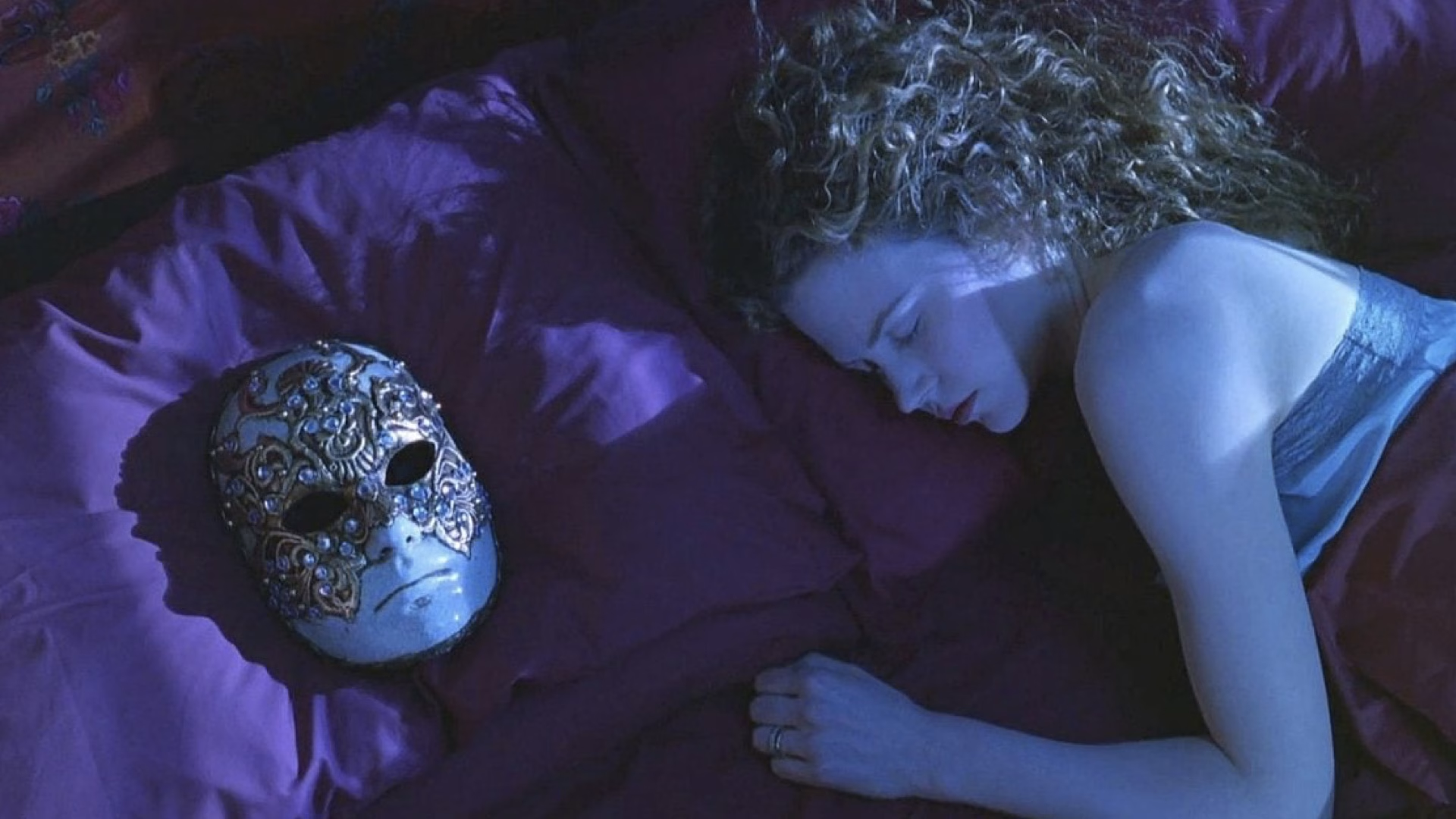
Eyes Wide Shut is one of the most controversial works in Kubrick’s oeuvre. With its erotic, dreamlike, and deeply unsettling tone, it re-creates New York nightlife inside the aesthetics of a masked ball. Given how meticulously Kubrick thought about this world, the very possibility that the film remained “incomplete” has been disturbing for decades.
The new restoration offers a kind of closure to that sense of incompleteness.
Not a definitive ending—but the feeling that we have finally “arrived somewhere.”
Final Word
Kubrick’s last film was finished by other hands after his death. Now, 30 years later, one of those hands has finally been able to add his own real touch. The Criterion version fills, just a little, the silent void the director left behind the screen:
This may not be Kubrick’s Eyes Wide Shut.
But for the first time, it is the version that truly feels complete.