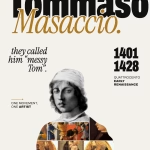


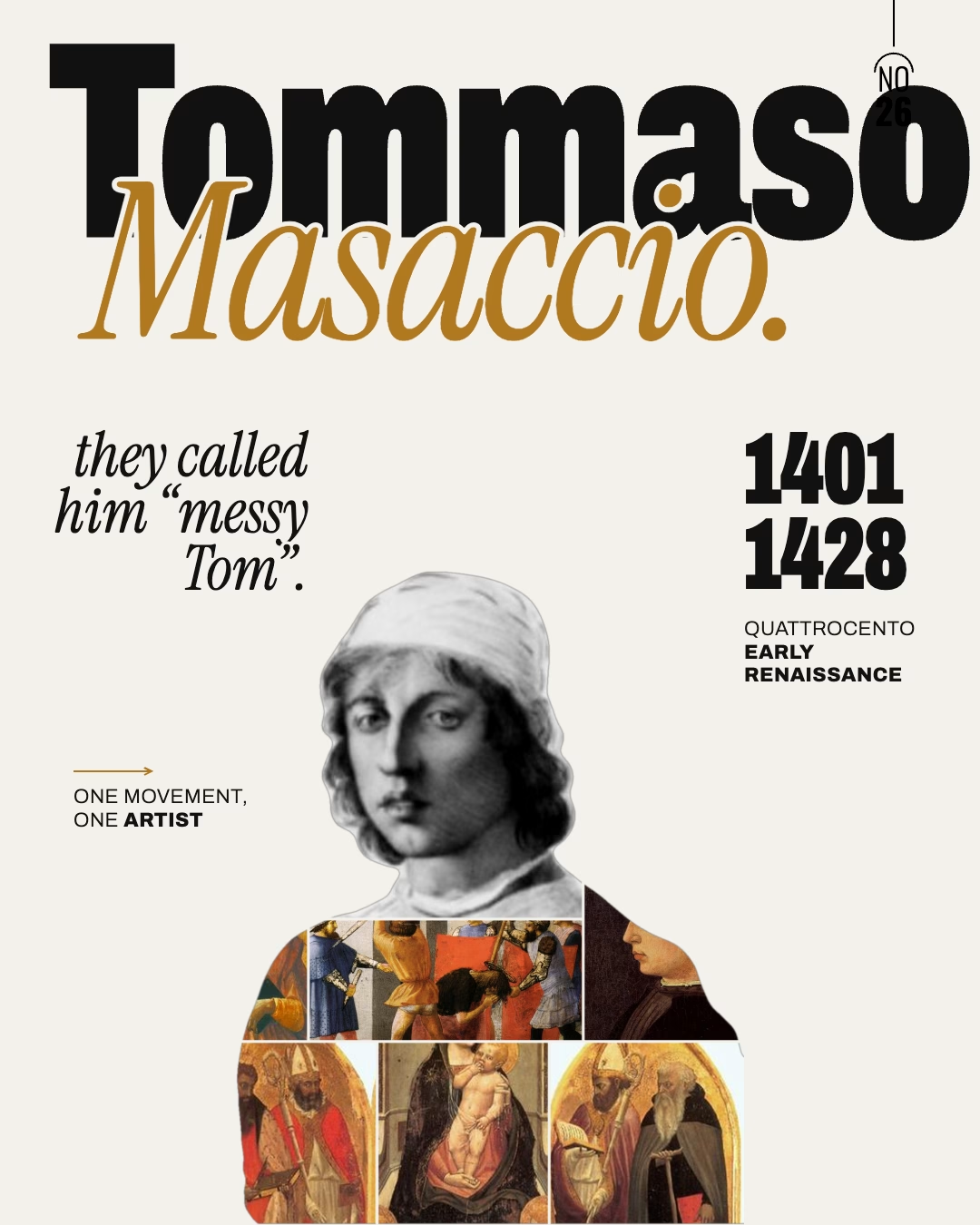
For the fifth instalment of our “One Movement, One Artist” series, we trace our way back to the fountainhead of both the classical and modern movements examined so far—the great watershed of Western art: the Renaissance. Our focus is Masaccio, the youthful master who ignited this aesthetic revolution and, despite a fleeting lifespan, fundamentally altered the destiny of mural and panel painting.
The Renaissance inevitably summons titans such as Leonardo da Vinci, Michelangelo, and Raphael. Yet these figures were not the architects of the movement; they were its apex—the masters of the High Renaissance at the turn of the sixteenth century. The intellectual and pictorial ground upon which they stood had been cleared nearly a century prior, forged by a handful of audacious artists in 1420s Florence. Foremost among these pioneers was a young painter who departed this world at just twenty-six, leaving behind an exceptionally lean yet epoch-defining body of work: Tommaso di Ser Giovanni di Simone, immortalised as Masaccio.
This essay first unpacks what the Renaissance truly was and how its evolving phases redefined our ways of seeing. It then explores why Masaccio is venerated as the progenitor of Renaissance painting, examining The Holy Trinity—the earliest surviving painting constructed through systematic linear perspective—and the Brancacci Chapel frescoes that even a young Michelangelo studied and copied. Finally, it considers the fascinating, lesser-known threads connecting the Italian Renaissance with Istanbul.
The Movement: What Was the Renaissance?
The Anatomy of ‘Rebirth’
Deriving from the French for “rebirth”, the word Renaissance finds its conceptual genesis in the sixteenth-century writings of the Italian painter and biographer Giorgio Vasari. In his foundational 1550 text, The Lives of the Artists, Vasari argued that the sublime aesthetic achievements of classical antiquity had withered into obscurity throughout the Middle Ages, only to be resurrected (rinascita) in the hands of Florentine masters. It was not until the nineteenth century, however, through the scholarship of Jules Michelet and Jacob Burckhardt, that the concept was firmly codified as an epochal designation.
Yet Vasari’s narrative reflects an unapologetically Florentine, partisan bias. Contemporary art historians largely reject the trope of the Middle Ages as a culturally barren “Dark Age”: the medieval era had its own generative revivals, notably the Carolingian and Twelfth-Century Renaissances, and the classical tradition was never entirely extinguished.
Rooted in fourteenth-century Europe, the Renaissance introduced a visual language in painting, sculpture, and architecture that ultimately displaced the Gothic idiom. Far more than a stylistic shift, it marked a vast epistemic transformation across science, philosophy, statecraft, and commerce, bridging the medieval worldview with the modern era. The famous 1401 competition for the bronze doors of the Florence Baptistery, which pitted Filippo Brunelleschi against Lorenzo Ghiberti, is widely cited as the symbolic inauguration of this transformation; it was also the exact year of Masaccio’s birth.
Humanism and the Florentine Crucible
The intellectual engine of the Renaissance was humanism: an intellectual movement that placed humankind, the rational mind, and worldly existence at the center of inquiry, interpreting reality through a direct re-engagement with classical Greek and Latin sources. Where medieval visual culture relied primarily on symbolic conventions to articulate the divine and the afterlife, Renaissance artists began grounding even sacred narratives in empirical reality—rendering flesh-and-blood human bodies within plausible spatial environments illuminated by natural light.
The epicenter of this transformation was Florence. Amassing immense wealth through merchant banking and the wool trade, the city evolved in the early fifteenth century into an intense artistic laboratory, propelled by lavish commissions from powerful guilds, wealthy mercantile families, and rival religious houses. The golden age of Medici patronage would only truly begin with Cosimo de’ Medici’s ascent to power in 1434—years after Masaccio’s death.
The Phases of the Renaissance
The Renaissance was not a static, singular moment, but a progression of distinct phases:
-
The Proto-Renaissance (1300s): Spearheaded by Giotto across Florence, Padua, and Siena, this formative stage brought unprecedented human pathos and sculptural weight to the painted figure.
-
The Early Renaissance (Quattrocento, 1400–1490): Centered in Florence, masters including Brunelleschi, Donatello, Masaccio, Fra Angelico, Piero della Francesca, and Botticelli formulated and resolved the mathematical rules of perspective, anatomy, and proportion.
-
The Northern Renaissance: Unfolding concurrently across Flanders and the German lands, figures such as Jan van Eyck and Albrecht Dürer brought oil painting and meticulous empirical observation to their heights. The notion that Van Eyck invented oil paint is a myth (one propagated by Vasari); rather, he brought the medium to technical perfection.
-
The High Renaissance (1490–1527): A brief, dazzling apex concentrated across Florence, Rome, and Milan, marked by the classical harmony, equilibrium, and compositional perfection of Leonardo da Vinci, Michelangelo, Raphael, and Bramante.
-
The Venetian Renaissance and Mannerism: The Venetian tradition, where color and light dissolved across the canvas under Giovanni Bellini and Titian, along with Mannerism (the Late Renaissance)—characterised by elongated proportions, compositional tension, and stylized virtuosity—constituted the subsequent chapters of this continuum.
Formal and Conceptual Innovations in Painting
The defining technical and intellectual shifts that severed Renaissance painting from its medieval antecedents include:
-
Linear Perspective: A geometric method wherein parallel orthogonals converge at a single vanishing point on the horizon line, creating for the first time a measurable, convincing illusion of three-dimensional depth on a two-dimensional surface. This system was first codified in Leon Battista Alberti’s treatise On Painting (De pictura, 1435).
-
Chiaroscuro: The sculptural modeling of form through subtle gradations from light to shadow, liberating figures from rigid, graphic contours.
-
Anatomy and Empirical Observation: The rigorous study of the skeletal and muscular structures of the human body, driven by an empirical curiosity that extended to anatomical dissection.
-
The Classical Revival: The reintegration of mythological subjects, the revival of the heroic nude, and the deliberate adoption of classical orders—columns, capitals, and coffered vaults—within architectural backgrounds.
-
The Elevated Status of the Artist: The medieval craftsman, historically subsumed by communal anonymity, yielded to the recognized, intellectually autonomous “genius”—an individual creator whose signature style commanded respect and critical appraisal.
The Artist: Masaccio (1401–1428)
Masaccio represents the most radical rupture in Early Renaissance (Quattrocento) painting. By translating scientific perspective into pictorial practice, he effectively ushered in modern painting, wrenching Italian art away from the decorative excesses of the International Gothic style. The sheer magnitude of this break becomes clear through a single comparison: Gentile da Fabriano’s opulent, gold-encrusted Adoration of the Magi (1423) was completed in the very same city and at almost the exact moment Masaccio was producing his revolutionary work. Most astonishing of all is that Masaccio accomplished all of this before ever turning twenty-seven.
The Founding Triumvirate of the Renaissance
Masaccio was no isolated figure. Alongside the architect Filippo Brunelleschi and the sculptor Donatello, he formed the central triad of the Early Renaissance. In 1420s Florence, these three contemporaries mounted a synchronized revolution across their respective disciplines.
Brunelleschi formulated the mathematical laws of linear perspective, revived the architectural grammar of ancient Rome, and engineered the colossal dome of Florence Cathedral. Donatello introduced spatial recession into low relief (schiacciato) with his Saint George and the Dragon (c. 1417), later restoring tangible physical presence to sculpture with his David (c. 1440s)—the first freestanding bronze nude cast since classical antiquity. Masaccio, in turn, synthesised Brunelleschi’s geometric spatial clarity with the massive physical weight and human warmth of Donatello’s figures, transposing both onto frescoed walls and wooden panels.
The earliest confirmation of this leadership among contemporaries is found in the 1436 Italian vernacular edition of Alberti’s On Painting. Dedicating the volume to Brunelleschi, Alberti explicitly singled out Masaccio alongside Donatello and Ghiberti as the preeminent masters of their age.
A Brief Life: ‘Clumsy Tom’
Born on 21 December 1401 in San Giovanni Valdarno, near Florence, Masaccio was christened Tommaso di Ser Giovanni di Simone. The moniker “Masaccio” translates roughly to “Clumsy Tom”, “Slovenly Tom”, or “Absent-minded Tom”—a sharp counterpoint to the diminutive given to his early collaborator, Tommaso di Cristoforo Fini, known as “Masolino” (“Little Tom”). As Vasari recounts, Masaccio acquired the nickname not from any malice of character, but because he was so entirely absorbed in the demands of his art that he paid no heed to his clothing, money, or worldly affairs.
His earliest attributed work is the San Giovenale Triptych, dated 1422 and discovered in a modest rural church in 1961. Enrolling in the Florentine guild of painters that very year, the young master partnered with Masolino around 1424 to begin the Brancacci Chapel frescoes. In 1426, he completed the Pisa Polyptych, followed around 1427 by The Holy Trinity fresco. In the summer of 1428, having traveled to Rome to pursue new projects, he died at the age of twenty-six. The cause of his death was never conclusively determined; Vasari notes a persistent rumor that he was poisoned by envious rivals. Upon receiving the news, Brunelleschi is reported to have lamented: “We have suffered a colossal loss.”
Masaccio drew deeply from Giotto’s dramatic moral gravitas, Donatello’s sculptural density, the monuments of Roman antiquity, and his early mentor Masolino, yet he transfigured this collective inheritance into something entirely unprecedented. By enforcing a single, unified light source to cast deliberate shadows, anchoring spatial recession to a true vanishing point that appeared to punch through the wall, and modeling form through chiaroscuro rather than brittle contour, he established the core tenets of modern painting. From Michelangelo and Raphael to twentieth-century masters like Picasso and Matisse, generations of artists returned to his compositions to grasp the fundamental mechanics of spatial painting.
In Close-Up: The Holy Trinity (c. 1427)
Painted on the north aisle wall of Santa Maria Novella in Florence, the monumental, nearly 6.7-metre-high fresco of The Holy Trinity (La Trinità) is recognized as the earliest surviving painting constructed according to systematic linear perspective. While subsequent geometric analyses have detected minor mathematical discrepancies, the work stands as the first triumphant application of perspective in the history of painting.
What We See
Standing before the fresco, the viewer is confronted not with a flat painted surface, but with the optical illusion of a deep architectural chapel carved directly into the church wall. Evoking a Roman triumphal arch, the architecture unfolds through a coffered barrel vault supported by Ionic columns, framed externally by Corinthian pilasters carrying an entablature—generating an arresting illusion of spatial recession.
Within this classical framework rises a strict theological hierarchy: the crucified Christ; behind and slightly above him, God the Father standing erect, supporting the cross with both hands; and between them, hovering as a white dove, the Holy Spirit. Flanking the cross in solemn dignity stand the Virgin Mary and Saint John the Baptist. Immediately outside the arch, occupying the terrestrial threshold shared with the viewer, kneel the two donors in pious devotion. Although their identities remain subject to debate, they are widely believed to represent a husband and wife of the Lenzi family.
At the very base of the composition, resting upon an open classical sarcophagus, lies a painted skeleton. Above it, a chilling vernacular inscription delivers an inescapable memento mori: “I was once what you are, and what I am you will become.” The fresco thus stages an ontological ascent, rising from the mortal reality of the grave, through saintly intercession, and into the eternal realm of the divine.
A Revolution of String and Nails
In orchestrating the fresco, Masaccio applied Brunelleschi’s geometric rules directly. He established the centric vanishing point precisely at the viewer’s eye level, aligning it with the base of the cross. This is not mere art-historical conjecture, but a documented physical reality: restoration work revealed a nail hole at this very locus, alongside incised orthogonal guide marks pressed into the damp plaster. By tying lengths of string to this central nail and drawing them taut across the wall, Masaccio systematically aligned the coffers of the barrel vault and the architectural orthogonals.
As a result, the illusory chamber within the painting matched the eye level of an observer standing on the church floor. The sacred realm was no longer confined to an inaccessible celestial abstraction; it occupied the very same physical geometry as the observer’s world. As Vasari observed, the wall appeared to have been breached. The Holy Trinity is nothing less than a visual manifesto of the Renaissance, synthesizing science, classical architecture, and the human observer on a single plaster surface.
The fresco also carries an ironic history: Vasari, who praised it so lavishly, was the very person responsible for its concealment. During the Counter-Reformation remodeling of Santa Maria Novella around 1570, he mounted a stone altar and an altarpiece of his own directly over the fresco, hiding it from view for nearly three centuries until it was uncovered once again in the 1860s.
The Brancacci Chapel and Masaccio’s Legacy
In 1424, the wealthy silk merchant Felice Brancacci commissioned Masolino and Masaccio to decorate his family chapel in the church of Santa Maria del Carmine with a cycle depicting the life of Saint Peter. When Masolino departed for Hungary in 1425, Masaccio continued the campaign alone; however, his departure for Rome in 1427 and subsequent death left several scenes unfinished, which were finally completed half a century later, in the 1480s, by Filippino Lippi. Felice Brancacci himself, an adversary of the Medici, was exiled from Florence in 1436.
The Brancacci Chapel demonstrates Masaccio’s absolute mastery of natural light. The lighting within the paintings is not arbitrary; the shadows cast by the figures were systematically calculated to align with the angle of light entering the chapel through its actual window.
The Tribute Money (Il Tributo): Illustrating the encounter between Christ, the apostles, and the Roman tax collector, this continuous narrative combines three successive episodes within a single unified composition. The perspective orthogonals of the buildings in the background converge directly behind the head of Christ, while the distant mountains recede through atmospheric perspective, their palette cooling and fading into the distance. The monumental drapery and grounded stances of the figures possess the gravitas of antique statuary.
The Expulsion from the Garden of Eden: Occupying the narrow entrance pilaster of the chapel, this small fresco remains one of the most raw and devastating depictions of human anguish in Western art. Driven out before the sword of an angel, Eve wails in unbridled shame and despair, while Adam buries his face in his hands, weeping convulsively. A raking light strikes their bodies from a single direction, articulating their muscular anatomy. In the late seventeenth century, modesty leaves were painted over the figures on moralistic grounds; it was only during the major restoration of the 1980s that these additions were removed, restoring Masaccio’s visceral nudes to their original state.
Following Masaccio’s death, the Brancacci Chapel became a de facto academy for generations of Florentine painters. According to Vasari, Leonardo, Botticelli, Perugino, and the young Michelangelo all made pilgrimages to the Carmine to copy Masaccio’s figures; several of Michelangelo’s preparatory drawings survive to this day. Indeed, as the sculptor Benvenuto Cellini recorded, Michelangelo’s famously broken nose was acquired in this very chapel, shattered by a punch from fellow sculptor Pietro Torrigiano during a brawl over copying the frescoes.
Where to See Masaccio’s Work
Because Masaccio’s greatest achievements are immovable wall frescoes, seeing them requires traveling to Florence. The Holy Trinity remains in Santa Maria Novella, while the Brancacci Chapel cycle adorns Santa Maria del Carmine. The Uffizi Gallery displays the Virgin and Child with Saint Anne, executed in collaboration with Masolino.
The fragments of the dismantled Pisa Polyptych are scattered across international institutions: the central panel hangs in the National Gallery in London; the crowning Crucifixion is in the Museo di Capodimonte in Naples; the predella panels reside at the Gemäldegalerie in Berlin; the panel depicting Saint Andrew is at the J. Paul Getty Museum in Los Angeles; and Saint Paul remains in Pisa at the Museo Nazionale di San Matteo.
A Note from Turkey: The Renaissance and Istanbul
The story of the Renaissance is too often circumscribed entirely within the borders of Italy. Yet Istanbul played a vital role both in the gestational emergence and during the peak of this great transformation.
The Intellectual Conduit: From Byzantium to Italy
The classical Greek manuscripts and philosophical currents that ignited Renaissance humanism were largely transmitted to Italy from the capital of the Eastern Roman Empire, Constantinople. From the late fourteenth century onward, Byzantine scholars who crossed to Italy—such as Manuel Chrysoloras, who began teaching Greek in Florence in 1397—introduced the ancient classics to the West. At the Council of Florence in 1439, convened to unite the Eastern and Western Churches, the Byzantine Emperor was accompanied by luminaries including Georgios Gemistos Plethon and Cardinal Bessarion. Plethon’s lectures on Plato are widely credited with inspiring Cosimo de’ Medici to establish the Platonic Academy in Florence.
From an art-historical perspective, a parallel visual awakening was already evident: the nascent volumetric weight and spatial curiosity seen in the 1315–1321 mosaics and frescoes of the Chora Church (Kariye) in Constantinople were produced in the very same years as Giotto’s frescoes in the Scrovegni Chapel in Padua, leading art historians to compare the two traditions as concurrent aesthetic flowerings.
Mehmed the Conqueror and Gentile Bellini
In 1479, following the peace treaty concluded with Venice, Sultan Mehmed II requested a distinguished portrait painter from the Venetian Doge. Gentile Bellini traveled to Istanbul, where during his residency at the imperial court he painted his celebrated portrait of the Sultan. Today housed in the National Gallery in London—under the very same roof as Masaccio’s Pisa Polyptych panel—this work marks the most direct meeting between the Italian Renaissance portraiture tradition and Ottoman court culture. Because the painting underwent extensive nineteenth-century repainting, its exact attribution has periodically been subject to scholarly debate.
Leonardo and Michelangelo’s Golden Horn Vision
Between 1502 and 1503, Sultan Bayezid II entertained a major civil engineering project: a bridge spanning the Golden Horn to connect Galata with the historic peninsula. Leonardo da Vinci submitted a design accompanied by a letter to the Sultan. Conceived as a single-span arch across an extraordinary 240 metres, it would have been the longest bridge in the world had it been realized; the Sultan, however, did not approve the project. An Ottoman Turkish translation of Leonardo’s letter is preserved in the Topkapı Palace archives, while the technical drawing survives in Leonardo’s notebooks. In 2001, a scaled-down timber version of this design was constructed as a pedestrian bridge in Norway through the initiative of artist Vebjørn Sand.
Following the dismissal of Leonardo’s proposal, the invitation was extended in 1506 to the young Michelangelo. According to his pupil and biographer Ascanio Condivi, Michelangelo—then at odds with Pope Julius II—seriously contemplated traveling to Istanbul; however, religious reservations and the prospect of reconciliation with the Pope prevented the journey. The French author Mathias Énard later drew upon this historical crossroads in his novel Tell Them of Battles, Kings, and Elephants (Parle-leur de batailles, de rois et d’éléphants, 2010), evoking a lyrical fictionalization of Michelangelo’s presence in the Ottoman capital.
The humble nail Masaccio drove into the wall in the 1420s would, within eighty years, reach across the Golden Horn in the architectural imaginations of Leonardo and Michelangelo. Such is the boundless trajectory of art and intellectual enquiry across borders.
Until the next instalment of the series.