

Art in Istanbul: Contemporary Currents, from Biennials to Museums, and a Historical Appraisal

This concluding installment of the series on Istanbul’s art history traces the city’s contemporary art ecosystem from the 1970s to the present. It examines the Istanbul Biennial, the ascendancy of private museums, a burgeoning commercial art market, the trajectory of the 2010 European Capital of Culture, and key developments unfolding across the 2025–2027 cycle. The second section offers an overarching synthesis of the entire series, surveying the city’s artistic lineage from Byzantion to the contemporary moment.
The central thesis is straightforward: the art scene shaped primarily by the state and the State Academy of Fine Arts during the early Republican era has, since the 1970s, been systematically restructured by civil society initiatives, family-holding foundations, and transnational networks. While this structural pivot firmly established Istanbul on the global contemporary art map, it also introduced fraught debates regarding institutional reliance on corporate capital, the spatial pressures of aggressive urban redevelopment, and the shifting boundaries of artistic expression.
İKSV and the Istanbul Biennial
Pre-Biennial Groundwork. The biennial did not emerge in an institutional vacuum. Between 1977 and 1987, the Yeni Eğilimler (New Trends) exhibitions held at the Istanbul Painting and Sculpture Museum served as a crucial proving ground. Marking the first time installation, conceptual art, and performance gained institutional visibility in Turkey, these exhibitions laid the intellectual and infrastructural foundation upon which the biennial would be built.
The Founding of İKSV and the Exhibition Model. The Istanbul Foundation for Culture and Arts (İKSV) was founded in 1973 under the leadership of Dr. Nejat F. Eczacıbaşı, alongside a circle of industrialists and art patrons, launching the inaugural Istanbul Festival that same year. Having shaped the city’s cultural landscape through dedicated festivals for music, theatre, cinema, and jazz, the foundation expanded into the visual arts in 1987 by inaugurating the Istanbul Biennial, later adding the Istanbul Design Biennial in 2012.
Rather than adopting the Venice Biennale’s model of national pavilions, the Istanbul Biennial embraced a unified curatorial framework that fosters direct dialogue between artists and audiences through the works themselves. Appointed on the recommendation of an international advisory board, the curator develops an overarching conceptual framework around which participating artists and projects are assembled. Regarded by İKSV alongside Venice, São Paulo, and Sydney as one of the world’s premier biennials, the exhibition remains the most comprehensive international contemporary art platform in the region.
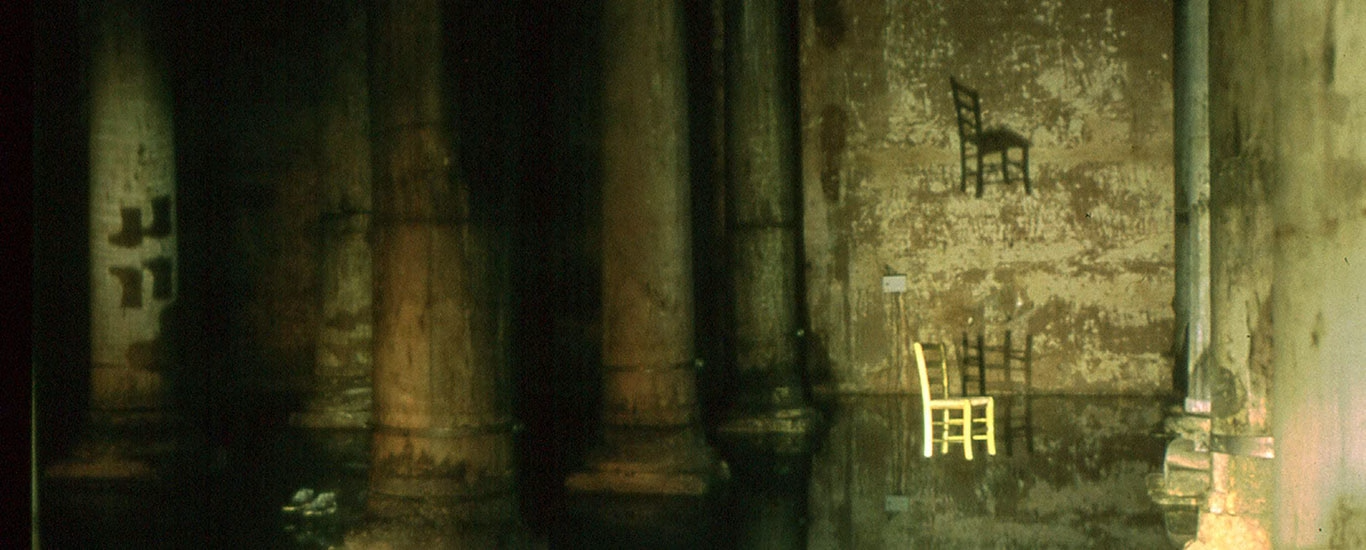
Formative Years and Trajectory. The first two editions (1987 and 1989), held under the general coordination of Beral Madra under the rubric Contemporary Art in Traditional Spaces, activated landmark monuments such as Hagia Sophia and Hagia Irene, turning the city’s layered architectural heritage into an experimental stage. Beginning with the 3rd edition in 1992—directed by Vasıf Kortun and featuring 65 artists from 15 countries—İKSV established the practice of appointing a distinct curator for each iteration, engaging international curators exclusively from 1995 onward.
The biennial’s chronological trajectory and conceptual frameworks comprise:
-
1st & 2nd Biennials (1987, 1989): Beral Madra (General Coordinator), Contemporary Art in Traditional Spaces
-
3rd Biennial (1992): Vasıf Kortun (Director), Production of Cultural Difference
-
4th Biennial (1995): René Block, Orient-ation: The Image of Art in a Paradoxical World
-
5th Biennial (1997): Rosa Martínez, On Life, Beauty, Translations and Other Difficulties
-
6th Biennial (1999): Paolo Colombo, The Passion & the Wave
-
7th Biennial (2001): Yuko Hasegawa, EGOfugal
-
8th Biennial (2003): Dan Cameron, Poetic Justice
-
9th Biennial (2005): Charles Esche and Vasıf Kortun, İstanbul
-
10th Biennial (2007): Hou Hanru, Not Only Possible, But Also Necessary: Optimism in the Age of Global War
-
11th Biennial (2009): What, How & for Whom / WHW, What Keeps Mankind Alive?
-
12th Biennial (2011): Adriano Pedrosa and Jens Hoffmann, Untitled (12th Istanbul Biennial)
-
13th Biennial (2013): Fulya Erdemci, Mom, am I barbarian?
-
14th Biennial (2015): Carolyn Christov-Bakargiev, SALTWATER: A Theory of Thought Forms
-
15th Biennial (2017): Elmgreen & Dragset, a good neighbour
-
16th Biennial (2019): Nicolas Bourriaud, The Seventh Continent
-
17th Biennial (2022): Ute Meta Bauer, Amar Kanwar, and David Teh
-
18th Biennial (2025–2027): Christine Tohmé, The Three-Legged Cat
Critical Turning Points. The 2005 edition, co-curated by Charles Esche and Vasıf Kortun, marked a watershed moment by redirecting the exhibition’s axis away from the Historical Peninsula and embedding it within the dense urban and residential fabric of Beyoğlu and Tophane. In 2013, against the backdrop of the Gezi Park protests, curator Fulya Erdemci withdrew planned interventions from public spaces as they turned into sites of direct political confrontation—a tactical retreat that ignited enduring debates over art’s relationship to contested urban territory. Carolyn Christov-Bakargiev’s 2015 edition broke disciplinary boundaries by staging cross-pollinations between more than 50 visual artists and an array of oceanographers, mathematicians, and neuroscientists. The 17th edition, delayed from 2021 to 2022 due to the pandemic, prioritized localized attunement over grand spectacle.
Beyond serving as an indispensable launching pad for Turkish and regional artists into global circulation, the biennial’s most enduring legacy has been institutional: every two years, it channels an international network of curators, critics, and collectors directly into the studios and artistic infrastructure of Istanbul.
The Rise of Private Museums and Institutions
Throughout most of the Republican era, Istanbul’s visual art institutions were almost exclusively affiliated with the state and the State Academy. The private museum paradigm began taking shape in the 1980s: the Koç family opened the Sadberk Hanım Museum in 1980 as Turkey’s first private museum, followed by Yapı Kredi Cultural Activities, Arts and Publishing (1992), Akbank Sanat (1993), and the Rahmi M. Koç Museum (1994). This institutional momentum surged exponentially after 2000. Corporate conglomerates, commercial banks, and private family foundations rapidly redrew the city’s cultural topography, frequently repurposing obsolete industrial and historic architectures—harbour warehouses, power plants, and former hotels—into contemporary exhibition spaces.
-
Proje4L / Elgiz Museum of Contemporary Art: Founded in 2001 by collectors Can and Sevda Elgiz, the institution positions itself as Turkey’s first private contemporary art museum.
-
Istanbul Modern: Direct public interest in the early biennials catalyzed the museum’s creation, realized through the initiative of Dr. Nejat F. Eczacıbaşı and Oya Eczacıbaşı. Its original home was Antrepo No. 4 in Karaköy—an 8,000-square-metre dry-cargo warehouse designed by Sedad Hakkı Eldem and built between 1957 and 1958. Adapted by Tabanlıoğlu Architects, it opened in 2004 as Turkey’s first large-scale private museum dedicated to modern and contemporary art, operating there for 14 years. The subsequent demolition of Eldem’s warehouse to clear ground for the Galataport project stands as one of the most vivid illustrations of urban capital redevelopment reshaping cultural sites. Following a temporary relocation to Beyoğlu’s Union Française building in March 2018, Istanbul Modern reopened on May 4, 2023, within a purpose-built Karaköy waterfront facility designed by Pritzker laureate Renzo Piano.
-
Pera Museum: Established in 2005 by the Suna and İnan Kıraç Foundation inside the refurbished historic Bristol Hotel in Tepebaşı, the museum houses three foundational permanent collections: Orientalist Painting, Anatolian Weights and Measures, and Kütahya Tiles and Ceramics. Osman Hamdi Bey’s celebrated canvas The Tortoise Trainer serves as the centerpiece of its Orientalist collection.
-
Sakıp Sabancı Museum: Opened in 2002 at Sabancı University’s Atlı Köşk (The Horse Mansion) in Emirgan and expanded with subterranean exhibition galleries in 2005, the museum pioneered international blockbuster exhibitions in Istanbul, mounting retrospectives of Picasso, Rodin, Rembrandt, Anish Kapoor, Sophie Calle, and Monet. It also preserves a premier collection of classical Ottoman calligraphy alongside 19th- and 20th-century Ottoman and Turkish paintings.
-
santralistanbul: Conceived by Istanbul Bilgi University in 2007 through the adaptive reuse of the Silahtarağa power plant—the Ottoman Empire’s first municipal-scale electricity facility—the complex was envisioned as an interdisciplinary nexus pairing industrial archaeology with contemporary art. Although its ambitious contemporary exhibition program gradually contracted, the site continues to operate as an Energy Museum and university campus.
-
Arter: Stemming from the Vehbi Koç Foundation’s long-term contemporary art strategy, Arter opened on İstiklal Street in May 2010, staging 35 exhibitions and commissioning 183 original works during its tenure there. On September 9, 2019, the institution relocated to an 18,000-square-metre building in Dolapdere designed by Grimshaw Architects. By 2022, its permanent collection held over 1,400 works by more than 400 artists.
-
SALT: Founded in 2011 by consolidating Garanti Bank’s cultural entities, SALT operates across two flagship sites: Beyoğlu and the former Imperial Ottoman Bank headquarters in Galata. Its most profound historiographical contribution remains SALT Research, a public-access digital repository and archive documenting late Ottoman and modern Turkish art, architecture, design, and socio-economic history.
-
Civil Society and Independent Spaces: Operating alongside corporate museums, non-governmental organizations and artist-run spaces have provided vital critical counterbalance. Depo, founded in 2008 by Anadolu Kültür within a former tobacco warehouse in Tophane, established itself as an indispensable center for practices addressing historical memory, minority rights, and social dialogue. Meanwhile, artist-led initiatives such as 5533 carved out sustained platforms for non-commercial and experimental practices existing beyond the institutional mainstream.
The Art Market and Contemporary Istanbul
In tandem with the proliferation of institutional venues, Istanbul fostered an increasingly globalized commercial gallery and art market infrastructure. At its center stands Contemporary Istanbul (CI), founded in 2006 by Ali Güreli and supported for years by main sponsor Akbank. Art critic Hasan Bülent Kahraman frames the fair as a concerted effort to tether a post-2000s Istanbul—then positioning itself as a global metropolis—directly to the international network of commercial galleries and art fairs.
Trajectory of the Fair. CI debuted with 49 galleries (40 domestic, 9 international). At its decennial edition in 2015, the fair reached an initial peak, hosting 102 galleries from 24 countries—with international representation reaching 65%—and exhibiting works by 700 artists. Organizers subsequently pruned participant numbers to roughly 70 to prioritize spatial and curatorial coherence. The fair has weathered marked turbulence: participant galleries dwindled to 51 in 2025. Yet, its 21st edition (September 23–27, 2026, at Tersane Istanbul) mounted a marked resurgence, bringing together 70 galleries—including 38 foreign exhibitors, 22 of which were participating for the first time—and 1,372 artworks. Forbes Türkiye characterized this rebound as a “second chance” for the city, propelled by regional geopolitical realignments and Istanbul’s logistical advantages, though whether this renewed visibility can coalesce into a self-sustaining art economy remains an open question.
Market Scope and Figures. Fair organizers reported that while the city’s active collector base numbered around 50 individuals in 2005, it had expanded to an estimated 700 to 800 by 2013. In 2017, Güreli estimated the total market volume for contemporary art in Turkey at roughly $250 million to $300 million. These figures, however, stem from self-reported organizational estimates and have not been corroborated by independent market analyses.
The Gallery Ecosystem. Alongside the fair, a network of commercial galleries took root. Pioneering galleries like Dirimart (founded in 2002) and Rodeo (founded in 2007) secured international representation for Turkish artists; Rodeo’s subsequent relocation abroad underscores the structural precarity of the domestic gallery sector. The gallery cluster that consolidated along Tophane’s Boğazkesen Street in the mid-2000s subsequently fragmented across Karaköy, Dolapdere, Nişantaşı, and Şişli—a dispersal precipitated by organized physical attacks on gallery openings in September 2010, combined with neighborhood gentrification and steep commercial rents.
2010 European Capital of Culture
In 2010, Istanbul assumed the mantle of European Capital of Culture alongside Germany’s Ruhr Region (Essen) and Pécs in Hungary. The program was administered by the specially legislated Istanbul 2010 European Capital of Culture Agency.
Operations and Funding. Spanning January 16 through December 19, 2010, the official program endorsed 588 projects and staged over 9,500 individual events. Funding was secured through a 2008 legislative act that levied a dedicated cultural tax on fuel sales within the Istanbul province. Of the approximately 257.6 million TL allocated by mid-2009, nearly 70% was directed toward urban infrastructure and the structural restoration of historical monuments, diverting capital away from contemporary cultural programming.
Critiques and Institutional Fall-Out. Throughout its mandate, the agency faced intense public criticism regarding high-profile resignations, an absence of administrative transparency, and controversial budgetary decisions. A frequent flashpoint was the budgetary commission’s routine vetoing of cultural projects previously greenlit by the agency’s artistic advisory boards. Parliamentary opposition figures pointed to inflated line-item expenditures and a failure to generate projected tourist windfalls—allegations consistently denied by agency leadership.
The program’s ultimate legacy remains contentious. On one hand, it financed indispensable conservation across Hagia Sophia, Topkapı Palace, and other imperial monuments, coinciding with an unprecedented international auction run for modern and contemporary Turkish art abroad. On the other hand, the scheduled renovation of the Atatürk Cultural Center (AKM)—one of the initiative’s marquee budgetary priorities—collapsed entirely. Boarded up in 2008, the modernist landmark sat vacant for a decade before being demolished in 2018; its replacement, an entirely new complex, opened on the same Taksim site in 2021.
The Contemporary Landscape (2025–2027)
18th Istanbul Biennial: The Three-Legged Cat. The 18th edition departed radically from the biennial’s historical format by expanding from a two-month showcase into a triennial framework spanning three years. The edition was also defined by a public governance dispute: in 2023, İKSV bypassed its own advisory board’s recommendation to appoint Iwona Blazwick as curator. Following widespread resignations and protests within the local artistic and curatorial community, Blazwick stepped aside, and Christine Tohmé—founding director of Beirut’s Ashkal Alwan—was appointed curator in 2024. Tohmé restructured the biennial into a three-phase model:
-
Phase One (September 20 – November 23, 2025): The inaugural exhibition phase, organized around themes of “self-preservation” and “speculative futures,” mounted free-admission exhibitions across eight venues along the Beyoğlu–Karaköy axis, presenting over 100 works by 47 artists representing more than 30 countries.
-
Phase Two (2026): The launch of the Istanbul Biennial Academy, establishing institutional affiliations with local artist initiatives and rolling out continuous, year-long public programming.
-
Phase Three (2027): A culminating program of exhibitions, workshops, and publications synthesizing the research generated across the multi-year cycle.
Likening the biennial in her curatorial statement to a cat stretched across time, Tohmé pivoted the exhibition away from periodic spectacle toward durable infrastructural investment for local artists, education, and initiatives. Directed by Kevser Güler, the full institutional outcomes of the 2026 Academy remain unpublished as of October 2026.
The 19th Istanbul Biennial. İKSV has announced that the 19th Istanbul Biennial will run from September 18 to November 14, 2027, under the curatorship of artist Liu Ding and art historian-curator Carol Yinghua Lu. Consequently, the year 2027 will stage an unusual institutional overlap, hosting both the culmination of the 18th edition’s three-year cycle and the opening of the 19th biennial.
Venice Biennale 2026: Pavilion of Turkey. At the 61st International Art Exhibition of La Biennale di Venezia (May 9 – November 22, 2026, Arsenale), the Pavilion of Turkey, coordinated by İKSV, presents Nilbar Güreş’s solo exhibition Gözlerinizden Öperim (A Kiss on the Eyes). The central biennial theme, In Minor Keys, was formulated by curator Koyo Kouoh, who passed away in May 2025 prior to the exhibition’s opening; the edition was subsequently realized posthumously by her team. Curated by Başak Doğa Temür, the pavilion features Güreş’s monumental textile sculptures and new commissions interrogating gender dynamics, displaced bodies, and institutional hegemony. Having played foundational roles in the formative years of Istanbul Modern, santralistanbul, and Arter, Temür’s appointment underscores the degree to which an institutional cadre that matured within the private foundations of the 2000s now steers the country’s international representation.
The Public Sector’s Institutional Re-emergence. In recent years, both central and municipal authorities have reasserted their presence within Istanbul’s visual arts sphere. The relocation and reopening of the Istanbul Painting and Sculpture Museum at its new Tophane venue (2021–2022), the inauguration of the rebuilt AKM (2021), the Ministry of Culture and Tourism’s Beyoğlu Culture Route Festival, and the Istanbul Metropolitan Municipality’s (İBB) expansive exhibition and acquisition programs have introduced a renewed municipal layer to an art ecosystem previously defined almost entirely by corporate philanthropy.
Overarching Appraisal: Istanbul’s Trajectory in Art History
Surveying Istanbul’s visual art trajectory across a span of 2,700 years—from the founding of Byzantion to the present—yields four structural conclusions:
1. Stratification Within Continuity. The defining dynamic of Istanbul’s art history is not a succession of catastrophic erasures, but a continuous process of palimpsestic accumulation in which each era absorbs, repurposes, and builds directly atop its predecessor. The urban spine established under Septimius Severus and expanded by Constantine—comprising the Tetrastoon, the Hippodrome, and the Mese—served as the spatial armature upon which Constantine’s New Rome, Justinian’s Hagia Sophia, and the imperial mosques of Mimar Sinan and Sedefkâr Mehmed Ağa were sequentially anchored. Standing in Sultanahmet Square today, a viewer takes in an Egyptian obelisk, the Delphic bronze Serpent Column, a Byzantine basilica, and an Ottoman imperial mosque within an unbroken panoramic sweep.
2. Hagia Sophia as Paradigm and Contested Space. Dedicated in 537, Hagia Sophia operated for a millennium as the canonical zenith of Eastern Christian art and structural engineering. In the 16th century, it became the primary architectural and spatial foil against which Mimar Sinan measured his structural achievements at the Süleymaniye. The monument’s interior mosaics, meticulously documented and re-plastered by the Fossati brothers in 1847–1849, were subsequently uncovered by Thomas Whittemore and the Byzantine Institute starting in 1931. The building’s conversion into a secular museum in 1934, followed by its reclassification as a working mosque in 2020, underscores how a single architectural shell can remain the ultimate ideological nexus across divergent political, theological, and aesthetic regimes.
3. Art as a Laboratory of Synthesis. The classical sculptures Constantine appropriated from across the Mediterranean to legitimize his new capital; Mehmed II’s invitation to Gentile Bellini to paint his court portrait; the imperial nakkaşhane developing a naturalistic botanical syntax alongside the calligraphic saz style; 18th-century Ottoman mosque architecture absorbing European Baroque curves; 19th-century military painters training in Parisian ateliers; and the 1914 Generation and the Group D integrating modernist methodologies with vernacular narratives—all reflect the same historical continuum. Rather than passively imitating imported idioms, the city consistently engaged external forms through negotiation, synthesizing them into distinct visual languages. Istanbul has never functioned as a passive, static “bridge” between East and West; it has operated as an active laboratory wherein both concepts are constantly contested and reconstituted.
4. The Shifting Regimes of Patronage. Art patronage in the city has systematically mirrored the locus of political and economic power across the centuries: the Imperial Court and the Orthodox Patriarchate in Byzantium; the Sultan, dynasty members, and charitable foundations (waqfs) in the Ottoman era; late-19th-century state initiatives like the Imperial Museum (Müze-i Hümayun) and the School of Fine Arts (Sanayi-i Nefise); and the state-directed modernization apparatus of the 1930s and 1940s channeled through the Academy, the State Exhibitions, and the People’s Houses (Halkevleri). From the 1970s onwards, philanthropic foundations such as İKSV stepped forward, followed in the 1980s and 2000s by corporate conglomerates and their private museums. The notable agility and structural precariousness of Istanbul’s contemporary art scene stem directly from this reliance on corporate capital—an equilibrium that the recent re-entry of municipal and state institutions is once again recalibrating.
Open Questions. Critical debates remain active across every period: from the construction chronology of the Hippodrome and the disputed building tallies in Sinan’s historical charters (tazkirahs), to the iconographic subtexts of The Tortoise Trainer, the long-term balance sheet of the 2010 European Capital of Culture, and the structural efficacy of the 18th Biennial’s triennial experiment. The comprehensive scholarly publication of the Yenikapı excavations alongside the ongoing digitization of institutional archives promise to unveil further suppressed strata.
Art history in Istanbul is not a closed chronicle preserved solely within vitrines or archival folios. It remains alive in the stone courses of the Theodosian Walls, the Iznik revetments of imperial mosques, the raw concrete of converted waterfront warehouses, and the biennial installations that continuously settle into these ancient historical fractures.