

From 1453 through the early decades of the twentieth century, Istanbul functioned as the administrative and cultural nexus of the Ottoman Empire, situated at the crossroads of Islamic, Byzantine, and European artistic traditions. Spanning five centuries—from Sultan Mehmed II’s ambitious urban reconstruction to the ideological assertions of the First National Architectural Movement—this accumulated legacy traces a distinct evolutionary arc when examined through surviving monuments, imperial court registers, and contemporary art-historical scholarship.
The governing dynamic of this trajectory was the development of an unprecedented synthesis: one that integrated the inherited domed spatial schemes of Byzantium with an ornamental vocabulary nurtured by Persian and Timurid traditions, sustained throughout by an ongoing dialogue with Western Europe. This synthesis crystallized into its classical vernacular during the sixteenth century, opened toward European stylistic idioms in the eighteenth, and transformed into an institutional modernization drive during the nineteenth century.
The Reign of Mehmed II (1453–1481): A Cosmopolitan Capital
Immediately following the conquest, Mehmed II did far more than simply repopulate the city; he envisioned a cosmopolitan imperial center that deliberately brought together the aesthetic legacies of East and West. The artistic initiatives of his reign unfolded across three principal axes: monumental urban development, the foundation of the imperial court atelier (nakkaşhane), and direct engagement with Italian Renaissance masters.
Architecture. Following the city’s transition, the Hagia Sophia was converted into the imperial mosque. Between 1463 and 1470, Mehmed commissioned the architect Atik Sinan to construct the Fatih Mosque Complex (Külliye) on the site of the ruined Church of the Holy Apostles. Comprising a central mosque, madrasas, a public kitchen (imaret), a hospital (darüşşifa), and a library, this complex was Istanbul’s first monumental imperial foundation—though earlier models existed in Bursa and Edirne. The original mosque collapsed in the catastrophic earthquake of 1766 and was rebuilt between 1767 and 1771 by Mehmed Tahir Ağa according to a revised plan. Urban renewal was not limited to the sovereign: prominent viziers sponsored key monuments, including the Mahmud Pasha and Rum Mehmed Pasha mosques. Meanwhile, rising from 1459 on the ancient acropolis of Sarayburnu, Topkapı Palace became the seat of imperial power. Built within its gardens in 1472, the Tiled Kiosk (Çinili Köşk) remains one of the earliest and most accomplished exemplars of Timurid-Persian architectural design in Istanbul.
The Imperial Nakkaşhane. The establishment of the court scriptorium and design atelier (nakkaşhane) centralized decorative production under court control, dictating patterns across book arts, ceramic tiles, textiles, and metalwork. The atelier’s foremost master was Nakkaş Sinan Bey. Concurrently, visits by Italian painters stirred an early fascination with naturalistic portraiture at court. The renowned portrait of Mehmed II smelling a rose (c. 1480–81)—attributed either to Sinan Bey or his pupil Şiblizade Ahmed—stands as the most famous of these hybrid works, synthesizing Gentile Bellini’s bust-length portrait format with the calligraphic contours and flat planes of the Ottoman miniature tradition.
Italian Masters and Gentile Bellini. Documentary evidence confirms Mehmed II’s deliberate patronage of Italian artists to paint his likeness. In 1461, Matteo de’ Pasti departed for Istanbul at the Sultan’s invitation, only to be arrested and turned back by Venetian authorities in Crete; later, during the 1460s and 1470s, Costanzo da Moysis of Ferrara reached the court. Following the conclusion of the Ottoman-Venetian peace treaty, the Sultan requested an accomplished portrait painter in August 1479. The Venetian Senate dispatched Gentile Bellini, official painter to the Serenissima and the Doge’s Palace. Setting sail from Venice in early September 1479, Bellini remained in Istanbul until late 1480 or early 1481, gaining direct access to the private quarters of Topkapı Palace and executing several works for the Sultan.
The most celebrated product of this encounter is the oil-on-canvas Portrait of Sultan Mehmed II (70 × 52 cm), dated in its inscription to 25 November 1480. Now held in London’s National Gallery, the painting’s attribution has provoked sustained debate due to heavy nineteenth-century overpainting. Another portrait of Mehmed attributed to Bellini’s workshop was acquired by the Istanbul Metropolitan Municipality at a London auction in 2020 for roughly £770,000, while a double portrait depicting Mehmed opposite an enigmatic youth remains in a private collection. While the Mehmed II Smelling a Rose miniature in the Topkapı Palace Museum reflects the adaptation of Western Renaissance framing into the Ottoman miniature vernacular, the pen-and-wash drawing A Seated Scribe at the Isabella Stewart Gardner Museum in Boston (attributed to Bellini) captures a contemporary courtly figure with forensic precision.
According to the memoirs of the Italian chronicler Giovanni Maria Angiolello, who served at court, Mehmed’s successor Bayezid II dispersed part of his father’s collection of Western paintings at the city bazaar. Consequently, Mehmed’s early overture did not seed an immediate, lasting tradition of oil portraiture. Nonetheless, these depictions established the compositional archetype for future imperial portraits. The dynastic portrait series (silsilename) was formally codified at the close of the sixteenth century through the court painter Nakkaş Osman’s pivotal 1579 manuscript, the Kıyâfetü’l-İnsâniyye fi Şemâ’ili’l-‘Osmâniyye.
The Classical Age and Mimar Sinan
The classical apogee of Ottoman architecture coincided with the reign of Suleiman the Magnificent and his successors, defined by the nearly half-century tenure of Chief Imperial Architect Mimar Sinan. Born in the 1490s in the Cappadocian village of Ağırnas and recruited into imperial service through the devshirme levy, Sinan steered the empire’s built environment to its historic zenith. He died, according to most sources, on 17 July 1588 and was interred in an austere open tomb of his own design beside the Süleymaniye complex.
Primary documentary accounts of Sinan’s corpus stem from biographical treatises (tezkire) penned by his close friend, the poet and painter Sâî Mustafa Çelebi—namely the Tezkiretü’l-Bünyân, Tezkiretü’l-Ebniye, and Tuhfetü’l-Mi‘mârîn, alongside the anonymous Adsız Risale. Across these three manuscripts, 477 individual structures are inventoried, with 312 shared across all three texts. Discrepancies among the lists reflect variations in copyist traditions as well as the ambiguous line dividing autonomous masterworks by Sinan from buildings produced under his supervision by the imperial corps of architects (hâssa mi‘marları). According to these registers, the architectural output of Sinan and his atelier encompassed roughly eighty monumental Friday mosques, over fifty smaller neighborhood mosques (mescit), fifty-five madrasas, forty-eight public baths (hamam), thirty-five palaces, twenty mausoleums (türbe), twenty caravanserai, seventeen soup kitchens, and between eight and ten aqueducts and bridges. The definitive modern scholarly study of this oeuvre remains Gülru Necipoğlu’s The Age of Sinan: Architectural Culture in the Ottoman Empire (2005).
Sinan famously classified his developmental trajectory through three benchmark monuments: the Şehzade Mosque as his “apprenticeship,” the Süleymaniye as his “journeymanship,” and the Selimiye in Edirne as his “masterwork”:
-
Şehzade Mosque (1543–1548): Commissioned by Suleiman in memory of his late son, Prince Mehmed, this marked Istanbul’s first rigorous monumental application of the four-semidome central plan, establishing a perfectly balanced, radially symmetrical interior.
-
Mihrimah Sultan Mosque, Üsküdar (1543–1548): Distinguished by a three-semidome arrangement and an expansive, double-porticoed esplanade facing the Bosphorus.
-
Süleymaniye Mosque (1550–1557): Crowned by a primary dome 53 meters high and 27.5 meters in diameter, the building represents an architectural confrontation with the two-semidome longitudinal schema of Hagia Sophia. Sinan visually neutralized the colossal weight of the piers and buttresses by incorporating them within exterior arcades and interior wall screens, creating a unified, brilliantly illuminated hall.
-
Rüstem Pasha Mosque (1559–1563): Elevated above an urban plinth of vaulted shops, this jewel-box structure transforms its interior into an unprecedented showcase for Iznik underglaze tilework.
-
Selimiye Mosque, Edirne (1568–1575): Resting upon an octagonal baldachin of eight massive piers, its soaring dome—measuring roughly 31.3 meters in diameter—marks the absolute pinnacle of Sinan’s structural and spatial daring. While Sinan asserted that he had surpassed Hagia Sophia with this dome, both share approximately equivalent spans, with Hagia Sophia retaining its supremacy in vertical height.
Rather than isolated structural feats, Sinan’s complexes formed an orchestrated urban silhouette across Istanbul’s historic hills. The Süleymaniye commanded the Third Hill overlooking the Golden Horn, the Şehzade anchored the Fourth Hill, and the Mihrimah Sultan Mosque at Edirnekapı crested the Sixth Hill along the Theodosian land walls—effectively recasting the Byzantine, Hagia Sophia-centric topography into an imperial panorama of Ottoman domes and pencil minarets.
Crucially, a significant proportion of Classical Ottoman masterworks were commissioned by elite imperial women. Foremost among them were Hürrem Sultan’s Haseki Complex, Mihrimah Sultan’s twin foundations in Üsküdar and Edirnekapı, and Nurbanu Sultan’s sprawling Atik Valide Complex in Üsküdar (1583). Female architectural patronage has emerged as one of the most vibrant fields of revisionist study within modern Ottoman historiography.
Iznik Ceramic Tiles
Under imperial patronage, Iznik ceramics flourished from the late fifteenth century through the early seventeenth, becoming inextricably bound to monumental architecture. The revetments of the Rüstem Pasha Mosque, the Sokollu Mehmed Pasha Mosque in Kadırga, the Mausoleum of Selim II, and the Circumcision Room (Sünnet Odası) and Baghdad Kiosk in Topkapı Palace stand as the highest achievements of these decorative programs.
Nineteenth-century European collectors routinely misattributed Iznik wares, classifying them variously as “Persian,” “Damascus,” or “Rhodian” pottery; only in the twentieth century was it conclusively established that all these stylistic phases originated in Iznik workshops. These historical terms are nevertheless retained today to delineate evolutionary stages:
-
The Blue-and-White Phase (c. 1490–1525): Frequently referred to as “Abraham of Kütahya” ware after an Armenian inscription on a celebrated ewer in the British Museum, this early period featured dark cobalt blue against a crisp white ground, heavily influenced by imported Ming blue-and-white porcelain.
-
The “Damascus” Phase (c. 1525–1555): Characterized by an enriched chromatic palette incorporating sage green and manganese purple alongside blue and turquoise.
-
The “Golden Horn” Phase (c. 1525–1555): Defined by delicate, concentric spirals of tiny floral scrolls and tendrils executed with calligraphic precision.
-
The Polychrome Classical Phase (“Rhodian” Ware, 1555 to the early 17th century): The zenith of the medium, marked by the harmonious union of brilliant cobalt, turquoise, emerald green, and a raised bole red.
During the construction of the Süleymaniye between 1550 and 1557, Iznik artisans mastered the application of a vibrant, slightly raised coral-red underglaze slip derived from iron oxide. Following initial experiments at the Süleymaniye, this legendary sealing-wax red matured in the tiles of the Rüstem Pasha Mosque and the Mausoleum of Hürrem Sultan, achieving its ultimate intensity in the 1570s at the Sokollu Mehmed Pasha Mosque and the Mausoleum of Selim II. The serrated saz leaves and naturalistic floral motifs glazed onto these tiles were conceived directly in the court nakkaşhane in Istanbul before being dispatched to the kilns of Iznik.
In the seventeenth century, broader fiscal crises and rigid state-imposed price caps (narh) triggered a steep decline in quality, culminating in the complete collapse of production by the early eighteenth century. An attempt under Sultan Ahmed III to revive the craft by establishing kilns at Tekfur Palace in 1719 failed to recover the technical brilliance of classical Iznik.
The Court Arts of the Nakkaşhane: Ornament, Miniature, and Calligraphy
Subordinated to the ehl-i hiref (the salaried guild of court craftsmen), the nakkaşhane served as the design nucleus for all decorative arts. Between the reigns of Mehmed II and Suleiman the Magnificent, three dominant ornamental styles crystallized:
-
The Baba Nakkaş Style: Developed under Mehmed II, featuring stylized scrolling arabesques and hatayi (Chinese-inspired) palmettes.
-
The Saz Style (c. 1520s–1555): Pioneered by the master Shahquli, a dynamic Persian-derived idiom characterized by sinuous, dagger-shaped leaves (saz), entwined mythical beasts (dragons, simurghs), and ethereal genii (peri).
-
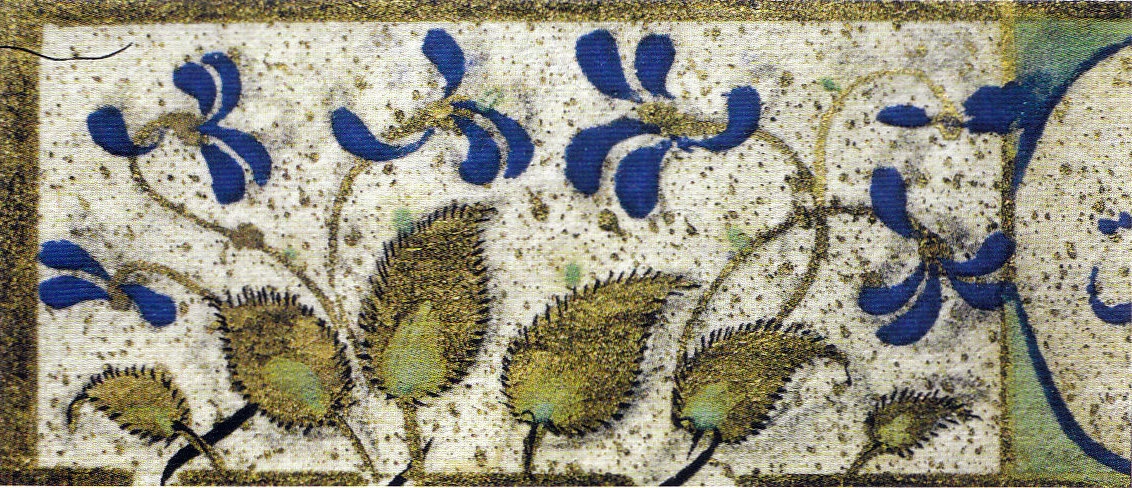
The Naturalistic Floral Style (c. 1550s–1570s): Formulated by court illuminator Kara Memi (Mehmed Çelebi), which drew upon the botanical specimens of imperial gardens—specifically tulips, carnations, hyacinths, and roses—to establish an unmistakably Ottoman visual language.
Kara Memi’s 1566 manuscript of the Divan-ı Muhibbi (the collected poems of Suleiman, written under the pen name Muhibbi) stands as a monument to this idiom, illuminating 1,552 panels with 370 distinct floral designs.
In the realm of miniature painting, Matrakçı Nasuh (c. 1480–1564) revolutionized historical documentation through the topographical landscape rendering seen in his 1537 chronicle, Beyân-ı Menâzil-i Sefer-i ‘Irâkeyn. His depiction of Istanbul—an unpeopled, birds-eye cartographic rendering—survives as an incomparable urban document of the era. Between 1570 and 1590, Nakkaş Osman established the canonical, sober Ottoman illustrative style across works such as the Şahnâme-i Selim Hân, the Şehinşahnâme, the Surnâme-i Hümâyûn (1582), and the Hünernâme (1584–1588), emphasizing spatial clarity, orderly rhythm, and documentary veracity.
In calligraphy, Şeyh Hamdullah (1429–1520), working under the patronal guidance of Sultan Bayezid II, codified the “Six Pens” (aqlām al-sittah), thereby founding the illustrious Istanbul school. Ahmed Karahisarî (c. 1470–1556) and his adopted son Hasan Çelebi executed the monumental inscriptions inside the Süleymaniye, while Hafız Osman (1642–1698) standardized the hilye-i şerif (the verbal portrait of the Prophet Muhammad) into a celebrated textual panel format, earning the epithet “The Second Sheikh.” This graphic mastery gave rise to the enduring adage: “The Holy Qur’an was revealed in the Hijaz, recited in Cairo, and written in Istanbul.”
The Seventeenth and Eighteenth Centuries: From the Classical Sunset to the Tulip Era and the Baroque
Constructed between 1609 and 1616 by Sinan’s pupil Sedefkâr Mehmed Ağa, the Sultan Ahmed Mosque (the Blue Mosque) represents the final monumental statement of the Classical idiom. With its 23.5-meter central dome carried by four massive “elephant-foot” piers, six minarets, and an interior enveloped in an estimated twenty thousand Iznik tiles, it emphasizes decorative theatricality over structural breakthrough. It also represents the final grand commission to employ Iznik revetments on an imperial scale.
The Tulip Era (1718–1730), coinciding with the reign of Ahmed III and his Grand Vizier Nevşehirli Damat Ibrahim Pasha, ushered in an epoch of courtly refinement, leisure, and open-air pavilion culture along the Bosphorus and Golden Horn. (It is worth noting that the term itself is an early-twentieth-century retrospective appellation popularized by poet Yahya Kemal and historian Ahmed Refik). The era’s premier court painter, Levnî (Abdülcelil Çelebi, d. 1732), gained renown for his 137 illustrations—many spanning double-page spreads—in Seyyid Vehbi’s Surnâme, recording the imperial circumcision festivities of 1720. While Levnî did not abandon the conventions of the bird’s-eye perspective, his genius lay in infusing figures with psychological individuality, volume, and undulating movement—attributes equally evident in his single-leaf portrait albums of women, musicians, and dancers.
Meanwhile, the Valenciennes-born painter Jean-Baptiste Vanmour (1671–1737) proved instrumental in transmitting the visual lexicon of the Ottoman court to Europe. Arriving in 1699 in the retinue of the French ambassador and remaining in the city until his death, Vanmour depicted ambassadorial audiences, imperial ceremonies, and urban dress; engraved reproductions of his work became the premier sourcebook for the continent-wide craze for turquerie.
Completed in 1728, the Fountain of Ahmed III—with its overhanging eaves and low-relief floral vases—epitomized this European-inflected rocaille lyricism. By mid-century, European Baroque and Rococo idioms fully seized the imperial architectural imagination. Constructed by Simeon Kalfa, the Nuruosmaniye Mosque (1748–1755) introduced a semicircular horse-shoe courtyard, undulating cornices, and acanthus mouldings, standing as the seminal imperial monument of the Ottoman Baroque. The subsequent Laleli and Ayazma mosques carried this curvilinear vocabulary forward.
Nineteenth-Century Architecture and the European Gaze
In the nineteenth century, the relocation of the imperial residence to the shores of the Bosphorus precipitated a radical shift in architectural scale and aesthetic allegiance. The era was defined by the Balyan dynasty of imperial architects, an Armenian family that held court appointments across three generations. Designed by Garabet Balyan and his son Nigoğos, Dolmabahçe Palace (1843–1856)—boasting 45,000 square meters of floor space, 285 rooms, 46 reception halls, and a staggering 2,000-square-meter Ceremonial Hall (Muayede Salonu)—stands as an eclectic synthesis of Baroque, Neoclassical, and traditional Ottoman tripartite palace layouts. Nigoğos Balyan applied a similarly theatrical historicism to the Ortaköy Mosque (1854–1856). Following Nigoğos’s premature death in 1858, his brothers Sarkis and Agop Balyan executed the waterfront palaces of Beylerbeyi (1861–1865) and Çırağan. Simultaneously, the publication of the Usûl-i Mi‘mârî-i ‘Osmânî (The Fundamentals of Ottoman Architecture) for the 1873 Vienna World’s Fair codified Ottoman building traditions theoretically for the first time, laying ideological groundwork for the subsequent First National Architectural Movement.
Concurrently, foreign artists decisively shaped the visual mythology of the city. Antoine-Ignace Melling (1763–1831), who served as architect to Princess Hatice Sultan, captured Bosphorus shorelines with exacting topographical fidelity in his celebrated 1819 folio of engravings. From mid-century onward, Ivan Aivazovsky translated the dynamic waters and luminescent atmosphere of the city across dozens of canvases, while Fausto Zonaro, serving as imperial court painter to Abdülhamid II between 1896 and 1909, chronicled its everyday street scenes and military spectacle.
The Institutionalization of Western Painting: The Military Painters
Western-style easel painting took root outside the court through drawing curricula introduced at the Imperial Schools of Military Engineering (Mühendishâne, 1773 and 1795) and the Imperial War Academy (Mekteb-i Harbiye, 1834). What originated as practical instruction in cartography and technical drawing soon fostered a generation of “military painters” who produced lyrical landscapes and still lifes.
Sent to Paris under the patronage of Sultan Abdülaziz, painters such as Şeker Ahmed Pasha (1841–1907) and Süleyman Seyyid (1842–1913) trained in the studios of academic luminaries like Gustave Boulanger and Jean-Léon Gérôme. In April 1873, Şeker Ahmed Pasha staged Istanbul’s first Western-style public art exhibition, laying the bedrock for a modern public sphere in the visual arts. Hüseyin Zekâi Pasha and the impressionistically inclined Hoca Ali Rıza (1858–1930) further enriched this domestic landscape tradition. Even the last Ottoman Crown Prince and Caliph, Abdülmecid Efendi, emerged as an accomplished painter, closely aligned with the avant-garde tendencies of the 1914 Generation.
Osman Hamdi Bey: Painter, Museologist, Reformer
Osman Hamdi Bey (1842–1910) stands as the singular architect of modern Ottoman cultural institutions. Appointed director of the Imperial Museum (Müze-i Hümâyûn) in 1881, he promulgated the landmark 1884 Antiquities Law (Âsâr-ı Atîka Nizâmnâmesi), effectively prohibiting the export of archaeological relics. He directed major excavations at Mount Nemrud, Lagina, and Sidon; to house monumental discoveries such as the Alexander Sarcophagus from Sidon, he commissioned architect Alexandre Vallaury to build the Istanbul Archaeological Museum, opened in 1891.
By imperial decree on 1 January 1882, he founded the Academy of Fine Arts (Sanayi-i Nefise Mektebi), inaugurating classes on 3 March 1883 as its founding director. The original academy building, also designed by Vallaury, houses the Museum of the Ancient Orient today. From an initial cohort of twenty students in 1883, enrollment neared two hundred by the mid-1890s, with standout alumni dispatched to Paris on state fellowships.
As a painter, Osman Hamdi was the first Ottoman artist to place monumental figurative composition at the center of his practice. His canvases depicted contemplative intellectuals, scholars, and musicians engaged in deep thought amid meticulously rendered Ottoman architectural backdrops. Having studied under Gérôme in Paris, his appropriation of the Orientalist lexicon remains intensely debated: scholars such as Wendy Shaw argue that he subverted the Orientalist gaze, reimagining the “East” from within through the critical lens of an Ottoman intellectual.
His most celebrated canvas, The Tortoise Trainer, exists in two iterations dated 1906 and 1907 (the 1906 version held by the Pera Museum). While long interpreted as an allegory for the glacial pace of Ottoman bureaucratic modernization, scholars such as historian Edhem Eldem caution against reductive political readings, proposing instead that the work embodies self-reflexive, gentle irony directed at Osman Hamdi’s own solitary tribulations as a modernizer.
The 1914 Generation, Women’s Art Education, and the Galatasaray Exhibitions
Following the Second Constitutional Era (1908), a vanguard of young painters traveled to Paris to study in the ateliers of Fernand Cormon and Jean-Paul Laurens, returning home hastily at the outbreak of the First World War. Known as the “1914 Generation” or the “Çallı Generation”—anchored by İbrahim Çallı, Hikmet Onat, Feyhaman Duran, Hüseyin Avni Lifij, Nazmi Ziya Güran, Namık İsmail, and Ruhi Arel—these painters tempered French Impressionism with academic rigor, capturing Istanbul’s crystalline light, sea vistas, and shifting urban textures.
Concurrently, through the tireless advocacy of the trailblazing painter Mihri Müşfik Hanım, the Academy of Fine Arts for Women (İnâs Sanâyi-i Nefîse Mektebi) opened its doors on 13 October 1914, providing women access to academic training in painting and sculpture for the first time. The women’s and men’s academies were subsequently unified between 1921 and 1925.
The Ottoman Painters’ Society, founded in 1909, introduced the plastic arts to a broader public via the annual Galatasaray Exhibitions at Galatasaray High School, launched in 1916. In 1917, Minister of War Enver Pasha commissioned the Şişli Atelier, where artists produced monumental patriotic and martial paintings. These works were exhibited in Vienna and Berlin in 1918, marking the first collective international exhibition of modern Ottoman painting.
The First National Architectural Movement
Flourishing between 1908 and 1930, the First National Architectural Movement—often termed the Ottoman Revivalist or National Neoclassical style—sought to reconcile historical Ottoman and Seljuk decorative elements (projecting eaves, domes, pointed arches, muqarnas, and ceramic tile revetments) with modern structural technologies like reinforced concrete and steel frames, aligned with the ideological currents of the Second Constitutional Era. The movement’s primary exponents were Vedat Tek and Mimar Kemaleddin:
-
Vedat Tek (1873–1942): Architect of the Central Post Office in Sirkeci (1905–1909, the movement’s foundational monument), the Land Registry Building in Sultanahmet (1908), the Hoca Hobyar Mosque in Bahçekapı (1909), the architect’s own residence in Nişantaşı (1913), and the Haydarpaşa Ferry Terminal (1915–1917).
-
Mimar Kemaleddin (1870–1927): Renowned for the Bebek Mosque (1913), the Harikzedegân (Tayyare) Apartments in Laleli (1918–1922, an innovative early social-housing complex), and the monumental Fourth Vakıf Han in Bahçekapı.
The brilliant ceramic tile facades adorning the Central Post Office and the Vakıf Hans emerged from the workshop of Mehmed Emin Efendi of Kütahya, effectively reviving a dormant architectural craft for the civic sphere. By the 1930s, this historicist style was superseded by Central European international modernism, championed by architects such as Ernst Egli and Clemens Holzmeister, before yielding in the 1940s to the Second National Architectural Movement, led by Sedad Hakkı Eldem and grounded in vernacular Anatolian domestic architecture.
The evolution of art in Ottoman Istanbul unfolds as a dynamic synthesis in which an inherited visual culture was continually reconfigured in dialogue with external currents. The intercultural exchanges between Mehmed II and Bellini, Sinan’s structural confrontation with Hagia Sophia, Kara Memi’s floral lexicon, the Baroque transformations of Nuruosmaniye, the foundation of the Sanayi-i Nefise, and the ideological assertions of the First National Architectural Movement are not disconnected episodes, but successive stages of a coherent historical continuum.
The scale of this artistic production is palpable in its figures: 477 structures cataloged in the biographical compendia of Sinan; 370 distinct floral compositions illuminating Kara Memi’s Divan-ı Muhibbi; and an imperial academy that expanded from a modest cohort of twenty pupils in 1883 into a fully fledged national academy.
Debates surrounding the precise boundaries of Sinan’s personal hand, the workshop transmission of decorative motifs from palace scriptorium to ceramic kiln, the chronology of Levnî’s oeuvre, and the hermeneutics of Osman Hamdi’s figurative canvases remain central to contemporary art-historical inquiry. Ultimately, this five-century legacy established the institutional scaffolding for Republican-era modernism and remains indelible in the aesthetic identity of contemporary Istanbul.