

In this instalment of our “One Movement, One Artist” series, we leap forward roughly a century from Impressionism into an era defined by the systematic interrogation of aesthetic dogma and formal boundaries. Our focus this time is an open-ended territory that resists classification as a single movement altogether: contemporary art. Our subject is Ai Weiwei, the Chinese artist whose provocative provocations, political activism, and unapologetically interdisciplinary practice have come to define the age.
Where the Impressionists were bound by a shared sensibility—en plein air illumination, visible brushwork, and the fleeting ephemera of the natural world—contemporary artists share neither a signature medium nor an aesthetic template. While one carpets a cavernous turbine hall with a hundred million porcelain seeds, another pushes bodily endurance to the brink by remaining motionless before an audience for hours; a third marshals artificial intelligence algorithms to transmute raw data into immersive spectacles. What, then, unites them?
To understand this landscape, we must first unpack what “contemporary art” actually signifies and why it eludes rigid categorisation. From there, we turn to Ai Weiwei, examining how his practice confronts globalization, displacement, technology, human rights, and cultural heritage. Finally, we trace Ai’s footprint in Istanbul and contextualize his work within the wider story of contemporary art in Turkey.
The Movement: What Is Contemporary Art?
A “Movement” That Isn’t One
At its most literal, contemporary art is simply the art of our time. Unlike Impressionism, Cubism, or Surrealism, it boasts no declared manifesto, unifying technique, or prescriptive formal agenda. Art historians therefore treat it less as an -ism than as an expansive temporal bracket and an intellectual posture.
Even its point of departure remains contested: some theorists date its emergence to the late 1960s, others to the 1970s, while platforms such as Google Arts & Culture benchmark 1980. Theorists such as Terry Smith locate the pivotal rupture in 1989, marked by the fall of the Berlin Wall, the end of the Cold War, and the rapid globalization of the art circuit.
Parsing Modern, Postmodern, and Contemporary
Disentangling these three frequently conflated terms is essential for grasping the zeitgeist:
-
Modern Art (c. 1860s–1960s): Driven by an urge to upend traditional academic painting and sculpture in an incessant pursuit of the “new.” Each successive movement staked out its own formal doctrine, with Impressionism, Cubism, Abstract Expressionism, and Geometric Abstraction each establishing their own governing rules.
-
Postmodern Art (late 1960s–1990s): Marked by an acute skepticism toward what French philosopher Jean-François Lyotard famously termed “grand narratives” in The Postmodern Condition (1979)—the overarching, totalizing claims to singular truth. Deploying irony, appropriation, pastiche, and collage, it eroded the once-sacrosanct boundaries between high art and vernacular culture.
-
Contemporary Art (1970s/1980s–Present): A wide umbrella that accommodates and transcends these historical precursors. While postmodernism operates within contemporary art, contemporary art cannot be reduced to it alone. Nor does the mere biological fact of being alive qualify every living painter or sculptor as “contemporary”: practitioners working strictly within traditional academic or mid-century modernist idioms are typically held outside the category. That said, this boundary has grown increasingly porous and contested—particularly amid the critical resurgence of painting in recent years. For most theorists, the deciding factor is not the calendar date, but whether the artist engages in a critical dialogue with the pressing, unresolved conditions of their historical moment.
A Globalized Art Circuit
The ascendancy of contemporary art is inseparable from the globalization of the art world itself. The landmark 1989 exhibition Magiciens de la Terre at the Centre Pompidou and Grande Halle de la Villette in Paris marked a watershed moment, presenting non-Western artists alongside their Western peers on an equal footing at monumental scale. Throughout the 1990s, the proliferation of international biennials consolidated this global network, with the Istanbul Biennial serving as one of the key milestones of that institutional wave.
Subject Matter and Mediums
What unifies contemporary art is not formal style, but thematic urgency and conceptual contextualization. Practitioners grapple with questions spanning globalization, migration, borders, identity politics, and gender, through to ecological collapse, ubiquitous surveillance, and artificial intelligence. Human rights, institutional censorship, historical memory, and precarity remain central conceptual touchstones.
In tackling these themes, the artist’s toolkit extends far beyond traditional canvas and bronze:
-
Site-specific installations transforming architectural space
-
Endurance performances centring the artist’s body
-
Video, photography, and soundscapes
-
Conceptual practices prioritizing idea over artifact
-
Participatory and community-based interventions
-
Generative digital media
Concurrently, biennials, art fairs, contemporary art museums, and curated frameworks have become active agents that directly author and mediate the work’s meaning. Returning to our opening question, the common denominator lies not in form, but in inquiry: what binds contemporary artists together is the critical questions they direct at their own era.
Terminology: “Çağdaş” or “Güncel”?
In Turkish art discourse, the English term “contemporary art” is rendered interchangeably as çağdaş sanat and güncel sanat. Because çağdaş sanat was historically used to describe the early Republican era’s modernist painting and sculpture, many local critics and curators adopted güncel sanat (literally “current” or “up-to-date art”) to delineate the post-1980 wave of experimental, conceptual production. Here, we treat the two terms as synonymous.
The Artist: Ai Weiwei (b. 1957)
While singling out an archetype for contemporary art might seem like an impossible exercise, Ai Weiwei—whose practice seamlessly synthesizes fine art, civil activism, architectural design, documentary filmmaking, and social media orchestration—remains one of the rare figures capable of touching upon almost every vital nerve of the contemporary condition.
Biographical Milestones
Born in Beijing on 28 August 1957, Ai’s formative years were defined by political banishment after his father, the revered modernist poet Ai Qing, was denounced as a “Rightist” during the Anti-Rightist Campaign. The family was exiled first to Heilongjiang in China’s northeast, and subsequently to labor camps on the edge of the Gobi Desert in Xinjiang. Following Mao Zedong’s death in 1976, the family returned to Beijing, where Ai enrolled at the Beijing Film Academy in 1978 and joined the Stars (Xingxing), an avant-garde, pro-democracy artist collective.
Between 1981 and 1993, Ai lived in the United States, predominantly in New York’s East Village. He studied briefly at Parsons School of Design and the Art Students League, assimilating Marcel Duchamp’s conceptual readymade and Andy Warhol’s Pop lexicon—encounters that permanently shaped his aesthetic trajectory. Returning to Beijing in 1993 to attend to his ailing father, Ai helped galvanize the burgeoning experimental Beijing East Village scene, chronicling its provocative actions through three underground publications. In 2003, he founded the architectural practice FAKE Design.
Between 2003 and 2008, he collaborated with Swiss architectural firm Herzog & de Meuron to design the iconic Beijing National Stadium—colloquially known as the “Bird’s Nest”—for the 2008 Summer Olympics, only to subsequently distance himself from the games, denouncing them as state propaganda.
The rift with Chinese authorities became irreparable in the wake of the catastrophic 2008 Sichuan earthquake. In response to the shoddy, corrupt construction of so-called “tofu-dreg” school buildings that crushed thousands of children, Ai initiated the “Citizens’ Investigation,” meticulously documenting and publishing the names of 5,197 student victims. In 2009, a brutal assault by local police in Chengdu resulted in a severe cerebral hemorrhage, necessitating emergency neurosurgery in Munich.
On 3 April 2011, Ai was detained at Beijing Capital International Airport without formal charges and held in secret detention for 81 days, his passport confiscated. Upon his conditional release, the company through which he operated was slapped with an astronomical fine for alleged tax evasion. When his passport was finally restored in 2015, he relocated to Berlin, followed by a move to the United Kingdom in 2019, before settling in Portugal. His epic 2017 documentary Human Flow, which surveyed the global displacement crisis across 23 countries, premiered at the Venice International Film Festival to widespread international acclaim.
Artist or Activist?
Ai’s practice deliberately destabilizes the division between these two vocations. During the years he was barred from foreign travel, his ritual of placing a fresh bouquet of flowers into the basket of a bicycle outside his studio gate each morning—or his pioneering use of social media as an unmediated instrument of documentation and resistance—demonstrated just how radically he blurs the threshold between art and daily existence.
Yet Ai is by no means an uncontested figure. Certain commentators have critiqued him as the West’s “favourite dissident,” arguing that his celebrity brand occasionally eclipses the conceptual rigor of his output. In 2016, his photographic reenactment on the shores of Lesbos—posing face-down in the surf to mimic Alan Kurdi, the drowned Syrian toddler whose image shocked global conscience—sparked a fierce ethical backlash. While some defended it as an act of raw solidarity, others condemned it as an unseemly aestheticization of unbearable human tragedy. Such polarizing episodes reflect precisely how porous the frontier between contemporary art and geopolitical spectacle has become.
Close-Up on a Work: Sunflower Seeds (Kui Hua Zi, 2010)
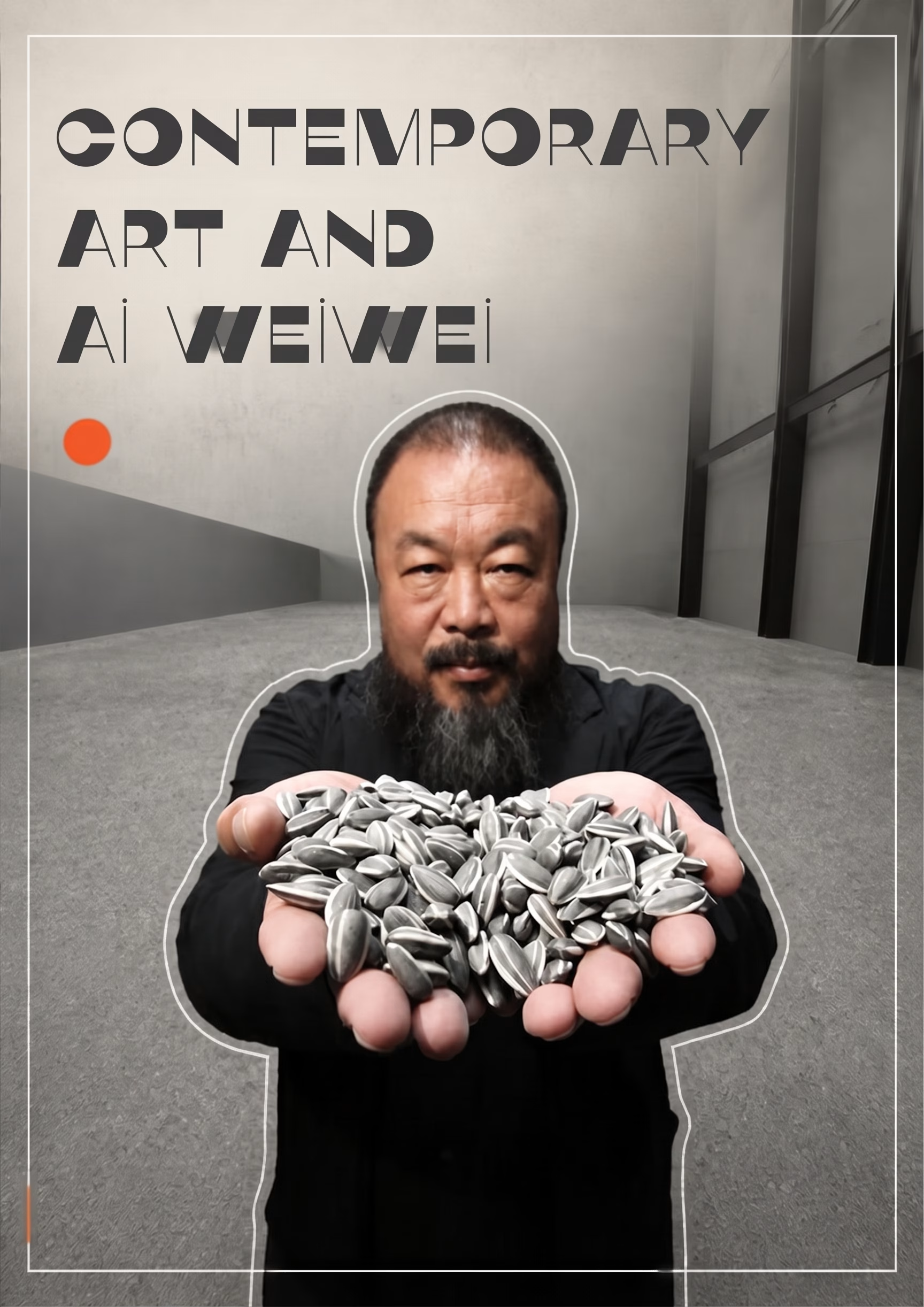
Installed within the cavernous Turbine Hall of Tate Modern in London between 12 October 2010 and 2 May 2011, Kui Hua Zi (Sunflower Seeds) stands as one of the defining landmarks of twenty-first-century installation art.
What We See
Entering the Turbine Hall, visitors were confronted by what appeared to be an expansive, 10-centimetre-deep field of grey gravel blanketing 1,000 square metres of the floor. On closer inspection, however, this vast expanse revealed itself to be a sea of more than 100 million sunflower seed husks. Held in the palm, each individual seed turned out to be an immaculate, unique artifact made of porcelain and individually painted by hand. Weighing roughly 150 tonnes in total, the installation forged a seamless synthesis between artisanal craftsmanship and conceptual monumentalism.
A Hundred Million Hands
Every single seed was fabricated in Jingdezhen, a historic city celebrated for its imperial porcelain production since the Song Dynasty (960–1279). Drawing on nearly two millennia of ceramic mastery, more than 1,600 local artisans—many of whom had been laid off following the privatization and closure of state-run porcelain factories—laboured for approximately two years. Each seed was slip-cast in a mould, fired, painted by hand with precise brushstrokes, and fired a second time.
Conceptual Layers
The work functions across several interwoven political and cultural registers:
-
Mao and the Masses: In Cultural Revolution propaganda, Chairman Mao was universally allegorized as the sun, with the Chinese populace depicted as loyal sunflowers turning their faces toward his light. Ai’s sea of one hundred million seeds interrogates the tension between the individual citizen and the homogenous, anonymous collective.
-
Famine and Solidarity: Sunflower seeds are ubiquitous street snacks across China. During the austere, famine-stricken years of Ai’s childhood exile, cracking seeds was an act of modest camaraderie—a shared currency of warmth and sustenance in times of profound scarcity.
-
Interrogating “Made in China”: For centuries, porcelain was imperial China’s preeminent luxury export to the West. By adopting this medium, Ai subverts contemporary Western stereotypes of Chinese manufacturing as synonymous with cheap, disposable mass-production, laying bare the immense, hyper-skilled human labour that underpins seemingly industrialized scale.
Dust, Sanctions, and Detainment
Ai originally intended for visitors to walk across, lie down on, and physically engage with the porcelain carpet. Just days into the exhibition, however, Tate Modern cordoned off the expanse after health and safety assessments revealed that friction between the ceramic seeds generated hazardous airborne porcelain dust. An intensely tactile, participatory artwork was abruptly converted into a distanced landscape for passive viewing. Critics noted that this institutional cordoning off unintentionally enacted the very surveillance, state regulation, and physical containment the installation subtly critiqued.
The work took on an even darker resonance midway through its run when Ai was secretly detained by Chinese authorities, imbuing the hall of silent, inert seeds with haunting political gravity. In 2012, Tate acquired a section of the installation comprising approximately eight million seeds for its permanent collection.
Other Key Works
Ai’s oeuvre spans an extraordinary breadth of contemporary art’s formal typologies:
-
Dropping a Han Dynasty Urn (1995): Captured in a stark triptych of black-and-white photographs, Ai smashes a 2,000-year-old ceremonial urn onto the ground. The performance enacts a radical, iconoclastic assault on received notions of cultural heritage, museum value, and historical veneration. The contested authenticity of the artifact itself was deliberately subsumed into the work’s provocation. The piece yielded an ironic postscript in 2014 when a visitor at the Pérez Art Museum Miami smashed one of Ai’s painted vases in protest, neatly recycling the question: Who dictates value?
-
Remembering (2009): Installed on the facade of Munich’s Haus der Kunst, this monumental typographic piece commemorated the school-children killed in the Sichuan earthquake using 9,000 brightly coloured children’s backpacks. Spelling out in Chinese characters the words of a grieving mother—“She lived happily on this earth for seven years”—the exhibition opened shortly after the artist underwent emergency surgery following police violence in Chengdu.
-
Straight (2008–2012): Comprising nearly 150 tonnes of bent steel rebar salvaged from the debris of collapsed schools across the earthquake zone, each rod was painstakingly hand-straightened by Ai’s studio team and laid out across the floor in an undulating, fault-line-like wave. It remains perhaps his most visceral memorial to the Sichuan catastrophe.
-
Forever Bicycles (2011): An intricate, modular architectural lattice assembled from hundreds of interconnected bicycles—the quintessential emblem of Chinese urban life. The title directly references Shanghai’s iconic “Forever” (Yongjiu) bicycle brand.
-
Trace (2014): Staged within the disused cell blocks of San Francisco’s former federal penitentiary on Alcatraz Island, this installation rendered 176 portraits of global political prisoners and prisoners of conscience entirely from Lego bricks. The Lego Group’s subsequent refusal to fulfill Ai’s bulk order in 2015 triggered international uproar and a spontaneous worldwide brick-donation campaign.
-
Good Fences Make Good Neighbors (2017): Commissioned by the Public Art Fund across New York City, Ai deployed site-specific security fences, cages, and turnstiles in public squares, parks, and rooftops, spotlighting the global migrant crisis and the politics of territorial exclusion.
-
Law of the Journey (2017): Installed at the National Gallery in Prague, this 70-metre-long black inflatable lifeboat carrying hundreds of faceless, crowded refugee figures stands as one of his most haunting visual meditations on forced displacement.
Ai Weiwei in Istanbul: On Porcelain (2017–2018)
Ai Weiwei’s inaugural major solo exhibition in Turkey, Ai Weiwei on Porcelain, was staged at Sabancı University’s Sakıp Sabancı Museum from 12 September 2017 to 11 March 2018.
The exhibition germinated during Ai’s visit to the Museum of Turkish and Islamic Arts in Istanbul. Locating the survey in the city carried profound historical resonance: Topkapı Palace holds one of the world’s most formidable collections of imperial Chinese porcelain outside China, having served as a premier patron of the trade along the Silk Road for centuries. Ai’s critical unpacking of the deep history of “Made in China” thus converged organically with the Ottoman court’s own heritage of patronage.
Spanning more than 100 works, the exhibition charted his practice from his earliest ceramic piece—a 1976–1977 plate with a bird motif—to a series of blue-and-white porcelain plates conceived specifically for Istanbul. A monumental five-tonne mound of porcelain sunflower seeds, nodding to his Turbine Hall intervention, anchored the galleries. The retrospective was selected as the best exhibition of 2017 by a 10-member cultural jury assembled by the daily Hürriyet.
A Note from Turkey: Tracing the Contemporary Lineage
The genealogy of experimental and conceptual contemporary art in Turkey reaches back to the late 1970s. Organized between 1977 and 1987 at the Istanbul Museum of Painting and Sculpture, the Yeni Eğilimler (New Trends) exhibitions provided the first institutional platform for installation, performance, and dematerialized conceptual practices. The launch of the Istanbul Biennial in 1987 subsequently integrated local practitioners into the international biennial circuit.
Leading figures of contemporary art from Turkey engage directly with the global themes outlined above:
-
Füsun Onur: A pioneer of conceptual art in Turkey, celebrated for poetic installations that recalibrate everyday ephemera and architectural space (representative of the Pavilion of Turkey at the 59th Venice Biennale, 2022).
-
Sarkis: Known for installations that layer light, sound, stain, and temporal traces within sites laden with historical memory (Pavilion of Turkey, 56th Venice Biennale, 2015).
-
Gülsün Karamustafa: A foundational voice in Turkish contemporary art, interrogating migration, displacement, gender constructs, and political memory.
-
Ayşe Erkmen: Alters spatial perception through subtle, site-conditioned architectural interventions (Pavilion of Turkey, 54th Venice Biennale, 2011).
-
Hale Tenger: Investigates political and collective trauma through evocative spatial and sound environments.
-
Kutluğ Ataman: Gained international prominence with multi-screen video installations capturing micro-narratives and contested identities (Turner Prize nominee and Carnegie Prize winner in 2004).
-
Nilbar Güreş: Deconstructs gender roles, migration, and cultural belonging via theatrical textile assemblages, staged photography, and sculpture (representing the Pavilion of Turkey at the 61st Venice Biennale, 2026).
-
Refik Anadol: Has become a globally recognized exponent of digital media by treating data and machine learning algorithms as artistic matter—though AI-generated art itself remains fiercely debated, with critics frequently pointing out the risk of depthless techno-spectacle.
In a striking historical convergence, while Ai Weiwei’s On Porcelain occupied the Sakıp Sabancı Museum, Refik Anadol’s machine-learning installation Archive Dreaming—commissioned for SALT Galata—was on view across the Bosphorus. In one city, two artists operating at polar ends of the material spectrum—one articulating through two millennia of ceramic craft, the other through bleeding-edge machine intelligence—demonstrated the boundless elasticity of contemporary art.
Until the next instalment.