

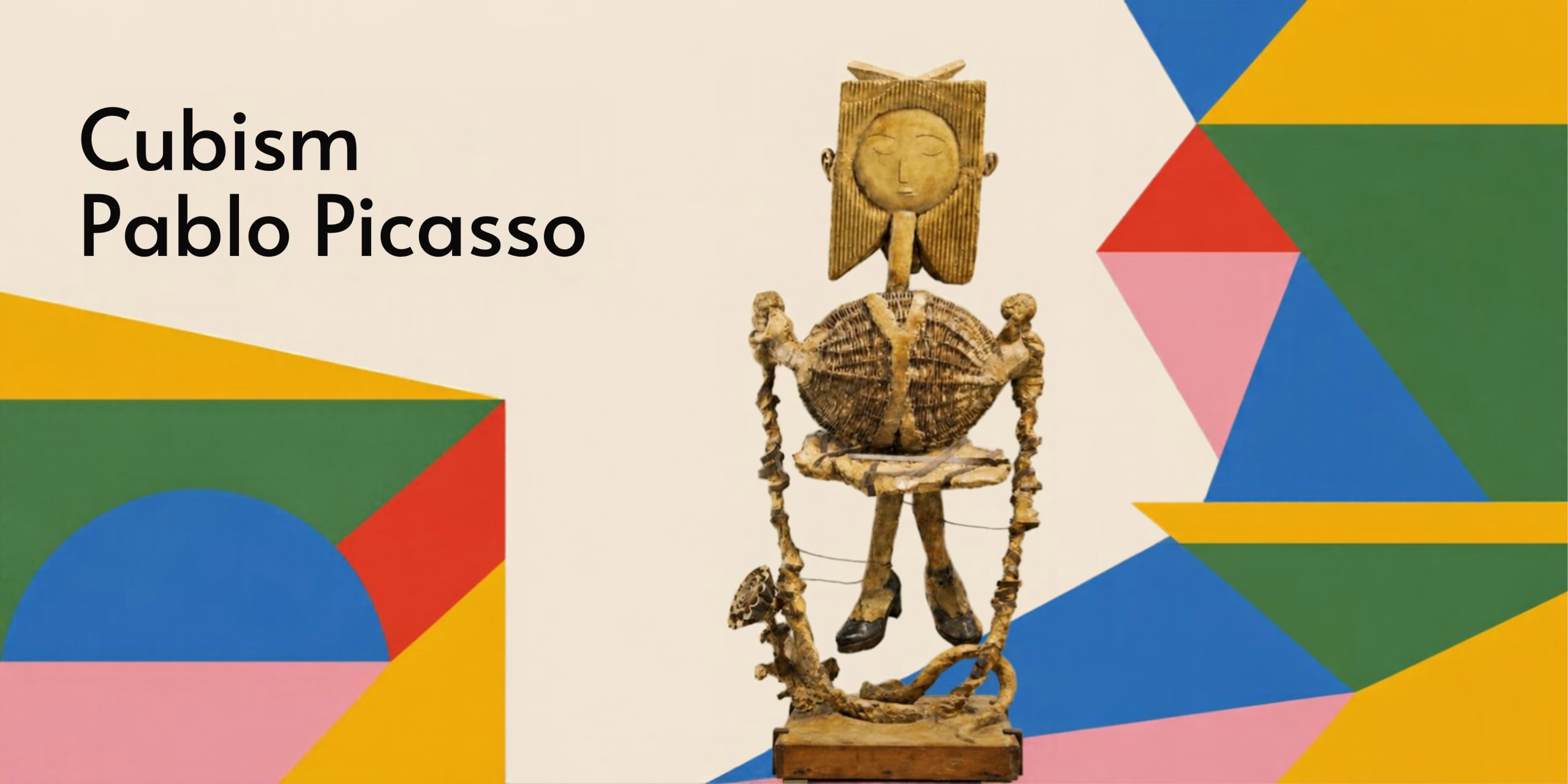
In this instalment of our “A Movement, An Artist” series, we turn to the radical rupture that fundamentally altered our way of seeing and redefined the trajectory of twentieth-century art: Cubism. At its center stands Pablo Picasso, who, alongside Georges Braque, ignited this aesthetic revolution.
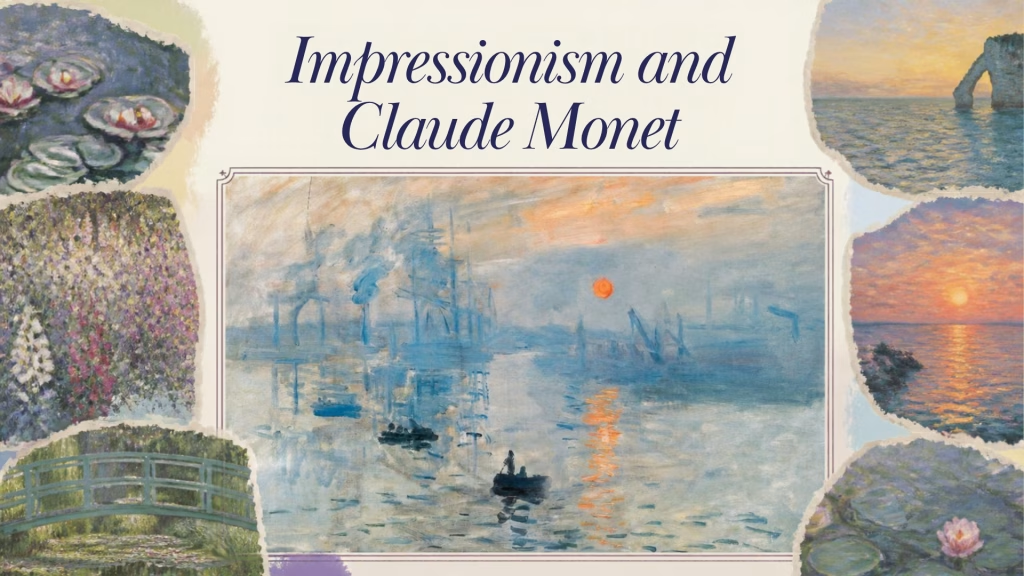
Our first essay traced Claude Monet standing before nature, easel in hand, to capture fleeting atmospheric light; our second immersed us in Ai Weiwei’s contemporary landscape, carpeting an immense museum turbine hall with one hundred million porcelain sunflower seeds. Spanning the distance between these two poles lies a seismic fault line: that revolutionary juncture where the single-point perspective window—painting’s guiding premise since the Renaissance—was decisively shattered. Here, a face registers simultaneously in profile and frontal view; a violin or bottle is fractured into faceted geometric planes, only to be reconstructed in the viewer’s mind. Cubism is the precise name for this paradigm shift.
This journey explores how Cubism germinated, the derisive criticism that christened it, and the distinct phases of its evolution. We will then examine Picasso as co-founder, unpack Les Demoiselles d’Avignon—widely regarded as the movement’s ground zero—and survey its defining masterpieces, before tracing its reverberations in Istanbul through the pioneering lens of the D Group (D Grubu).
The Movement: What Is Cubism?
From Monocular Perspective to Simultaneous Vision
Since the Renaissance, Western painting operated on the illusion of a world witnessed by a single, stationary eye. Cubism dismantled this centuries-old orthodoxy. Rather than depicting an object or figure from a fixed vantage point, Cubist painters dissected their subjects into geometric facets, reassembling them across the canvas to present multiple perspectives at once. Painting ceased to be a passive, momentary facsimile of nature; it became an epistemological synthesis—the sum of what we know about an object, accumulated through perception as we move around it in space and time.
Incubated in Paris roughly between 1907 and 1914, Cubism exerted a potent influence well into the 1920s. Much of the twentieth-century avant-garde—from Italian Futurism and Russian Constructivism to De Stijl and the broader currents of geometric abstraction—travelled down the path it broke open.
Cézanne’s Legacy and the Derisive Coining of a Name
Cubism’s primary catalyst was Paul Cézanne. His famous injunction in a 1904 letter to Émile Bernard—advising him to “treat nature by means of the cylinder, the sphere, the cone”—paired with the monumental Cézanne retrospective at the 1907 Salon d’Automne in Paris, struck the young Picasso and Braque with the force of a revelation.
The movement’s name, echoing the provenance of Impressionism, was coined in derision. When Braque’s landscapes of L’Estaque were exhibited at Daniel-Henry Kahnweiler’s Paris gallery in November 1908, the critic Louis Vauxcelles dismissively remarked that Braque reduced everything—sites, figures, and houses—to “geometric schemas, to cubes.” Another account attributes the phrasing to Henri Matisse, who, as a juror rejecting Braque’s submissions to the Salon d’Automne earlier that year, reportedly described the compositions as made of “little cubes.” Vauxcelles returned to the charge in 1909, writing of “cubic oddities.” Whatever the initial malice, the dismissive label stuck, crystallizing into the moniker of one of modern art’s most formidable movements.
Two Minds, One Vision: Picasso and Braque
From 1908 onward, Picasso and Braque operated in near-symbiotic alignment. Meeting daily and interrogating one another’s canvases, their formal approaches converged to such a degree that differentiating their unsigned works from this period remains a delicate task even for seasoned connoisseurs. Braque famously likened this intense creative pact to “two mountaineers roped together.”
Curiously, neither artist stood on the front lines of public exhibitions during Cubism’s formative years. Bound by exclusive representation contracts with Kahnweiler, they bypassed Paris’s sprawling official Salons and issued virtually no written manifestos or theoretical treatises before 1914.
The Metamorphic Phases of Cubism
Cubism was never a static dogma; it was an evolving inquiry parsed chronologically by Kahnweiler and later art historians into distinct phases:
-
Cézannian / Proto-Cubism (1907–1908): The inaugural phase, in which Cézanne’s volumetric simplifications coalesced with the stark, angular forms of archaic Iberian and African sculpture. Picasso’s Les Demoiselles d’Avignon and Braque’s Houses at L’Estaque unlocked this threshold.
-
Analytic Cubism (1909–1912): A rigorous deconstruction where subjects were splintered into hundreds of interlocking, semi-transparent facets. The palette was deliberately subdued to an austere spectrum of browns, grays, and ochres to prioritize structural and spatial syntax. For the nearly indecipherable works of 1910–1911, the term “Hermetic Cubism” is frequently applied. Picasso’s Portrait of Daniel-Henry Kahnweiler and Ma Jolie epitomize this cerebral peak.
-
Synthetic Cubism (1912–1919 and beyond): Following the radical dissolution of form, fragments of the physical world were directly imported onto the support. Collage, papier collé, newsprint, and vibrant swaths of flat color entered the composition. Picasso’s Still Life with Chair Caning and Three Musicians stand as lodestars of this generative phase.
The Salon Cubists and International Dispersal
Cubism was far from a private dialogue between two men. The movement’s clamorous public debut occurred in the spring of 1911 in the notorious Room 41 of the Salon des Indépendants. Featuring works by Jean Metzinger, Albert Gleizes, Fernand Léger, Robert Delaunay, and Henri Le Fauconnier, the exhibition contained not a single canvas by Picasso or Braque, yet it was through this collective that the wider public first encountered Cubism.
Gleizes and Metzinger’s 1912 treatise Du “Cubisme” provided the movement’s first theoretical manifesto, subsequently complemented by the poet Guillaume Apollinaire’s The Cubist Painters (1913) and Kahnweiler’s The Rise of Cubism (1920). Léger’s tubular forms prefigured an emerging machine aesthetic, while Delaunay’s chromatic experiments with pure light—dubbed “Orphism” by Apollinaire—broadened the Cubist dialectic. Women modernists such as Marie Laurencin and Sonia Delaunay played vital, if historically sidelined, roles within this fertile milieu.
Concurrently, Spanish painter Juan Gris, Picasso’s neighbor at the Bateau-Lavoir, aligned with the “Gallery Cubists,” refining Synthetic Cubism into crystalline, chromatically luminous structures. In sculpture, Alexander Archipenko and Jacques Lipchitz translated Cubist vocabulary into three dimensions.
The idiom swiftly crossed borders. The historic 1913 Armory Show introduced Cubism to American audiences, where Marcel Duchamp’s Nude Descending a Staircase, No. 2 ignited a media sensation and public outrage—ironically, a work rejected by the Parisian Cubists only the year before. Its global resonance manifested diversely, from Cubist architecture in Prague and Russian Cubo-Futurism to the early Cubist output of Diego Rivera.
It was the outbreak of the First World War that definitively fractured Cubism as a unified movement: Braque was conscripted and severely wounded at the front, while Kahnweiler, as a German national, saw his Parisian gallery stock sequestered as enemy property and subsequently dispersed at auction between 1921 and 1923.
The Artist: Pablo Picasso (1881–1973)
Beyond his role as co-architect of Cubism, Pablo Picasso was a protean force whose relentless eight-decade career yielded over 20,000 works. Transmuting every medium he touched—from painting and printmaking to ceramics and stage design—Picasso repeatedly disassembled and reinvented his visual lexicon long after Cubism’s zenith.
Milestones of a Restless Life
Born in Málaga on 25 October 1881, Picasso displayed prodigious draughtsmanship from early childhood under the tutelage of his father, a painter and academic instructor. Following the family’s relocation to Barcelona in 1895, he made his initial pilgrimage to Paris in 1900, eventually settling in 1904 at the ramshackle Montmartre studio complex known as the Bateau-Lavoir. In 1907, he completed Les Demoiselles d’Avignon, a canvas that, despite being seen only by an intimate circle for years, would stand as one of the pivotal turning points of modern art.
Between 1908 and 1914, he formulated Cubism alongside Braque. During the Second World War, Picasso remained in occupied Paris, banned from exhibiting by German authorities. Though he did not actively participate in the Resistance—a passivity that has drawn critique from some historians—his decision to join the French Communist Party in October 1944, immediately following liberation, cast him as an icon of post-war European intellectual freedom. Relocating to the South of France after the war, he immersed himself in ceramics at Vallauris while maintaining a prolific output in painting and sculpture. He died in Mougins on 8 April 1973 at the age of ninety-one.
The Arc of a Career: Periods and Stylistic Shifts
Picasso’s artistic evolution is mapped across distinct stylistic phases, each indexed to personal crises and intellectual shifts:
-
The Blue Period (1901–1904): Triggered by the suicide of his close friend Carlos Casagemas, this was an elegiac suite steeped in melancholia, destitution, and estrangement, articulated through somber monochromes of Prussian blue and slate.
-
The Rose Period (1904–1906): A warm chromatic shift toward rose, terracotta, and earth tones, focusing on the bohemian underworld of saltimbanques, harlequins, and itinerant circus performers.
-
African and Iberian Influence (1906–1909): A critical transitional phase spurred by archaic Iberian relief sculptures viewed at the Louvre in 1906 and West and Central African masks encountered at the Musée d’Ethnographie du Trocadéro in 1907, introducing angular severity and mask-like stylization to his human figures.
-
Analytic and Synthetic Cubism (1909–1919): The revolutionary decennium marked by the systematic deconstruction of form followed by its synthetic reconstruction via collage, typography, and found materials.
-
The Neoclassical Period (1918–1920s): A post-World War I retour à l’ordre characterized by monumental, serene, and statuesque figures indebted to Greco-Roman antiquity.
-
Surrealist Affinity (1925–1930s): Marked by anatomical distortion, oneiric imagery, and the recurring myth of the Minotaur; though he exhibited alongside the Surrealists, Picasso never officially joined the group.
-
The Late Period (1940s–1973): Prolific explorations in pottery and monumental public sculpture alongside an obsessive engagement with the Old Masters—producing radical variations on Velázquez, Delacroix, and Manet.
While Picasso moved in the vanguard circles of Gertrude Stein, Guillaume Apollinaire, and Henri Matisse, his fraught, consuming, and often destructive relationships with his partners and muses—Fernande Olivier, Olga Khokhlova, Marie-Thérèse Walter, Dora Maar, Françoise Gilot, and Jacqueline Roque—have increasingly become the subject of rigorous art-historical and ethical re-examination. Landmarks in this continuing critical reassessment include Gilot’s candid 1964 memoir Life with Picasso and the Brooklyn Museum’s contentious 2023 feminist reappraisal, It’s Pablo-matic: Picasso According to Hannah Gadsby, staged on the fiftieth anniversary of the artist’s death.
The Crucible of Modernism: Les Demoiselles d’Avignon (1907)
Executed between June and July 1907 in his Paris studio, Les Demoiselles d’Avignon marks a watershed moment in modern art history. Measuring an imposing 244 × 234 cm, the colossal canvas today anchors the permanent collection of the Museum of Modern Art (MoMA) in New York.
Iconography and Composition
The painting presents five monumental female nudes composed of sharp, jagged facets. The two central figures gaze out with the impassive, stylized features of archaic Iberian sculpture, while the two on the right bear the striations and disquieting forms of African masks. The pictorial space is violently claustrophobic; drapery, walls, and flesh splinter forward like shards of broken glass. In the foreground, a still life featuring a crescent of melon rests precipitously on a sharply tilted tabletop that defies gravitational logic. The “Avignon” of the title references not the historic French city, but Carrer d’Avinyó, a street in Barcelona’s red-light district notorious for its brothels.
The Formal Rupture
Here, the Renaissance illusion of receding spatial depth is dismantled. In the lower right corner, a crouching figure turns her back toward the viewer, yet her head is wrenched around at an anatomically impossible angle to stare directly out of the picture plane. Bodies are rendered simultaneously in profile and from the front. With this audacious transgression, Picasso rejected mimetic optical fidelity in favor of a conceptual multiplicity, rendering the subject not as it appears in a fleeting glance, but as it exists conceptually in the mind.
Whether the painting is strictly “Cubist” remains a perennial debate in art historiography, with most scholars designating it as “Proto-Cubist.” In his seminal 1972 essay “The Philosophical Brothel,” Leo Steinberg reoriented scholarship away from pure formalist genealogy, reading the composition through the prism of visceral sexual and psychological confrontation between the female subjects and the viewer.
African Tribal Art and the Post-Colonial Debate
The mask-like visages of the two figures on the right are widely linked to Picasso’s visits during the painting’s gestation to the Musée d’Ethnographie du Trocadéro, Paris’s first anthropological museum. Though Picasso disavowed this debt in later years, historians view his denial with skepticism. The discourse carries another dimension today: these African artifacts arrived in the metropole via colonial extraction. Modernism’s co-optation of non-Western cultures under the patronizing rubric of “primitivism” forms an urgent locus of critical interrogation within contemporary museology.
Genesis and Reception
Picasso executed an unprecedented volume of preparatory sketchbooks and studies for the work. When friends and peers were first invited to inspect the canvas at the Bateau-Lavoir, reactions were overwhelmingly hostile or bewildered. Braque famously remarked that looking at it felt as though someone had drunk kerosene in order to spit fire; Matisse was reportedly enraged, mistaking the composition for an elaborate hoax intended to ridicule the modern movement. Yet it was Braque who probed the painting most acutely, setting the stage for their historic alliance.
The painting languished rolled up in Picasso’s studio for nearly a decade. When publicly exhibited for the first time in July 1916—in a salon organized by the poet André Salmon—it was denounced as obscene. Picasso had originally titled the canvas Le Bordel d’Avignon (The Brothel of Avignon); it was Salmon who retitled it Les Demoiselles d’Avignon to temper public scandal, a euphemism Picasso never warmed to. Acquired by the couturier and collector Jacques Doucet in 1924, the monumental work entered MoMA’s collection in 1939.
Key Works of the Cubist Canon
Analytic Mastery: Portrait of Daniel-Henry Kahnweiler and Ma Jolie
Now housed at the Art Institute of Chicago, the 1910 Portrait of Daniel-Henry Kahnweiler remains the quintessential archetype of high Analytic Cubism. The pioneering dealer is fractured into an interlocking scaffolding of shimmering brown and silvery-gray facets. Yet close scrutiny uncovers anchoring figurative ciphers: neatly parted hair, the curve of an eye, clasped hands, and the delicate chain of a pocket watch. Picasso refused to dissolve the figure into absolute non-objectivity, balancing precariously on the razor-thin boundary between representation and pure abstraction.
In Ma Jolie (painted in the winter of 1911–1912), the artist stenciled the words “MA JOLIE” in bold capital letters alongside a treble clef across the lower edge of the fractured field. Serving simultaneously as an intimate tribute to his lover Marcelle Humbert (Eva Gouel) and the refrain of a popular music-hall tune, this introduction of typography and graphic signs marked an ontological shift: it declared that a painting is not an illusory window into another world, but a flat, semiotic surface of signs.
Synthetic Innovations and the Re-Engineering of Sculpture
Still Life with Chair Caning (1912) is widely heralded as the first modern collage. Picasso affixed an oval piece of oilcloth printed with a faux-chair-caning pattern onto the canvas and framed the composition with a length of actual marine rope. The canvas was no longer an arena mimicking external reality; it was transformed into a self-sufficient physical object incorporating real-world debris. That same autumn, Braque pushed this vernacular further, inventing the technique of papier collé by pasting strips of faux-wood wallpaper into his charcoal drawings.
Picasso’s Guitar constructions of 1912 and 1914 proved equally epochal for three-dimensional art. Historically, sculpture had relied on subtractive carving (marble) or additive casting (bronze) of solid mass. Picasso assembled cardboard, sheet metal, wire, and string, constructing volume out of negative space. When Russian artist Vladimir Tatlin visited Picasso’s studio in 1914, these cardboard assemblages directly inspired his own counter-reliefs—a lineage running from Russian Constructivism straight through to contemporary installation art.
The monumental Three Musicians (1921) serves as the grand summation of Synthetic Cubism, featuring flat, crisp planes of saturated color that emulate cut-and-pasted paper on an ambitious scale. Picasso painted two versions that summer, which now reside respectively in MoMA and the Philadelphia Museum of Art.
Beyond Cubism: The Agony of Guernica (1937)
Though Cubism waned as a cohesive movement, its ethos of structural dislocation and synthesis remained ingrained in Picasso’s artistic DNA. Its most monumental realization is Guernica (1937), a towering anti-war manifesto spanning 3.5 meters in height and nearly 7.8 meters across.
Galvanized by news of the 26 April 1937 aerial bombing of the Basque town of Guernica by Nazi German and Fascist Italian aircraft on behalf of Franco’s Nationalists, Picasso executed the monochromatic tour de force in a matter of weeks. The writhing horse, the wailing mother clutching a dead infant, the dismembered soldier, and the impassive bull leverage the violent fragmentation of Cubist form to distill human carnage into a universal lament. Picasso stipulated that the canvas must not enter Spain until the restoration of democratic liberties. Entrusted for decades to MoMA, Guernica finally returned to Spanish soil in 1981 following Franco’s death and the transition to democracy, hanging initially at the Casón del Buen Retiro before finding its permanent home at the Museo Nacional Centro de Arte Reina Sofía in Madrid in 1992.
An Ottoman/Turkish Chapter: Cubism in Istanbul
The first organized and potent reverberation of Cubism in Turkey crystallized with the formation of the D Group (D Grubu) in Istanbul in 1933. Founded by young artists largely trained in Paris—including Nurullah Berk, Zeki Faik İzer, Elif Naci, Cemal Tollu, Abidin Dino, and sculptor Zühtü Müridoğlu—the collective rebelled against the atmospheric, impressionistic palettes of the 1914 Generation (Çallı Kuşağı). Mounting their inaugural exhibition on 8 October 1933 inside a hat shop in Beyoğlu, the group championed structural draughtsmanship, volumetric fragmentation, and architectural composition.
It is often observed that the D Group assimilated Cubism not through the raw radicalism of early Picasso and Braque, but largely via the codified, academicized “tempered Cubism” taught in Paris at the atelier of André Lhote. Even so, the group’s reception of the movement was far from passive pastiche. Much as Picasso had drawn on archaic Iberian and African idioms, Turkish modernists filtered indigenous visual traditions through a Cubist matrix: Cemal Tollu drew upon the blocky, monumental geometries of Hittite bas-reliefs; Nurullah Berk turned to the flattened spatial planes of Ottoman miniature painting; Elif Naci appropriated calligraphic linearity; and Bedri Rahmi Eyüboğlu, who joined the ranks later, translated the ornamental geometry of Anatolian kilims and block-printed textiles (yazma). Traces of Picasso’s influence are palpable in Eyüboğlu’s canvases produced between 1933 and 1936.
Today, Picasso’s sweeping legacy spans institutions worldwide, from MoMA in New York and the Reina Sofía in Madrid to the dedicated Musée Picasso in Paris, the Museu Picasso in Barcelona, and his birthplace in Málaga. For Istanbul’s art public, an indelible encounter with this avant-garde spirit arrived with Picasso in Istanbul, mounted at the Sakıp Sabancı Museum between 24 November 2005 and 26 March 2006. Bringing together 135 works, it stood as the first major retrospective dedicated to a Western master in Turkey.
Until the next instalment of the series.