

Interview with Director Banu Sıvacı: “Thirty years ago is not detached history; it is the fault line running beneath today”

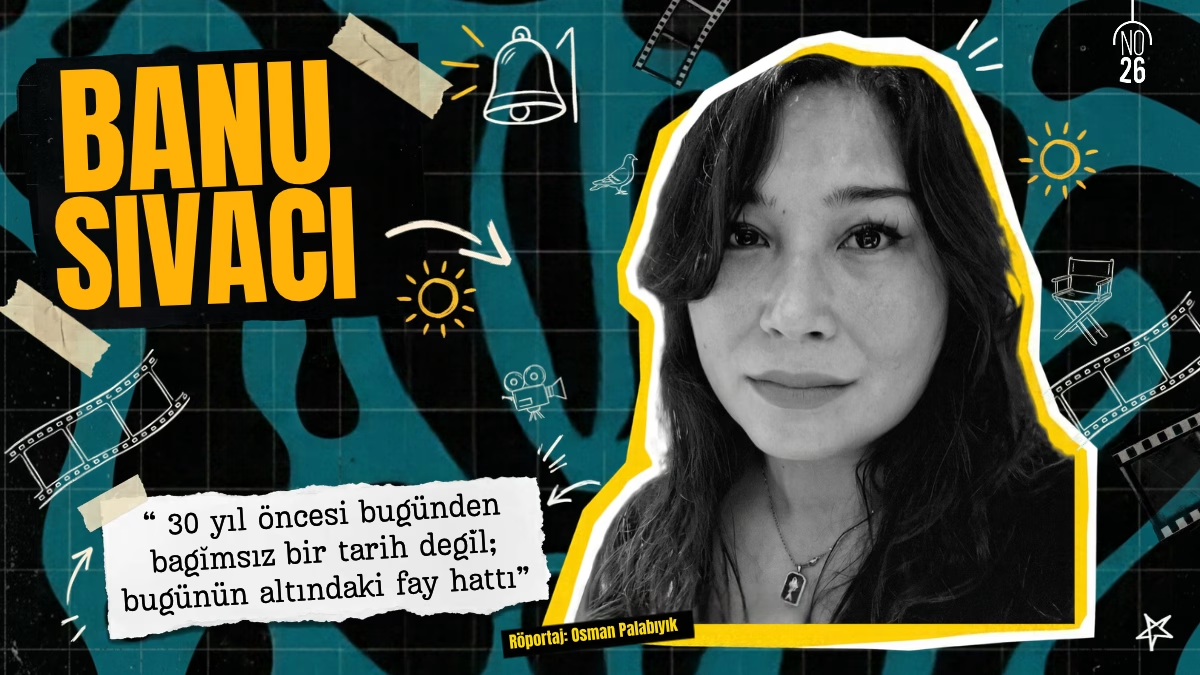
We sat down with director Banu Sıvacı to discuss the journey of Günyüzü (Daylight), which resonated deeply with jury and audiences alike at the Adana Golden Boll Film Festival, sweeping the prestigious Yılmaz Güney Best Film Award alongside accolades for Best Supporting Actor and Best Supporting Actress.
In Günyüzü, an event that transpired thirty years ago still exerts a profound hold over the lives of people today. What drew you to tell this story specifically through the lens of elapsed time? Does time truly reveal whether a wound has healed, or do certain fractures simply learn to speak in different registers as the years pass?
Time is hardly a universal healer; rather, it cloaks unresolved trauma while quietly allowing the underlying truth to fester. Whether a wound ever closes is determined not by the mere passage of time, but by the subtle ways it transmutes. What we refer to as “thirty years ago” is not an isolated chapter of history—it is an active fault line running beneath our present. Human memory suppresses things until life forces you back to the threshold where it all began. That is precisely Suna’s story: an unhealed wound that mutates, resurfacing as a disembodied voice, an intrusive memory, or an inescapable face.
Suna’s return to confront the past reads not merely as a physical homecoming, but as an excavation into the interior terrain of her own memory. In sending her on this journey, what did you intend for her to discover—and what did you expect her to lose?
When dispatching Suna back into this landscape, I wanted her ultimate quarry to be not an external culprit, but her own suppressed sense of injustice. In seeking resolution to doubts she has harboured for decades, she finds the ground shifting beneath everything she assumed she knew. On this journey, I wanted her to shed the illusion of absolute retribution or moral righteousness, confronting instead the nebulous, indistinct contours of the human psyche. What she lost, perhaps, was a clearly defined adversary; what she found was an unexpected, fragile kinship with the daughter of her brother’s killer.
Silence in Günyüzü carries as much weight as spoken dialogue. The suppression of truth within the domestic sphere—the deliberate refusal to speak lest the delicate order be disrupted—forms a potent undercurrent. Is what preserves a family sometimes not the truth, but a mutually sustained conspiracy of silence?
Within the broader social fabric—and particularly the institution of the family—preserving “order” almost always hinges upon the sacrifice of truth. Silence may originate as a protective shield, but it inevitably calcifies into a toxic, suffocating atmosphere. Suna emerges precisely as a disruptive force, resolved to tear down this rehearsed familial silence and the insulated fictions upheld by a patriarchal order.
You have noted that you deliberately distanced Suna’s portrayal from conventional archetypes of female victimhood. What were the creative stakes in crafting a protagonist who does not weep, feels no obligation to explain herself, and maintains an unyielding detachment? What preconceptions do you anticipate the audience will grapple with when confronting her?
Cinema and narrative traditions broadly have long cast women into rigidly prescribed molds: the helpless victim or the selfless, nurturing mother. Suna resists both tropes entirely; she is aloof, introspective, unapologetic, and carves out her own justice with uncompromising clarity. My primary concern throughout writing and filming was preserving this mute, taciturn resilience. When viewers encounter Suna, I expect them to confront their own ingrained assumptions—wondering, “Why doesn’t she cry?” or “Why doesn’t she vent her fury out loud?” Her power resides largely in the quiet resolve of her restraint.
Dementia in the film functions not merely as an individual’s cognitive decline, but as an allegory for a collective social memory eager to evade its past. How did you conceive the relationship between the erasure of memory and the erasure of truth?
Does truth vanish simply because it dissolves from a single human mind? That is the exact dilemma the film wrestles with. Bekir’s memory may have clouded, but the memory embedded in the landscape, the geography, and the living remains intact. Guilt is not extinguished merely because the perpetrator has forgotten; it is a weight that reconfigures itself upon the shoulders of those left behind. Ultimately, my overarching ambition was to demonstrate that time does not mend families marked by such profound devastation with any kind of easy catharsis.
The landscape in Günyüzü exercises almost as much agency as the characters themselves. The lake, the arid earth, dwindling waters, animals, and open voids carry the emotional tenor of the piece. Did you seek to give voice to nature where human speech falters, or did you perceive the natural world as an enduring witness to these tragedies?
Nature is never a passive backdrop in this story; it represents both belonging and memory. When people fall silent and words prove inadequate, geography begins to speak. The state of the lake, the cracked earth, the desolation of the evacuated village—all serve as witnesses to, and mirrors of, the tragedy that unfolded. Coming from a painterly background, anchoring the visual grammar in the genius loci of the setting felt like the most honest medium for externalizing interior human psychology.
Rather than confronting loss in the abstract, the film dwells on the voids left behind. Yıldız’s absence, Leyla’s disappearance, and the diminutions in other characters’ lives continually intersect. As a director, was rendering “absence” on screen more demanding than staging what is tangibly present?
If you treat absence as a character in its own right—one endowed with its own voice and gravitas—you discover that it possesses an eloquence all its own. In any case, everything that is present or missing in a film materializes only through the viewer’s perception and the meaning they ascribe to that emptiness. Unlike in the natural world, absence for a human being can exert a far heavier pull than presence. To extinguish a human life is to inaugurate an inexhaustible vortex of absence around everyone they touched.
It is striking that Suna’s pursuit of truth and justice exacts a heavy personal toll. Is the quest for justice inherently restorative, or do we risk opening fresh wounds whenever we unbolt the doors to the past? What answer did you arrive at through Suna?
When Suna levers open the past, she does not simply settle an old score; she is forced to confront domestic distortions and escalating fractures within her own kin. The search for truth isolates just as fiercely as it liberates. Suna’s trajectory reveals the precarious thresholds of conscience one is forced to navigate in the relentless pursuit of justice.
Geography exerts immense gravity across the visual universe of Günyüzü. We know the film draws deeply from your own childhood and mental topography. How did you negotiate the distance between personal memory and cinematic memory?
Personal memory is notoriously subjective, sentimental, and diffuse. Translating it into cinematic memory requires preserving an aura of intimacy while stepping back far enough to serve the story’s universal vernacular. While I draw from my roots and familiar topographies, once the camera enters that terrain, it ceases to be my personal recollection and transforms into the psychological topography of the protagonist.
Has the film shifted for you along its trajectory from Berlin to the Golden Boll? Were there revelatory encounters between what first-time audiences gleaned from the screen and the raw emotions you carried during its making?
As a film travels through festivals and encounters audiences from varied contexts, it slips from the director’s grasp to become a shared communion. Following its international premiere in Berlin, presenting it at the Golden Boll to an audience from its own native soil transported the work to an entirely different dimension. You craft a narrative driven by visceral, internal impulses, but it is the audience who fills in those deliberate lacunae with their own lived realities—a humbling reminder that cinema is a living, breathing organism.