

In Conversation with Moni: ‘Deprivation Led Us to Seek and Forge Alternative Paths’

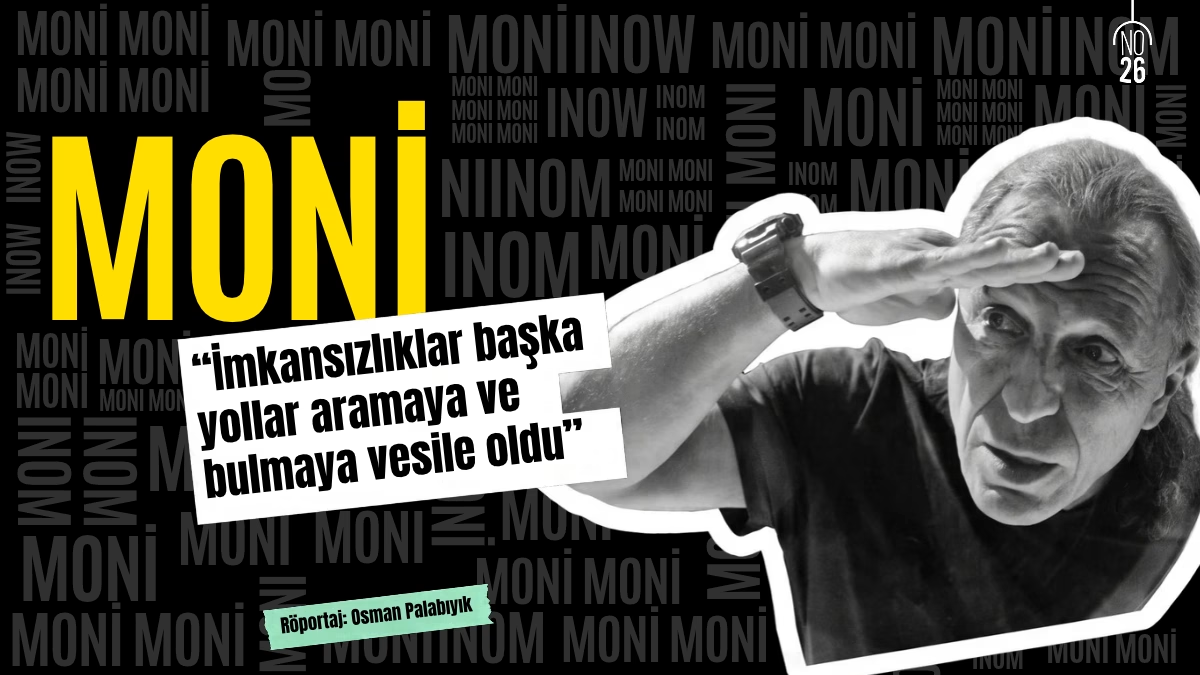
Since the 1990s, Moni has continuously reconfigured everyday debris, found objects, and ephemeral remnants left behind by transient visitors into radically altered forms through an ongoing gesture of wrapping. We sat down with the artist to discuss ADRIFT / ASKIDA, an exhibition that severs everyday objects from their former utility, setting them adrift across the subconscious recesses of the human psyche.
Since the late 1980s, your performances and happenings have consistently nudged the audience out of passive spectatorship and into active participation. When you look at your current practice, how much of that earlier Moni do you encounter?
Quite often, actually. That unmediated friction established with the public on the street during the 1980s has simply migrated into fresh spatial inquiries within the gallery and unfamiliar settings; it has assumed different guises. In ADRIFT / ASKIDA, I envisioned viewers navigating between the works, brushing against them, setting them in motion—casting shadows, fracturing the light, enriching the visual textures, and ultimately becoming integrated into this suspended ecosystem. Play should be possible anywhere, and accessible to anyone. What matters is how the space converses with the intended work and the atmosphere it seeks to conjure. Take the murmur of traffic drifting in from Bakanlıklar Caddesi, bleeding into the ambient sound installation, or the sheer curtain veiling the balcony windows, subtly evoking aquatic ripples…
Looking back at the art scene of the 1980s and ’90s, what felt most liberating, and what presented the greatest challenge?
The liberating aspect was, I think, an unbridled curiosity and an earnest conviction that we could alter the course of things—that everything was possible. The intensely politicised university milieu of the era, steeped in philosophy and dialectics, was immensely nourishing. Defying the dictates of the market or institutional demands felt inevitable, and we were perhaps far less timid than artists are today. Despite the scarcity of communication channels and material resources, we relished the license to make mistakes, to dismantle, to start anew, or simply to abandon work. Yet even those limitations compelled us to scrutinise ourselves and our immediate surroundings more acutely, prompting us to seek—and discover—alternative avenues.
Your background in geological engineering alongside your training in painting offers an unusual confluence. Does your grounding in geology inform how you interrogate objects, materiality, strata, and transformation today?
Geology teaches you to read time and matter across a vastly different scale. Once you register that you are physically immersed within 4.5 billion years of planetary memory, your perception of objects and occurrences shifts entirely. It leads you to consider that every entity deemed inanimate might harbour an innate reservoir of time and memory—that it could well be an indeterminate, more-than-human organism. Stratification, erosion, metamorphic deformation under pressure, sedimentation, eruption, flux, and suspension through morphic change… I believe everything I absorbed about these geological processes operates as a foundational reflex in how I relate to objects, to life, and to the natural world. The impulse to persist through continuous metamorphosis likely seeped in from geology.
Stratification and deep time are fundamental to geology. Looking at Askıda, one encounters an intricately layered architecture where objects and narratives seem to accrete. Is this dialogue between the two realms a deliberate strategy?
Rather than a premeditated strategy, it is perhaps better described as an instinctual, subconscious drive. One cannot help but register the patina of elapsed time and traces of human touch accrued on things. In ADRIFT / ASKIDA, mannequin heads, fabric strips, Kermes oak branches, and diving masks coalesce, superimposing upon other accretions. Each wrapped and unravelled layer allows the object to sediment its memory in an alternate register. It functions like an artificial reef: objects cluster, cling to one another, and gradually mutate into a different form of vitality.
ADRIFT / ASKIDA opens with a compelling premise: an ecology where everything seems slightly displaced and linear time ceases to function. For you, is ‘Askıda’ (suspended/in limbo) primarily a physical space, an emotional state, or a temporal condition?
It is all three simultaneously—space, psyche, and temporal register—and perhaps dimensions beyond what I can consciously perceive. It is an ephemeral threshold, an anteroom suspended between stories in the process of being written. A state neither fully rooted nor entirely lost; an interlude where the rigid laws governing space, spirit, or chronology are held in abeyance. It is a snapshot that resists dogmatic definition, resting easily in the perpetual possibility of drifting elsewhere at any given moment.
How do you articulate the dialogue between the two poles of the exhibition’s title: ‘Adrift’, evoking surrender to the current, and ‘Askıda’, signifying suspension or being held in abeyance?
While ‘Adrift’ suggests being caught in a current and yielding to motion, ‘Askıda’ implies seizing a foothold, grazing an edge, remaining poised in mid-air—an unreciprocated invitation primed for imminent metamorphosis. One dictates the vector of movement, while the other marks a caesura within that momentum. There is a rhythm at play: discarded materials severed from their familiar contexts drift aimlessly (Adrift), only to wrap around one another and linger suspended in an otherworldly realm (Askıda). It establishes an open-ended state of generative indeterminacy, whose resolution rests with the viewer stepping into it. It carries the latent kinetic charge of that which demands nothing in return—an allegory of infinity, even.
The exhibition relies heavily on everyday debris, found items, and relics left behind by transient inhabitants in your region. What determines when an object crosses the threshold into ‘art material’?
It begins with looking at the surrounding world askance—a ludic, instinctive impulse gradually refined through experience. When an object you encounter and bring back to the studio has been stripped of its functional utility and cast aside, the utilitarian burden imposed upon it evaporates. I salvage discarded relics that pique my curiosity, whose morphology or latent function sparks the imagination, and place them alongside others in the workspace. In due course, they either integrate into a narrative I wish to construct or organically carve out their own cosmos. I merely facilitate and orchestrate the encounter.
When handling an object discarded from someone else’s life, do you project an affinity with its prior provenance, or do you sever it entirely from its past to reconstruct it anew?
That connection sparks spontaneously at first encounter. The temporal deposit it holds converges with my own accumulated time. Nothing, after all, exists as a singular, isolated entity. These objects interface with my reality across different registers while actively shaping my world. The burdens and traces they bear are vital. In discarded mannequin heads, for instance, resides the residual trace of wear, the ghost of shorn hair; their scope and resonance shift. As I unravel skeins of fabric and bind them around these objects, past narratives interweave with emergent ones, laying down new stratifications. The object mutates without disavowing its provenance.
At times, they remain subterranean components of a larger tale: an object worked on meticulously might end up buried beneath other layers, yet the invisible substrate it provides is paramount to the whole. Disinterring it, registering its presence, and enabling the viewer to perceive it lies at the very crux of making and experiencing art.
The gesture of wrapping, a fixture of your lexicon since the 1990s, occupies a central position here. Does wrapping signify protection, concealment, entrapment, or transmutation for you?
It grazes against all of them. While wrapping might appear as an act of shelter or concealment, the clues that emerge during the unravelling initiate a fresh narrative. Binding an object in strips of textile dismantles its received form and endows it with an alternate anatomy. Consider touches of pigment applied to forms on canvas: at every stage, the process mutates, demanding unexpected interventions and compelling alternate configurations and narratives. The acts of binding and unbinding, cutting and pasting, accreting and excising constitute an existential condition.
By wrapping an object you render it invisible, yet paradoxically draw heightened attention to it. How do you navigate this contradiction?
Rather than exhibiting things in their raw state, grafting onto them, altering their morphology, interrogating them, and provoking curiosity drive the process. Imbuing an object with altered resonance, reframing it within an unfamiliar context, and offering traces of its collective memory—thereby granting the viewer space to forge their own relation to it—animates the work. What is shared is an unsettled state of discontinuity. Wrapped in fabric, these found relics cease to be inert refuse; they transform into uncanny yet curiously endearing entities. It is not about literal representation, but about excavating enigmatic states that manifest through play, and seizing upon them when revealed. That, precisely, is the condition of being adrift and suspended.
The confluence of Kermes oak and olive branches with everyday objects forms another vital facet of the exhibition. What do you seek in this confrontation between the organic and the man-made?
The fact that this boundary is ultimately demarcated by human capacity—that it tests the perimeter of imagination—is inherently human. When these entities are brought into proximity or intertwined, rigid demarcations begin to dissolve. These unexpected encounters and juxtapositions invite the viewer in. A desiccated Kermes oak branch gathered in the mountains converges in the same space with a discarded plastic flipper, a diving mask, or a mannequin head cast away after its utility had expired. Bound and wrapped in swaths of fabric, they yield a hybrid taxonomy that is neither purely organic nor entirely synthetic. Ultimately, I am probing the possibilities of coexistence: how man-made refuse and organic forms might lean on one another, cohabitate, and endure together.
You describe Askıda almost as a submerged world. What does the imagery of the underwater hold for you?
The underwater is a realm where gravity, mass, acoustics, chromatics, temporality, and rhythm are radically altered. Drawn to the water, constantly curious about and attuned to what lies beneath the surface, I was captivated by the proposition of transposing that seemingly tranquil yet intrinsically turbulent marine ecosystem into an Ankara apartment flat. The subterranean sea is an otherworldly realm where rigid definitions dissolve, where suspended objects generate their own acoustic silence, pulling the viewer into its chromatic blueness and gentle tremor. It is an act of purification, weightlessness, and release.
Transformation is central to your practice. What is the relationship for you between transforming an object and transforming yourself?
They are not disparate processes. To spend time with a discarded remnant—unravelling it, wrapping it in polychrome textiles, or suspending it in space—is to untangle the knots in one’s own psyche and memory. Because I perceive art not as proprietary accumulation or an urge to leave a permanent monument for posterity, but as an experiential encounter and an ongoing game, every tactile engagement with matter directly alters me. As the object mutates and evolves into an altered vitality, one cannot remain immutable; you shed accumulated baggage, or take on new weight.