

An Interview with Nuri Cihan Özdoğan, Director of Dead Dogs Don’t Bite: In This System, Only ‘Dead Dogs Don’t Bite’

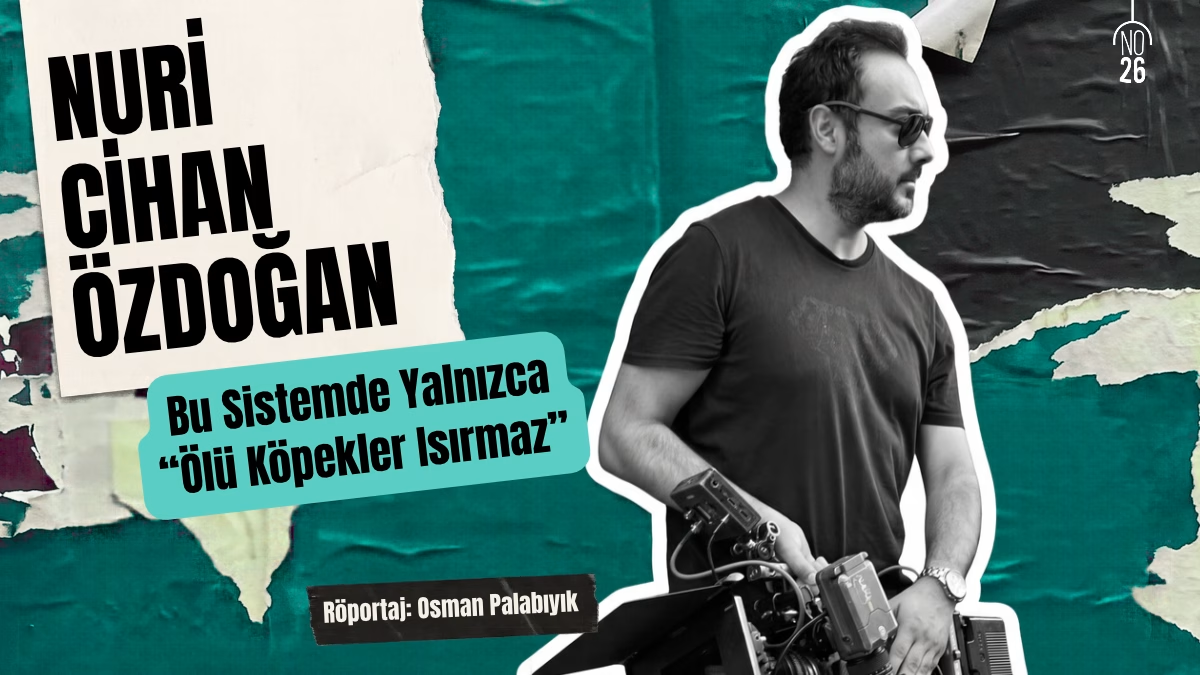
Following its world premiere at this year’s International Film Festival Rotterdam and its domestic debut at the Istanbul Film Festival, Dead Dogs Don’t Bite (Ölü Köpekler Isırmaz) screened in the National Competition at the 33rd International Adana Golden Boll Film Festival, where it picked up the Turkish Film Critics Association (SİYAD) Award for Best Film. We sat down with director Nuri Cihan Özdoğan to discuss the work.
Dead Dogs Don’t Bite centres on the illicit waste trade and the underbelly of organised crime. Through the dumping of refuse into the natural landscape, the film explores far more than an ecological crisis—it interrogates human ambition and our complicity within systemic structures. What was the initial impulse that drew you into this story?
My point of departure was the characters. The dynamic between İsmet and Dogo took shape in my mind first: two companions bound by an asymmetric, fundamentally dysfunctional codependency. Having grown up without a father, İsmet idealises Dogo’s brute strength. He defines power and the sphere he yearns to belong to through Dogo, viewing him as a master key to that world—a dynamic that leaves him acutely reliant on him. Dogo, conversely, anchors the relationship in a more narcissistic impulse. The aura of invulnerability he projects in İsmet’s eyes flatters his ego; İsmet’s vulnerability allows Dogo to relish his own sense of dominance, binding him to İsmet in an equally parasitic manner.
It is a reciprocal bond, yet deeply fragile and pathological. The issue of ‘waste’ served as the catalyst that charted where this dynamic would inevitably head. The contamination of the environment mirrors the corrosion of their friendship, just as it reflects the moral and spiritual degradation of these two youths. As a screenwriter and director, it afforded a richly layered narrative canvas. The reality of waste could be grafted seamlessly onto İsmet and Dogo’s arc, which made it an organic fit for the thematic framework I wanted to build. Furthermore, the illicit importation of foreign waste is a pressing reality in the Çukurova region. As a filmmaker born and raised in Adana, this landscape and its lived conditions are profoundly personal to me. Because it dovetailed so naturally with the dramatic architecture I envisioned, framing the narrative around the illegal waste trade felt inevitable.
In the film, we watch these two close friends drift apart as their desire for a better life and their upward climb through the criminal underworld consume them. Where, in your view, lies the tipping point where friendship and ambition begin to devour one another?
I had no interest in romanticising their friendship, especially since both youths are actively seeking entry into this criminal underworld. Given that premise, I chose not to frame this as an ascension or success story, but rather as an inverse trajectory: an anatomy of rot, corruption, and eventual oblivion. In probing humanity’s relationship with crime, I wanted an unvarnished approach, entirely stripped of romanticisation and aestheticisation. There is indeed a pivotal fracture where friendship and ambition begin to eat away at each other, and that moment arrives when İsmet finally realises that he holds no inherent worth in Dogo’s eyes.
Dogo navigates this sordid machinery by doing sordid things; compared to İsmet, he carries out the dirtiest tasks with cold ruthlessness. Yet none of those transgressions erode İsmet’s devotion. No matter what Dogo does, İsmet is perpetually ready to forgive, protect, and absolve him. But there is a definitive threshold where the friendship abruptly collapses for İsmet: the moment he grasps that, to Dogo, he is entirely disposable. The film opens with an oath of loyalty. Throughout the narrative, we watch how these two characters interpret devotion and mutual allegiance in fundamentally divergent ways. Once İsmet discovers how Dogo genuinely perceives him through the prism of that oath, the bond loses all meaning. That psychological rupture in their friendship is the core turning point of the film.
While the dumping of waste in the landscape appears as a concrete physical act, the narrative gradually evolves into a broader study of human and interpersonal decay. How did you draw the conceptual parallels between refuse, decomposition, and extinction and the inner world of your characters?
To me, these narrative threads are inextricably intertwined. The pollution of the environment and the moral degeneration and rot of the characters are deeply enmeshed throughout the story. When we examine the waste trade and the illicit mechanisms trailing behind it, we are fundamentally looking at man’s drive to dominate nature. It exposes human hubris—the sheer audacity of positioning oneself above the natural world and presuming to subjugate it with impunity. Yet nature, as we know and experience daily, remains overwhelmingly formidable.
This same hubris and domination that humanity exerts over nature is replicated between human beings. We witness this exact dynamic of domination play out between İsmet and Dogo. And inevitably, whenever a relationship is predicated on domination, it is doomed to toxicity and decay. In that respect, the interpersonal and ecological dynamics inform and layer one another.
Simultaneously, the film addresses another axis of subjugation: that between imperialist nations and what is conventionally designated as ‘the rest of the world.’ Developed imperial powers find no qualms in offloading refuse they deem non-recyclable or functionally useless onto foreign soil. Throughout history, imperialism has been synonymous with colonisation, and what we are confronting here is a form of ecological colonialism. Sadly, our country has been drawn into this dynamic. Yet I hope and believe that widespread awareness will take hold swiftly, rendering this entire process an obsolete, defunct chapter of our past in the very near future.
You shot the entirety of the film in Adana. Did the city remain merely a backdrop, or did its unique atmosphere, inhabitants, physical spaces, and everyday rhythm actively reshape your visual and narrative language?
The entire film was shot in Adana, and the story itself was conceived out of the city’s terrain. The project initially began with an urge to shoot a film at the seaside amusement park in Karataş; subsequent to that, the illicit networks surrounding Adana’s waste imports were woven into the script. Consequently, Adana ceases to be a mere setting and operates as a character in its own right. That said, while we drew from Adana’s stark realities to craft a fictional narrative, we also wanted to disentangle the film from rigid temporal and geographic bounds. We referred to the port via a codename, for instance, and described Adana without naming it outright, designating it instead as ‘the eastern Mediterranean.’ After all, whether you alter the logistics of the waste trade or substitute it with other systemic operations, the underlying human and socioeconomic machinery remains identical. I wanted the narrative to feel universal and timeless, even if Adana remained a decisive, presiding protagonist.
Regarding everyday life and vernacular, our characters do not speak in an overt Adana dialect or accent. As a native of Adana, neither I nor my circle speak with the exaggerated local cadence often depicted in other screen portrayals of the city. While the Adana dialect certainly possesses its own distinct cadence, I deliberately avoided amplifying it to a blaring or folkloric degree.
Crime cinema frequently revels in the glamour and allure of the underworld as much as the illicit acts themselves. You, however, focus on how the characters’ ambition for social mobility drives them into this realm. What rationalisations did you want these two friends to construct for themselves as they crossed into that darkness?
Interrogating the human relationship with crime is endlessly fascinating. As a storyteller, it provides an abundance of internal and external conflict. Furthermore, examining the impulse or perceived necessity to commit crime offers a poignant lens through which to decode an individual’s fraught relationship with the society they are coerced into navigating. Naturally, this is never something to condone, which is precisely the ethos of the film. Crime films often lean into the glamour of delinquency, but my absolute red line was that criminality must never be romanticised or framed as genuine upward mobility. As a director, I remained vigilant about that distinction.
Of course, as they cross that threshold, both characters harbour a desperate longing for societal recognition. Economic precarity, financial gain, and ambitions of climbing the ladder certainly fuel them, but the primordial driving force is their hunger for respect. There is a table in the film where pivotal decisions are brokered: will they ever earn a seat there? More pointedly, these are street kids who understand they will never secure a place through formal education or pedigree. Consequently, they have been conditioned to believe that criminality is their only currency to earn a seat at that table.
The deeper crisis today—especially given how ruthlessly street gangs exploit minors—is the cultural lionisation of crime figures as idols for these youths. We cannot simply absolve children who construct fantasies around crime. I also believe we must be cautious with euphemistic phrasing like ‘children driven to crime,’ because reality confronts us with minors raiding schools and violently assaulting peers. We witnessed tragic incidents like the Mattia Ahmet Minguzzi case, which demonstrates that violent offenders cannot simply be absolved. The burgeoning appetite for crime among youths is alarming, and I find the cultural glamorisation of crime bosses—and the social respect accorded to them—deeply pathological.
Dead Dogs Don’t Bite had its world premiere in the Bright Future section of the International Film Festival Rotterdam. What was it like to take a narrative rooted so specifically in Adana beyond Turkey’s borders and introduce it to an international festival audience for the first time?
Premiering in Rotterdam’s Bright Future section gave the film an immediate framing, serving as our maiden gateway to the international film world. The section identifies its titles as daring, emerging cinematic voices worth discovering. I was thrilled to embark on our journey under that banner, because from the outset, we were conscious of our intent to deliver a bold film in both form and substance.
Screening in Rotterdam held an added resonance because it is a major Dutch port city, and the Netherlands ranks among the top three European exporters of waste to Turkey. When we shared the film with audiences there, we discovered that Dutch viewers were acutely aware of this ecological transfer. I was both surprised and heartened to see that the public does not condone this practice, which made the exchange invaluable.
When the film met our domestic audience in Istanbul in April 2026, I was disheartened to find that our own public was largely oblivious to the reality—largely due to a domestic media establishment that plays dead. We shot the film in November 2024, having begun the script back in 2021–2022. At the time, it was almost impossible to spark an open dialogue on the subject. But when the Mediterranean began literally vomiting plastic this past summer, the ecological catastrophe became undeniable. By the time audiences in Adana saw the film, they were fully cognisant of the crisis. While drafting the screenplay and filming, I harboured hope that the issue might have been resolved by our release; ironically, just before our premiere, the sea coughed up that plastic truth for all to see. If our film has contributed to bringing this reality into the light, I can only be gratified, both as a filmmaker and as a native of Adana.
You draw a direct continuum between environmental devastation and organised crime. What significance do you attach to making these illicit waste trades, criminal syndicates, and financial cartels—so often invisible in daily life—palpable on screen?
What became abundantly clear during my research for the screenplay is that waste importation exists as a formally legal operation. Yet nestled within that formal apparatus is a rampant illicit underworld. Because the margins are staggering, organised crime inevitably muscles in. The dynamic is inherently porous to illegality: we see wholesale document forgery involving miscoded shipments arriving from abroad, followed by the fraudulent handling of non-recyclable materials once inside the border. While these toxic materials could technically be neutralized with minimal harm at a specified financial cost, criminal syndicates bypass proper disposal to maximise profit, dumping them directly into open nature. Where an illicit shortcut exists in waste importation, organised syndicates will seize upon it without hesitation. Human life is treated as disposable; the fertile soil of Çukurova is entirely disregarded.
Once financial profit is on the line, the film’s title crystallises: Dead Dogs Don’t Bite. Anything perceived as a threat or impediment to this system is eradicated. For this machine, pecuniary self-interest reigns supreme. It takes very little scrutiny to demystify: wherever unearned economic rents exist, organised crime inevitably takes root. Tragically, in Çukurova, this trade operates through criminal enterprise. Our film anchors its fictional narrative in these real-world foundations. In Dead Dogs Don’t Bite, there is a full-scale turf war between rival waste-trafficking gangs. While this specific turf war is a fictional invention I introduced into the script rather than an existing reality in Adana, turf wars between youth gangs are an undeniable fact across Turkey today. I merely brought these two worlds into collision.
Dead Dogs Don’t Bite is a visceral, memorable title. Looking back on this phrase now that the project is complete, in which sense do you feel it best encapsulates the narrative as a whole?
The title Dead Dogs Don’t Bite reverberates across multiple thematic strata for me. In my eyes, it stands as the central motto of this machinery: this system, this engine, eliminates anything that poses the slightest threat to its continuity. If a dog bares its teeth in pursuit of its own interests and becomes a liability, that dog is put down. In this machine, only dead dogs don’t bite.
On the other hand, the film is fundamentally an inquiry into loyalty. The story opens with a blood oath, and what unfolds is a crucible in which İsmet and Dogo’s allegiance to each other is tested against the very system they seek to enter. Given that the canine figure is universally codified as a ‘loyal companion,’ the metaphor gains its sharpest resonance right at that junction.