

Winds redraw ocean routes, heat changes the shape of landmasses, and storms gather far away long before reaching our doorstep. Like the weather, the world is in a state of continuous motion. While today’s rising far-right political climate creates an uncanny atmosphere where pressure increases and tensions suddenly explode; art takes the stage not as a passive backdrop to this atmosphere, but as a mutual political force shaping the climate. One of Europe’s most established contemporary dance gatherings, Tanz im August, opens its doors in its 2026 edition right in the midst of these moving pressures and changing storms.
Setting the direction of the festival, Artistic Director Ricardo Carmona states that they curated this year’s program almost like a meteorological map showing shifting currents, heatwaves, and approaching winds. According to Carmona, the festival transforms along with the audience and artists into a living atmosphere where we inhabit and search for a common path amidst unpredictable winds. Meanwhile, Annemie Vanackere, Artistic and General Director of HAU Hebbel am Ufer, presents a vision titled “Outlook: changeable”; emphasizing the power of art, and dance in particular, to build fragile yet unwavering alliances amidst the feeling of powerlessness and political storms in the world.
Currents Crossing Borders and Social Memory
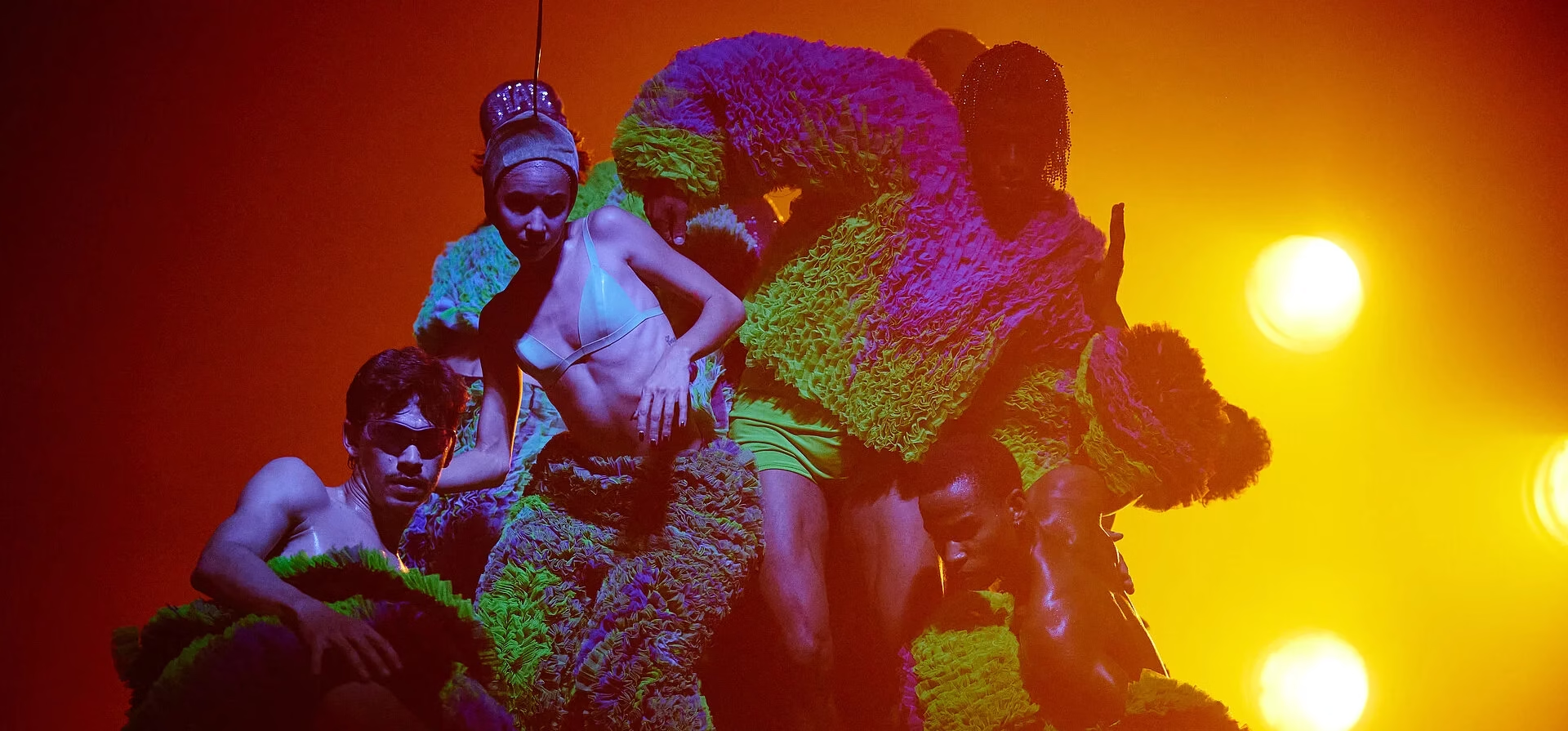
Just as weather systems do not stop at national borders, many artists featured in the festival this year question the concept of the nation-state, migration, and transnational identities. TRAPICANA, a co-production by Joana Tischkau, Jeremy Nedd, and Sophie Yukiko with the Malpaso Dance Company, brings the tensions between cultural authenticity and exoticization to the stage. While Mohamed Toukabri traces personal routes shaped by language and migration, Marco da Silva Ferreira resists militarization and toxic masculinity through the language of dance.
In the festival, history is also addressed not as a static narrative, but as a climate surrounding us. Chara Kotsali rereads history as a succession of disappointments, while Trajal Harrell treats music tracks like an archived memory. While Calixto Neto transforms music into an act of resistance, the En–Knap crew (with Emese Cuhorka and Csaba Molnár) confronts layered references of the Western dance canon.
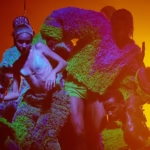
In this period where the global atmosphere is becoming increasingly turbulent, themes of violence, war, and conflict also find ample space on stage. Agnietė Lisičkinaitė and Igor Shugaleev convey the devastating effects of Russia’s invasion of Ukraine with CLAP & SLAP, while Jumana Dabis gives voice to resilience and instability in Gaza. Ballet national de Marseille / (LA)HORDE creates a domain of transgression fed by rebellion, while Mélissa Guex develops survival strategies in a seemingly hopeless present.
Rhythms of Nature and Ecological Pursuits
Beyond the storms, artists turn to nature and ecological rhythms seeking a possibility for transformation. While Dana Michel embarks on an exploration of aquatic histories of swimming, Taiwan’s Cloud Gate Dance Theatre (Cheng Tsung-lung) brings landscapes shaped by elemental forces to the stage. Simona Deaconescu, Ioana Vreme Moser, and Simina Oprescu establish parallels between water currents and our bodies with The Choreography of Water. Lenio Kaklea transforms bird movements, and Kareth Schaffer & Jonas Hauer transform the echolocation systems of bats into dance as a way of perceiving the environment.
Stage Routes and Festival Calendar (August 13 – 29, 2026)
Spreading across various cultural spaces in Berlin such as HAU1, HAU2, HAU3, Radialsystem, Haus der Berliner Festspiele, Sophiensæle, Berlinische Galerie, and St. Elisabeth-Kirche, the prominent route of the program takes shape as follows:
-
August 13 – 16: Setting the opening momentum of the festival, TRAPICANA (HAU2 & Sophiensæle) is followed by Chara Kotsali’s production IT’S THE END OF THE AMUSEMENT PHASE (HAU1) and Mohamed Toukabri’s performance (Radialsystem).
-
August 15 – 17: Dana Michel’s project YOU CANNOT CAN (Stadtbad Oderberger) and Cloud Gate Dance Theatre’s magnificent show Sounding Light (Haus der Berliner Festspiele) are on stage.
-
August 17 – 20: Jumana Dabis’s film Sarkha صرخة (HAU2) and screenings of The Choreography of Water by Simona Deaconescu and team (HAU3) meet the audience.
-
August 20 – 23: Agnietė Lisičkinaitė & Igor Shugaleev’s performance CLAP & SLAP (Radialsystem), Ballet national de Marseille / (LA)HORDE’s work Après moi, le déluge (Haus der Berliner Festspiele), and Trajal Harrell’s show Music Music (HAU1) stand out on stage. Performances by Lenio Kaklea (Les Oiseaux) and Diana Niepce (HORNFUCKERS) also draw attention in this window.
-
August 24 – 29: The festival enters its final week with Kasia Wolińska’s production Phoenix.Sun (St. Elisabeth-Kirche), Mélissa Guex’s show DOWN (Berlinische Galerie), Kareth Schaffer & Jonas Hauer’s work Bat Dances (HAU3), and Calixto Neto’s work Bruits Marrons (HAU2). The marathon concludes on August 29 with Outbox Me Battle x Tanz im August.