

In our “One Movement, One Artist” series, each installment pairs an art movement with its defining figure. Our inaugural subject: Impressionism and the painter who—however inadvertently—christened it: Claude Monet.
In April 1874, inside the former Parisian studio of the photographer Nadar, a loose coalition of young artists bypassed the state-sanctioned jury system to stage their own independent exhibition. A modest seascape in the show provoked a scathing, satirical broadside from a local critic. Yet that fleeting mockery would ultimately give its name to one of the most celebrated movements in art history.
The Movement: What Is Impressionism?
Rebellion Against the Salon
In nineteenth-century France, an artist’s path to recognition ran almost exclusively through the Salon, the official annual exhibition mounted by the Académie des Beaux-Arts. The Salon enforced a strict hierarchy of genres—enthroning historical, mythological, and religious subjects at its apex while prizing seamlessly blended, immaculately “finished” surfaces. Stifled by these rigid academic orthodoxies, forward-looking painters began seeking alternative platforms. Precedents already existed: Gustave Courbet in 1855 and Édouard Manet in 1867 had erected their own independent pavilions, while the Salon des Refusés of 1863 had exposed the jury’s rejections directly to public scrutiny.
The catalyst for this new venture coalesced among the young painters congregating in the cafés of the Batignolles quarter. Monet and his close friend Frédéric Bazille had envisioned an independent group show as early as 1867. The realization of that ambition, however, was delayed by the upheavals of the Franco-Prussian War (1870–71) and the Paris Commune. Bazille never lived to see it happen, having fallen on the battlefield in 1870.
15 April 1874: Nadar’s Studio
By December 1873, the artists had formally incorporated as the Société anonyme des artistes peintres, sculpteurs, graveurs, etc. From 15 April to 15 May 1874, they staged a juryless, prize-free exhibition on the premises of Nadar’s former studio at 35 Boulevard des Capucines. Bringing together roughly thirty painters, sculptors, and printmakers, the show assembled 165 works. It marked the first collective display of paintings now canonized as masterpieces: Monet’s Impression, Sunrise, Berthe Morisot’s The Cradle, Pierre-Auguste Renoir’s La Loge, Edgar Degas’s At the Races in the Countryside, Camille Pissarro’s The Orchard, and Paul Cézanne’s The House of the Hanged Man.
Commercially, the venture faltered. While the official Salon drew half a million visitors that same year, the independent show attracted only around 3,500; the fledgling joint-stock company dissolved before the year was out. Yet this modest gathering proved a watershed moment for modern art, inaugurating a series of eight landmark group exhibitions held between 1874 and 1886.
A Name Born of Derision
On 25 April 1874, critic Louis Leroy published a biting, dismissive review in the satirical journal Le Charivari, titled “The Exhibition of the Impressionists.” Structured as an invented dialogue, the piece followed a traditionalist academic painter gradually losing his sanity as he wandered through the galleries. Leroy reserved his sharpest vitriol for Monet’s depiction of the port of Le Havre: of Impression, Sunrise, he scoffed, “Wallpaper in its embryonic state is more finished than that seascape!” With that sneer, he branded the entire collective “impressionists.”
The fate of the epithet was swift and ironic. Just four days later, on 29 April, critic Jules-Antoine Castagnary reclaimed the term in Le Siècle, this time as an accolade: these artists, he argued, were impressionists because they rendered not the landscape itself, but the sensation it evoked. The painters themselves did not formally adopt the label until their third exhibition in 1877, and even then, they frequently reverted to designations like “The Independents.” Certain core members, Degas prominent among them, harbored a lifelong distaste for the moniker.
Core Tenets of Impressionist Painting
-
Open-Air Painting (En plein air): The easel migrated from the dark atelier into nature. The invention of collapsible metal paint tubes (patented in 1841) granted artists unprecedented mobility, allowing them to set up their easels directly in fields, orchards, and along coastlines.
-
A Brighter, Synthetic Palette: Breakthroughs in nineteenth-century industrial chemistry introduced vibrant new pigments—including synthetic ultramarine, cobalt blue, chrome yellow, and emerald green—infusing palettes with unprecedented luminosity.
-
The Pursuit of Light and the Ephemeral: The focus shifted from the permanent physical identity of an object to the transient light falling upon it at a particular hour and under specific atmospheric conditions.
-
Broken Brushwork: Rather than pre-mixing pigments smoothly on the palette, artists applied pure colors directly onto the canvas in rapid, visible strokes. This intuitive touch was later codified into a rigorous scientific method of optical mixture by Georges Seurat in Neo-Impressionism.
-
Colored Shadows: The traditional studio convention of black and grey shadows yielded to luminous purples, deep blues, and greens—a tendency especially prominent in the works of Monet and Pissarro. This was by no means an absolute rule: Manet and Degas continued to utilize rich blacks to striking effect.
-
Scenes of Modern Life: Classical and mythological narratives gave way to the realities of contemporary Paris: tree-lined boulevards, bustling railway terminals, leisurely regattas, and animated café-concerts.
-
Radical Perspectives: Heavily influenced by Japanese woodblock prints (ukiyo-e) and the nascent medium of photography, compositions embraced high horizons, oblique angles, and abruptly cropped margins that implied life extending beyond the frame.
The Artist: Claude Monet (1840–1926)
Each painter within the Impressionist circle brought a distinct sensibility to the collective endeavor: Degas pursued movement, Renoir captured convivial warmth, Morisot and Mary Cassatt illuminated the private spheres of women’s daily lives, and Pissarro remained rooted in rural existence. Yet it was Claude Monet who pursued the ephemeral shifts of light with an unswerving, lifelong devotion. Aside from Alfred Sisley, who remained equally steadfast in his Impressionist convictions, Monet was the movement’s most unrelenting champion; Pissarro, by contrast, briefly detoured into Seurat’s pointillist experiments.
From Destitution to Global Renown
Born in Paris on 14 November 1840 and raised in the Norman port town of Le Havre, Monet initially found modest acclaim as a teenage caricaturist. It was the marine painter Eugène Boudin who introduced him to open-air painting. Monet’s visual sensibility was further sharpened by the dazzling North African sunlight during his military service in Algeria (1861–62). Entering the Parisian atelier of Charles Gleyre in 1862, he forged lifelong bonds with Renoir, Sisley, and Bazille. His initial institutional breakthrough came via official channels: he was accepted into the Salon of 1865.
Though his canvases command tens of millions today, Monet spent much of his early career trapped in crippling poverty and debt. His frantic, pleading letters to patrons and fellow artists testify to the bleakness of those years. The loss of his first wife and primary muse, Camille Doncieux, in 1879 occurred amid acute financial ruin. His most steadfast benefactor throughout these hardships was the Parisian art dealer Paul Durand-Ruel, whom Monet had met in London in 1870. The decisive turning point arrived in 1886, when Durand-Ruel staged a landmark Impressionist survey in New York. The enthusiastic embrace of American collectors transformed Monet into a celebrated and prosperous figure by the 1890s.
The Method
For Monet, the motif itself was incidental; the true subject was the envelope of light that cloaked it. He returned to the same landscape repeatedly at various times of day, setting aside one canvas as the light shifted and returning to it at the precise hour the following day. The romantic myth that he completed every work outdoors in a single spontaneous burst, however, is largely unfounded: many of his serial canvases underwent months of meticulous reworking in his studio.
As recounted by the American painter Lilla Cabot Perry, Monet routinely advised younger artists to forget what they were painting—a tree, a house, a field—and see only patches of color and shape: a square of blue, an oblong of pink, a streak of yellow. He famously remarked that he wished he had been born blind and suddenly gained his sight, so that he might look upon the world without preconceptions or names for the things before him.
A Closer Look: Impression, Sunrise (1872)
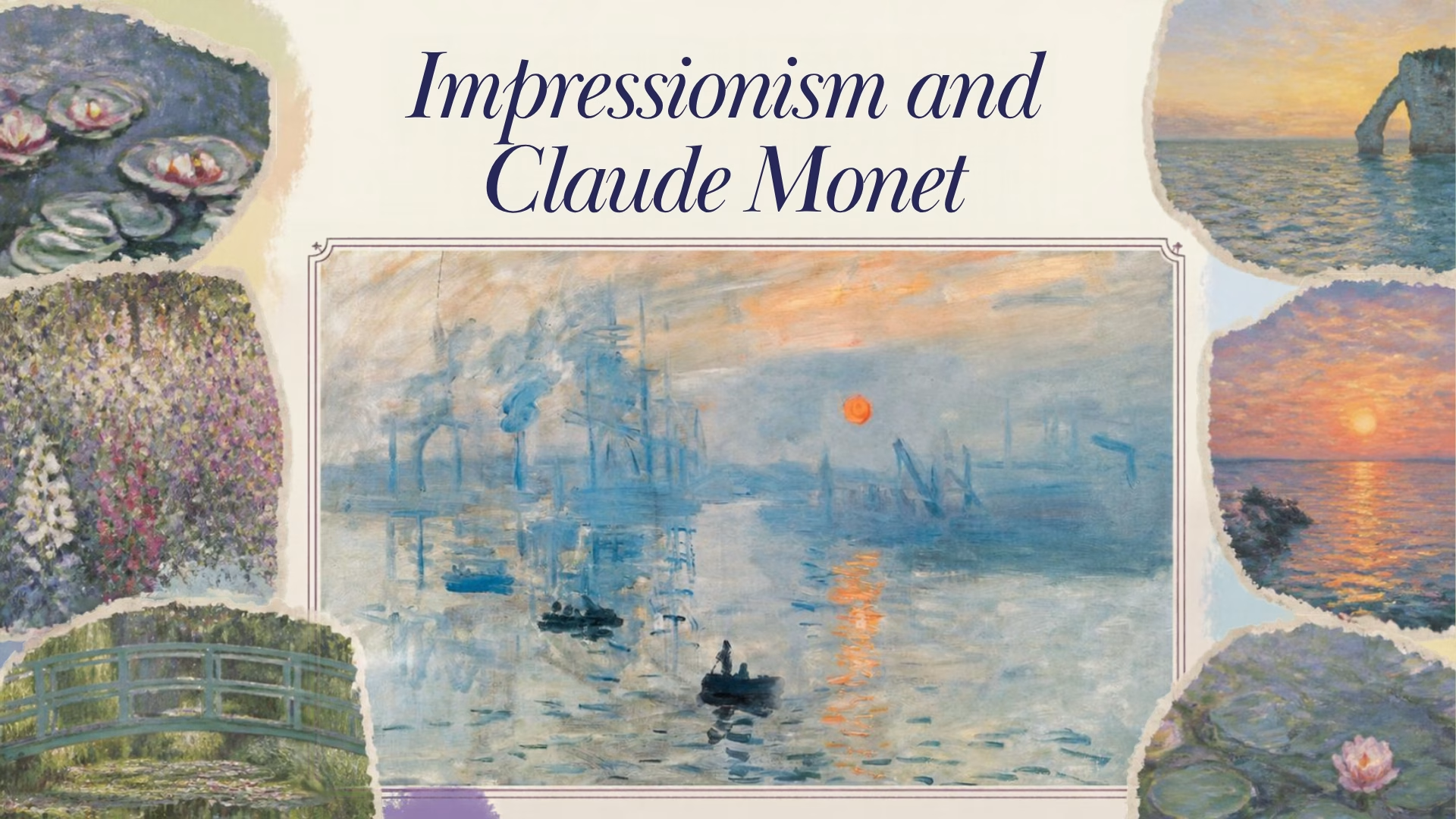
Housed in Paris at the Musée Marmottan Monet, this modest canvas measuring 48 × 63 cm depicts the break of dawn over the industrial port of Le Havre.
Through the morning mist, small rowboats emerge in the foreground, anchored by a vivid orange sun rising over undulating waters. In the veiled distance, silhouettes of smoking factory chimneys, cranes, and ship masts puncture the horizon. The composition’s most arresting visual property lies in its chromatic values: the fiery orange orb shares virtually the same luminance as the surrounding cool grey-blue sky. Photographed in black and white, the sun practically vanishes into the atmosphere. As neurobiologist Margaret Livingstone has demonstrated, Monet achieved the brilliance of the sun not through contrast in brightness, but through pure, saturated color—triggering an optical vibration that mimics the shimmering perception of early morning light.
The Exact Minute: 13 November 1872, Around 07:35 AM
Though inscribed “Claude Monet 72” in the corner, the painting’s exact date of execution remained contested for decades, with various scholars advocating for 1873. In 2014, astrophysicist Donald Olson resolved the chronology through meticulous forensic analysis. Cross-referencing nineteenth-century cadastral maps, archival photographs of Le Havre, tide charts, wind patterns, and meteorological records, Olson determined that Monet observed this exact view from his third-floor window at the Hôtel de l’Amirauté on the morning of 13 November 1872, at approximately 07:35 AM. While Olson’s finding presents a rigorously argued date, it remains possible that Monet synthesized impressions gathered across several successive mornings into a single canvas.
In 1985, the masterpiece was brazenly stolen from the museum at gunpoint; it was recovered five years later in Corsica in 1990 and returned to its rightful home.
The Series and Giverny: One Subject, Endless Iterations of Light
From the 1890s onward, Monet channeled his energies into serial painting, repeatedly depicting a single motif across dozens of canvases. The genesis of this systematic inquiry had appeared earlier, in 1877, when he executed twelve views of the Gare Saint-Lazare. While light appeared to be the ostensible subject of these later series, the chosen motifs were far from arbitrary. As art historian Paul Hayes Tucker has pointed out, haystacks, poplars, and Gothic architecture were deliberate emblems deeply tied to the iconography of French national identity.
-
Haystacks (Meules, 1890–1891): A twenty-five-part series documenting the conical grain stacks in the fields outside Giverny under shifting seasonal and atmospheric conditions. In 2019, one canvas from this cycle fetched $110.7 million at Sotheby’s New York, setting an auction record for an Impressionist work.
-
Poplars (1891): Over twenty variations capturing the rhythmic silhouettes of trees along the banks of the River Epte.
-
Rouen Cathedral (1892–1894): More than thirty canvases charting the play of morning, midday, and twilight light across the sculpted stone facade of the Gothic monument.
-
The Houses of Parliament, London (1899–1904): Luminous studies of light fracturing through the dense, smog-laden fog of the Thames.
-
Water Lilies (Nymphéas, 1897–1926): A monumental cycle comprising roughly 250 canvases devoted to the aquatic garden and Japanese footbridge Monet constructed at his home in Giverny.
Having settled in the Norman hamlet of Giverny in 1883, Monet purchased the property outright in 1890. He landscaped the grounds as if arranging a living canvas, dedicating the final three decades of his life to its blossoms and water surfaces. On 12 November 1918, the day after the Armistice that ended the First World War, Monet wrote to Prime Minister Georges Clemenceau offering to donate a monumental suite of decorative water lily panels to the French state as a monument to peace. Formalized in 1922, the donation found its permanent home in 1927—several months after the painter’s death—within the custom-built oval galleries of the Musée de l’Orangerie in Paris.
The increasingly saturated reddish and amber palette of Monet’s late output is often attributed to the cataracts diagnosed in 1912, though it also reflects a deliberate turn toward expressive abstraction. Following eye surgery in 1923, he experienced aphakic vision—perceiving colors with a strong bluish cast—and reportedly scraped down and reworked several canvases. These monumental panels stand as the final, heroic testaments to a lifetime consecrated to the pursuit of light.
A Note from Turkey: Impressionism in Istanbul
Impressionism arrived in Istanbul roughly four decades after its Parisian inception. While early atmospheric sensitivities surfaced in the late landscapes of Halil Pasha, the movement was decisively introduced by the “1914 Generation” (also known as the Çallı Generation). Dispatched to Paris for academic training following the Second Constitutional Era of 1908, figures such as İbrahim Çallı, Nazmi Ziya Güran, Avni Lifij, Feyhaman Duran, Namık İsmail, and Hikmet Onat were forced to return home upon the outbreak of World War I.
Rather than adopting Monet’s radical dissolution of solid form, however, these painters practiced an Impressionism tempered and moderated within the academic ateliers of masters like Fernand Cormon and Jean-Paul Laurens. Often labeled “Turkish Impressionism,” the classification remains a subject of debate among art historians, some of whom question whether the movement aligns strictly with Western Impressionist tenets. Their primary subject matter became the shimmering vistas of Istanbul: the Bosphorus, the Golden Horn, Üsküdar, and the Princes’ Islands. The annual Galatasaray Exhibitions, inaugurated in 1916, became the premier public showcase where this light-dappled aesthetic captivated local audiences.
Until the next installment in the series.