

Is Craft Ever “Just” Craft? An Object Biography from the Wixárika Sierra to the Bauhaus Workshops

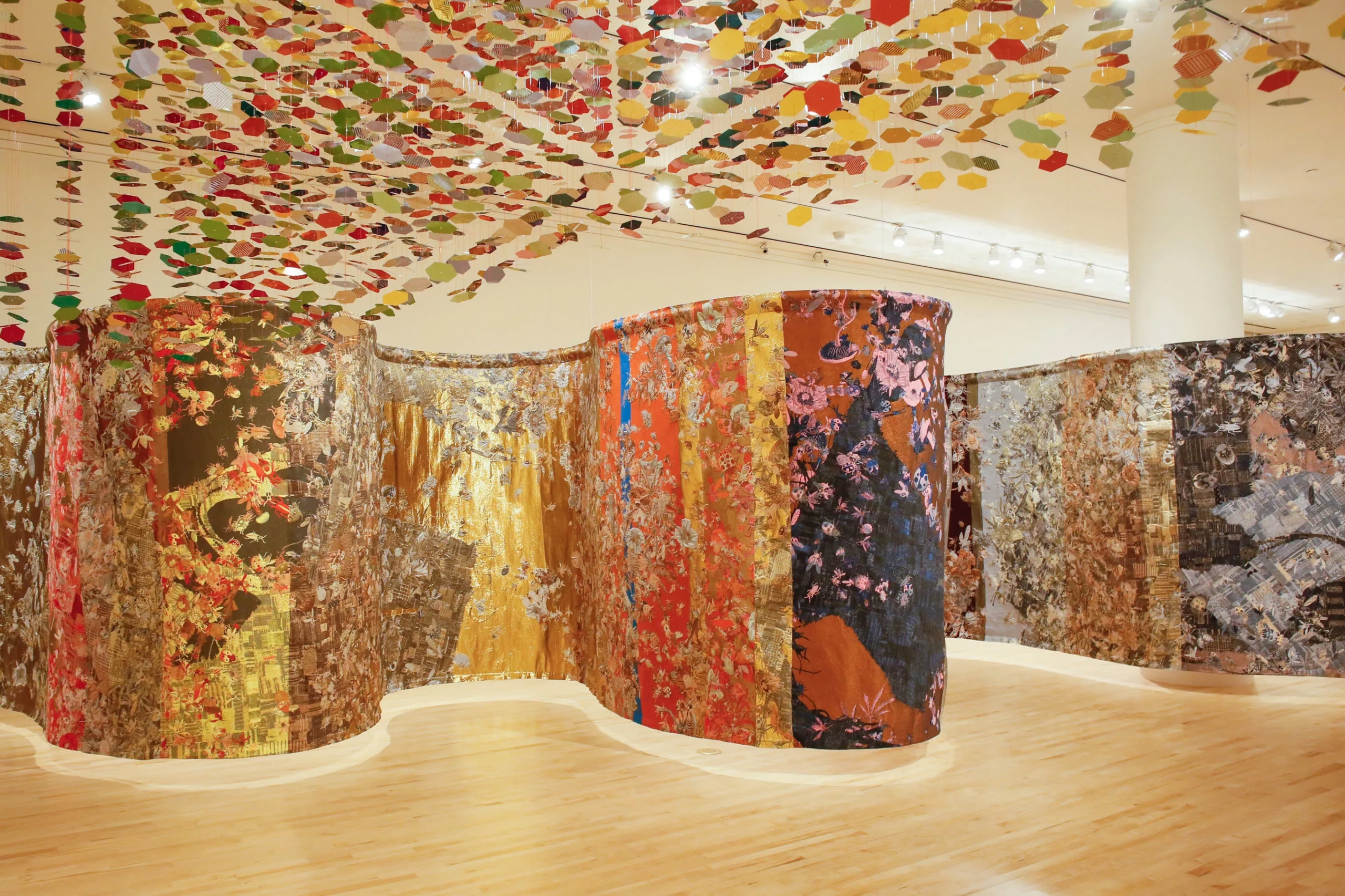
High in the rugged mountains of Mexico, vibrant threads and tiny glass beads are laid one by one onto beeswax-coated wooden boards. Across weeks—sometimes months—of painstaking devotion, every shift in color is far more than a stylistic choice; it is the physical manifestation of a generational cosmological memory, a tactile epistemology. It is precisely within this landscape that contemporary artist Pae White chose to collaborate with Wixárika artisans.
But when this intoxicating surface is transplanted to a sterile, white-cube gallery wall—drenched in spotlights—what are we actually looking at? A conceptual artwork, or the raw dexterity of craft? Perhaps both. Yet the very impulse to ask the question reveals a great deal about the art world’s unspoken border controls.
A Genealogy of Hierarchy: Class, the Academy, and Mind-Body Dualism
The rigid line separating craft from fine art is deeply ingrained in Western cultural memory—the product of a centuries-old hierarchy. With the advent of the Renaissance, painters and sculptors fought aggressively to distance themselves from the dust of guild workshops and the stigma of the manual artisan, vying for the rarefied status of the “fine artist.” Textiles, ceramics, and carpets—disciplines rooted in physical endurance and manual dexterity—were relegated to the subordinate categories of “decorative” or “applied” arts.
This division was hardly a neutral taxonomy; it was anchored in a strict class structure. While the artist contemplated the world from the pristine vantage point of the academy to produce intellectual concepts, the artisan engaged in physical labor in a soot-stained workshop. Institutionalized over centuries, this philosophical legacy prioritized mind over body. The art market and its attendant institutions depended heavily on this hierarchy to safeguard their exclusivity and the economic premium attached to the designation of “artist.”
Bauhaus: The Dream of Dismantling the Wall Between Studio and Academy
In 1919, the emergence of the Bauhaus in Weimar struck the first major blow against this entrenched divide. Walter Gropius’s founding manifesto declared something far more ambitious than a mere desire: “The ultimate goal of all creative activity is the building! … Fine artists, sculptors, and craftsmen must all return to the workshop.”
By placing painters behind pottery wheels and encouraging master weavers to draft graphic geometries, the Bauhaus attempted to collapse the aloof distance between art and craft, reimagining creation as a holistic endeavor. Yet while this intervention radically altered 20th-century design horizons, the dream was short-lived. Forced to close under Nazi pressure in 1933, the school’s legacy fractured. In the hands of Gropius and his exiled peers in the United States, the Bauhaus gradually morphed into a functionalist, modernist design philosophy, leaving its vision of an organic fusion of craft and art as little more than an idealized historical slogan.
TextielLab Tilburg: A Contemporary Conduit Between Thread and Technology
Today, this ancient tension manifests differently in hybrid institutions like TextielLab Tilburg in the Netherlands. By granting contemporary artists access to industrial loom machinery and cutting-edge technology, the lab grounds the relationship between concept and craft in real-time practice.
An artist can upload a digital render and watch a complex woven pattern take shape. Yet behind the computer monitor, the machinery remains inert without the specialized intelligence of the master technician—the artisan who understands thread tension, material tactile integrity, and loom mechanics. The resulting artwork emerges from a shared breath between artist concept and artisan material expertise. And yet, on the sleek brass plaque at the gallery opening, usually only one name glimmers.
Which brings us to the core dilemma: Where do the hands behind these mesmerizing creations actually fit into the story?
Invisible Hands and the Colonial Legacy
Consider again Pae White’s collaboration with the Wixárika artisans. While the artist’s name anchors exhibition catalogues and collection inventories, the Wixárika masters whose hands breathe life into the thread are frequently subsumed into footnotes or wall-text acknowledgments. This dynamic is emblematic of how the art market systematically mines craft traditions as an endless “aesthetic resource” while denying the makers equal authorial agency.
The political roots run deep. Through a colonial lens, Indigenous craft was initially dismissed as “primitive,” only to be later romanticized under a veneer of exotic “authenticity.” Rarely, however, has it been granted equal partnership alongside contemporary art practice. We must critically interrogate the power imbalances masked by contemporary art’s rhetoric of “collaboration.” Artisans must be recognized not as passive fabricators, but as co-creators who shape the conceptual and spiritual essence of the work.
Transcending an Artificial Divide
Craft has long overflowed the narrow parameters drawn by art institutions. The unfulfilled dream of the Bauhaus, the technological integrations of TextielLab, and the centuries-old tactile memory of Wixárika artisans are not disconnected worlds; they are tributaries of the same creative stream. The invisible barrier between craft and art is not a natural fact, but a man-made hierarchy.
Like any construct, this wall can be disassembled. The urgent question facing us today is not “Is craft truly art?” but rather: “Whose interests does this artificial divide continue to serve?”
Frequently Asked Questions
What is the fundamental difference between craft and fine art?
The distinction rests less on aesthetic quality than on historical and class-based assumptions stemming from the Renaissance. Academic intellectual production was canonized as “high art,” whereas manual studio fabrication was categorized as “craft” or “applied art.”
How did the Bauhaus attempt to unite craft and art?
Founded in 1919, the Bauhaus aimed to collapse academic hierarchies by encouraging painters to work directly at pottery wheels and looms. Though it sought to synthesize all creative disciplines under the umbrella of architecture, the school’s closure left this integration largely idealized.
What does Wixárika art represent?
The beadwork and yarn painting of the Indigenous Wixárika (Huichol) people of Mexico constitute a visual memory system encoding spiritual narratives and cosmological symbolism. Today, these practices are increasingly engaged within contemporary art contexts.