

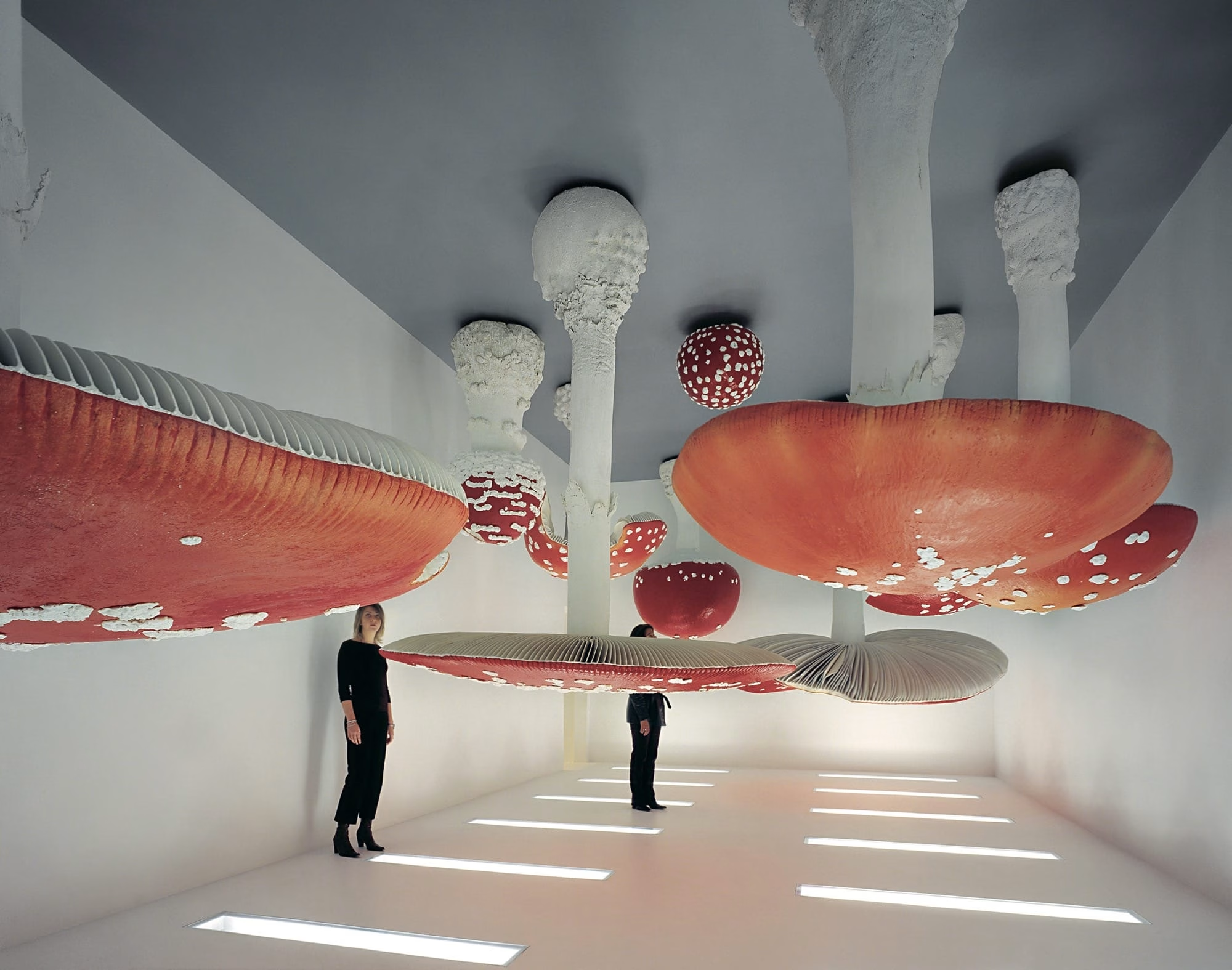
A vast, uncanny kingdom concealed within the damp, silent strata of the soil and the whispering shadows of the forest floor… Having previously surveyed the visual histories of butterflies, birds, deep oceans, and ancient trees, Phaidon’s editors now turn their lens toward nature’s most enigmatic protagonists: fungi. The publisher’s latest release, Fungi: The Mushroom World (published on 15 October 2026), gathers the aesthetic and creative traces of mycology across thousands of years into a single, comprehensive volume.
Assembling more than two hundred photographs, historical artefacts, and artworks spanning antiquity to the present day, the survey demonstrates that the mushroom is not merely a biological organism, but an enduring motif that continues to fertilize the human imagination. Navigating the book’s pages evokes nothing less than a surreal woodland walk: Carsten Höller’s monumental, red-capped mushroom installation—suspended inverted from the ceiling at Fondazione Prada—upends our sense of space, while Riitta Ikonen and Anni Koponen’s uncanny, costumed portraits staged deep in the woods dissolve the boundaries between the human and the wild.
From the delicate, scrupulous botanical studies produced in 1893 by Hilma af Klint—a pioneer of both abstraction and botanical illustration—to Chris Ritson’s time-defying ‘living’ paintings cultivated from viable fungal spores and sawdust, each work testifies to how artists have engaged with this microscopic wonder. Ranging from a mystical stone carving dating back to c. 400 BCE to FoldHaus Collective’s colossal electronic mushroom sculptures radiating an ethereal twilight glow, the book’s sweeping scope elevates nature’s subterranean curiosities into a rich visual feast.
An enthralling and richly textured release, this volume already stands as one of the most compelling additions to the archive of visual culture—essential reading for anyone drawn to the hidden aesthetics of the earth and the mesmerizing power of micro-universes.