


At the beginning of every year, at the turn of every generation, or in those glamorous special issues of culture magazines, we inevitably encounter famous lists. Titles like “100 Books You Must Read Before You Die,” “The 50 Most Important Novels of This Century,” or “10 Nobel Prize-Winning Masterpieces” instantly resonate in our minds. In the face of uncertainty and a massive bombardment of information, our mind always seeks a shortcut; book lists are one of the cleanest and most attractive forms of this shortcut. Delegating the decision-making burden of which book to choose to an authority gives us a sense of “already selected” and approved completeness. Moreover, these lists are a powerful tool for social recognition; being able to say “I’ve read the books on that list” signals belonging to a specific cultural community. However, right at this point, a critical question emerges: When do these lists serve as a guide, and when do they become a trap we fall into?
In fact, the reading journey often begins with an external recommendation, a sort of “mini-list.” The suggestion of a parent, teacher, or friend paves the way for someone still unfamiliar with reading culture to find that first and most appropriate book, thereby democratizing literature. Reference points like Nobel, Booker, or TIME selections also hold vital importance for the developing literary market and global circulation. On the other hand, lists like Harold Bloom’s 1994 The Western Canon both provide strong references to art history and actively shape that history itself. Readers often wonder whether these “great books” lists truly point to the greatest works. Partially, yes; however, at this point, the risk of the list turning into an imposition rather than a guide begins. Because the answer to the question of whether lists develop reading habits is two-sided: While they are wonderful as a starting point and discovery, the pressure to “finish the list” can instantly turn that pure joy of reading into a tedious chore that must be completed.
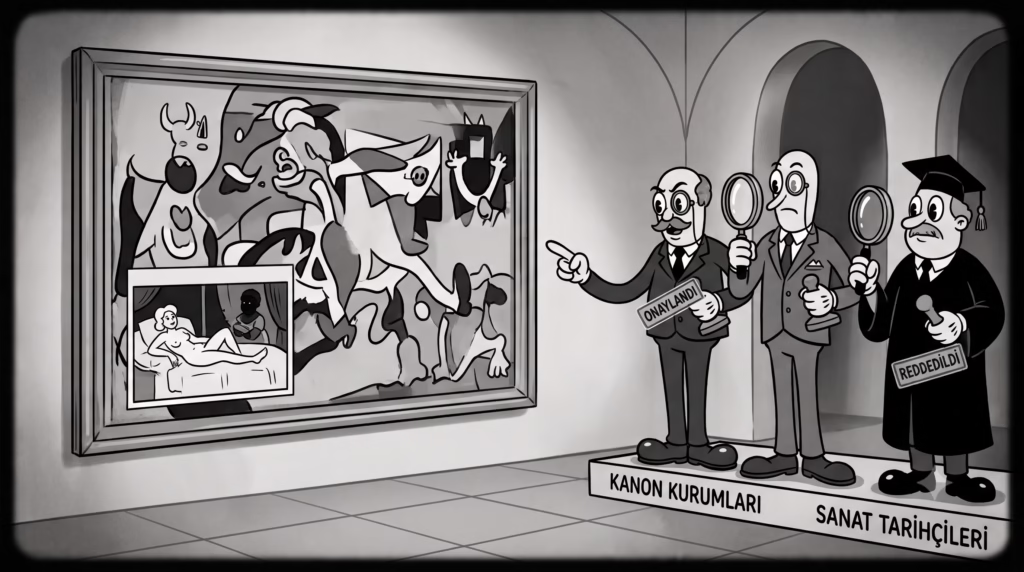
The power of a list is, paradoxically, its greatest limitation. There is no “universal” or completely “objective” list; every selection reflects the cultural position, ideology, and inevitable blind spots of its creator. Since the 1970s, feminist and postcolonial literary critics have systematically exposed precisely these biases. For example, those massive English-language literature lists prepared until the mid-20th century were almost entirely monopolized by Western, white, male authors. If we adapt Chimamanda Ngozi Adichie’s famous concept of “The Danger of a Single Story” to book lists, we must always question which voices make it onto that golden list and which are left outside. Moreover, the “list anxiety” created by these authorities further deepens the cultural taboo spoofed in Pierre Bayard’s work How to Talk About Books You Haven’t Read?—that is, the fear of confessing that you haven’t read something. So, what should we do instead of following an imposed book list? In fact, taking only the initial reading clue from a list and following that trail to discover our own literary taste is the healthiest and most liberating way.
Completely rejecting book lists is naive, while blindly obeying them is an intellectual restriction. Rather than viewing these lists as a definitive and insurmountable framework, evaluating them as clues to discover a few works suited to you is a much more fruitful approach. Looking at the source of the list—questioning who prepared that selection, in which year, and from what perspective—is also an essential part of this process. For the recommendations of a human rights foundation and the marketing list of a commercial publishing house whisper entirely different things. Ultimately, the best reading compass is not following someone else’s footsteps, but constructing your own reading list yourself. Step through the doorway of a list; if the first few books captivate you, stay on that route; but when the pages grow heavy and reading begins to turn into an ordeal, do not hesitate to veer off in another direction. Remember: you must not allow the list to read you or homogenize your tastes; you must read the list of your own free will.