

The Alchemy of Straying from the Right Path: “Errantry” by Felipe Baeza at Morena di Luna


Deviating from the accepted path, tracking in the dark, or spilling outside known boundaries… Can these actions, often perceived as failure or error, turn into the most powerful alchemy of transformation and discovery in the hands of an artistic mind?
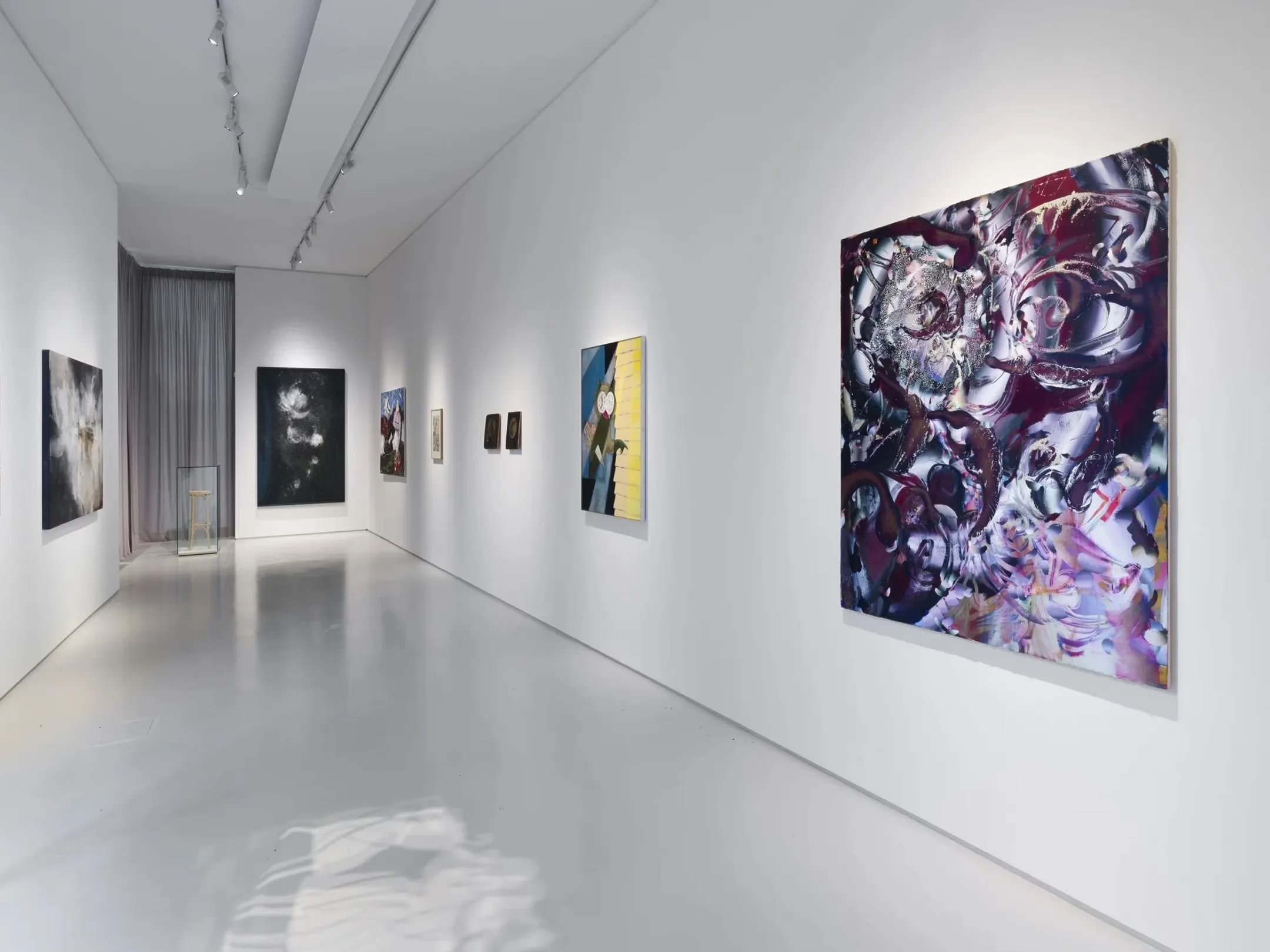
Mexican-born, New York-based artist Felipe Baeza focuses on precisely this question with his third solo exhibition, “Errantry,” under the umbrella of Maureen Paley. Meeting viewers between July 18 and September 6, 2026, at the Morena di Luna space in Hove, UK, the exhibition offers a captivating gateway into the artist’s mystical, queer, and material-focused layered universe.
A Diversity of Materials Beyond Boundaries
Baeza’s practice is shaped by a productive restlessness that refuses to remain static or trapped in a single medium. Bringing together materials such as ink, acrylic, cut paper, twine, varnish, watercolor, and silver leaf on canvas or panels, the artist conducts a meticulous material investigation that makes room for chance and experimentation.
As highlighted in the accompanying text written by Christopher Alessandrini, Errantry (straying/drifting) argues that moving away from traditional models is a spiritual and artistic necessity. In large-scale works such as Signals beneath the surface or elsewhere, still, eyes looking through layered surfaces and the artist’s signature cut-paper hand figures stand out. These compositions are enveloped by rich brown shields that give the viewer a sense of womb-like warmth or an unknown depth.
Caves, Cinema, and the Soul Growing in Darkness
Drawing inspiration from poet Frank O’Hara’s lines, “And what about the soul that grows in darkness, adorned with silvery images?”, the exhibition invites the viewer to the transformative power of darkness. Extending from the Naj Tunich caves—considered sacred spaces of fertility and the underworld in Maya cosmology—to present-day cinema halls, this narrative addresses how hidden desires, queer culture, and spaces free from social control nourish the human soul.
In today’s transparent world dominated by camera tracking, glass buildings, and constant surveillance, Baeza chooses to meet his audience in the shadows, on the threshold, and in the unseen.
The “Sonder” Series and Community Memory in the Vitrine
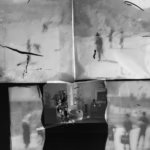
One of Baeza’s prominent works in the exhibition is the portrait series he titles “Sonder.” The artist presents faceless portraits in which he paints only the eyes of the visionary artists, writers, and activists who shaped his world. Alongside the work dedicated to queer icon and activist Agosto Machado, small-scale portraits of pioneering figures such as Sylvia Rivera and Marsha P. Johnson are also featured in this selection.
Additionally, a special vitrine arrangement consisting of ephemera and printed materials brought from Baeza’s studio is displayed in the gallery. Functioning as an “exhibition within an exhibition,” this vitrine brings personal memory into the public sphere by establishing a transhistorical bond of kinship and solidarity with figures like Agosto, Sylvia, and Marsha.