

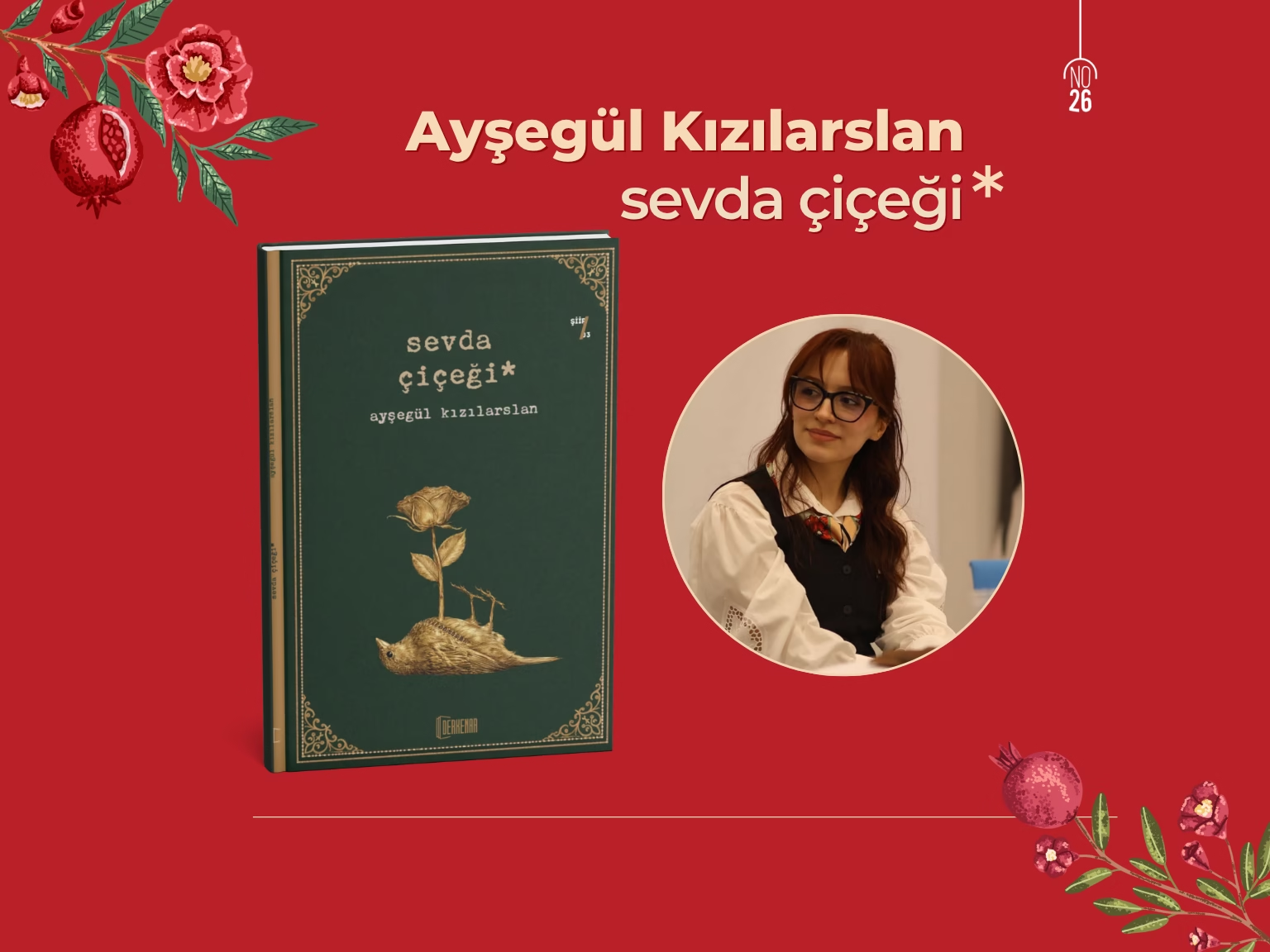
We talked with Ayşegül Kızılarslan—who has built a strong bond with literature lovers through the high-quality content she produces on literature and culture on social media, and who invites the reader to the battlefield of disproportionate loves where she is both victim and defeated—about her first poetry book, Sevda Çiçeği…
—Many people know you from social media, but let me ask for readers who will get to know you for the first time through your book: Who is Ayşegül Kızılarslan?
Ayşegül Kızılarslan is a 22-year-old girl studying journalism who loves living very much. I produce content on literature and culture on social media, read a lot, and write. I work as an editor at our own publishing house, Derkenar Yayınları, and at Hisdüşüm Magazine. Although these seem enough to describe me, it is not easy for a person to describe themselves in a few sentences. I think I am still living out the truest answer to the question “Who is Ayşegül?”.
—How long have you been writing poetry?
I’ve been writing for as long as I can remember. I didn’t “start” poetry; I was already always writing, and later I learned that what I wrote was poetry. As a child, I saw Nâzım Hikmet’s poem Tahir ile Zühre in my foster uncle’s black leather-bound notebook. I remember saying, “I want to read and write things like this too.” He told me, “You’re already writing.” Around that time, I was taking care of an injured cat. He said, “Look, you love it to heal it—that’s what poetry is.” That was the first day I understood that poetry isn’t just something written, but something lived. That’s why poetry isn’t a genre to me, but a way of looking at life.
—Looking back from the day you picked up the pen until today, has poetry made you stronger or more fragile?
Poetry taught me not to be ashamed of my fragility. A human being is whole through their fragile sides just as much as their strong sides. If I have been able to become someone who doesn’t hide themselves today, who isn’t afraid to love, and who embraces their emotions, poetry played a huge part in that.
—Which emotion feeds you the most when writing? Longing, anger, hope, love…
From love. From love’s heartbreak too, from its anger, and from its longing… To me, everything in life is a different state of love. Sometimes even hatred is born out of love. I think love suits poetry best. If a poet feeds on love, you can feel it even when they are writing about anger.
—How do you become convinced that a poem is complete?
I’m not someone who can sit down at a desk and say, “Now I will write a poem.” Sometimes on the subway, sometimes while walking, sometimes at a crowded dinner table, a line comes to my mind. What follows flows on its own. After writing, I don’t publish the poem right away; I let it rest. Days, sometimes months later, I read it again. I subtract, I add. Then a moment comes when I feel it: anything beyond this won’t expand the poem, it will only clutter it. That’s when I can entrust it to the reader.
—How did the journey of Sevda Çiçeği begin?
Actually, for many years I never thought of publishing a book. I couldn’t see such audacity in myself. As I started sharing what I wrote with people, I began hearing the question “When will we read these as a book?” more frequently. The same demand grew on social media. I kept proceeding by saying “Who am I to do that?”, but in the end, I prepared a manuscript. If it weren’t for the encouragement of my Editor-in-Chief, Enes, that manuscript would most likely still be sitting on my computer. The oldest poem in the book was written when I was 16, and the newest just a few weeks before printing. So this book is actually the trace of an eight-year journey.
—In your dedication, you say, “To everyone struggling to grow their own flower… and for my mother.” What is the story behind this?
I believe everyone has an invisible flower inside that they are trying to grow. When writing that dedication, I wanted everyone reading it to feel that their own flower was seen. As for my mother, she is one of the strongest, most compassionate people I have ever known in this life. No matter what life brought her, she never gave up on love. I learned both how to grow flowers and how to nurture hope from her. That’s why the biggest thanks in the book goes to her.
—When you first held your book in your hands, what did you say to the 13-year-old Ayşegül?
I couldn’t say anything. I just cried. But today, with every good development regarding my book, the same sentence goes through my mind: “Look, you’re succeeding.”
—Your book reached its third printing in a short time. Were you expecting it?
I wasn’t expecting it, but of course I was dreaming of it. Whenever news of a new printing comes, I experience the excitement of the first day all over again. There is a very special bond between my readers and me. Seeing the book accompany their coffee breaks, journeys, and moments of solitude is an indescribable happiness. What touches me most is hearing the sentence, “I felt that you understood me.” I don’t think there is a greater gift for a writer than that.
—What was it like to meet face-to-face with your readers?
It’s truly hard to describe. Sitting at the same table with people who read what you wrote and seeing the excitement in their eyes is so precious. Sometimes I think: years ago, the little Ayşegül who read books with a flashlight, trying to understand why poets wrote a line in a certain way, is today signing her own book. Even this thought alone is enough to make me smile.
—Hope and heartbreak exist simultaneously in your poems. How do these two emotions stand side by side in your world?
If a person loves deeply, they get a little heartbroken too. There’s no escaping it. As Şükrü Erbaş said: “What does a person who doesn’t see pain understand about happiness?” I think so too. Loving life only through its beautiful sides would be an incomplete way of loving. Both hope and heartbreak feed from the same place in me. My poems are just as I am.
—Is writing poetry a way of dressing wounds for you, or making them visible?
To heal, one must first see the wound. Poetry does exactly that. Today’s world advises us to appear strong; it wants us to hide our emotions and not show our wounds. Yet poetry says the exact opposite: “You are beautiful with your wound, too.” Writing first makes the wound visible, then dresses it together.
—Do you have plans for new books in the near future?
I do. This time I am working on a short story book, not poetry. I am still at the beginning of the road, but if I can gather my courage, I would love to meet readers through stories in 2027.