

Anatomy of the Root: Donald Locke’s “Resistant Forms” Retrospective at Camden Art Centre

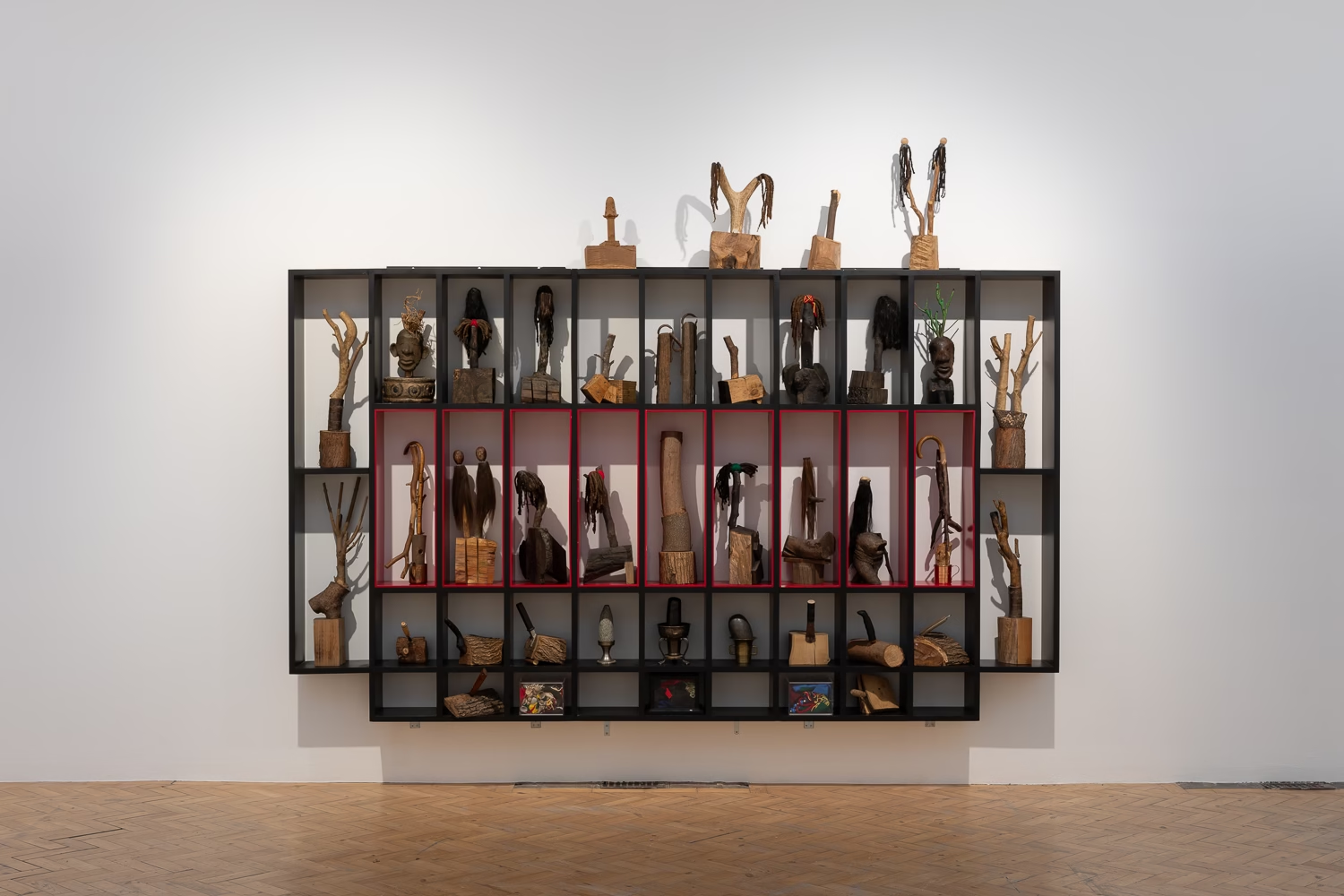
Sometimes you discover an artist only after they have passed away, and the weight of this discovery is different—you can no longer ask questions, you cannot get their confirmation, you are left alone only with what the works say. This is precisely the case for Donald Locke. Born in Guyana in 1930 and passing away in Atlanta in 2010, Locke was one of the most unique voices in 20th-century British sculpture; yet Britain refused to hear this voice enough. The exhibition “Resistant Forms” at the Camden Art Centre is the London leg of this overdue reckoning.
The exhibition covers five decades with more than 80 artworks. Locke grew up in Guyana, studied at the Bath Academy of Art and Edinburgh College of Art in the 1950s, and later shuttled between London and Georgetown before settling in America in the late 1970s. This geographical fragmentation also shaped his artistic language: ceramics, sculpture, painting, mixed media—a practice that was never imprisoned by any medium, yet returned to the same obsessive history in all of them.
His Plantation Series from the 1970s stands among his most shattering works. Translating the grid plan of Guyanese sugar plantations—built by Dutch colonizers and later taken over by the British—into the language of geometric abstraction, these paintings carry a minimalist serenity on the surface; yet sharp protrusions and iron bars burst forth from the canvas. Abstraction here is not an aesthetic preference, but the singular way to render historical violence visible.
The exhibition reaches its most comprehensive iteration as it travels to London from its previous stops at Spike Island in Bristol and the Ikon Gallery in Birmingham. The five decades and three institutions involved in its making indicate that this is not merely an exhibition, but a project of memorialization and repositioning. Let the title “Resistant Forms” not be misunderstood either—the “resistance” here is not merely political; it is simultaneously the definition of a body of work that resists specific art-historical narratives, a single identity, or a single interpretation.
Locke’s famous series “Trophies of Empire” (1972–74) from the Tate Britain collection—an artwork consisting of handmade ceramic “missiles” arranged inside a wooden display cabinet—is also represented in this exhibition. Using the format of a trophy to interrogate the trophies of imperialism, this work has lost none of its edge today, reminding us of how ironic and sharp an intervention it was even for that era.
This is London’s first comprehensive retrospective dedicated to Locke. A debt repayment that no one should miss.
- Closing Date: Until August 30, 2026
Exhibition Details:
- Venue: Camden Art Centre, Arkwright Rd, London, UK
- Artist: Donald Locke (1930–2010)
- Exhibition Title: Resistant Forms
- Closing Date: August 30, 2026