

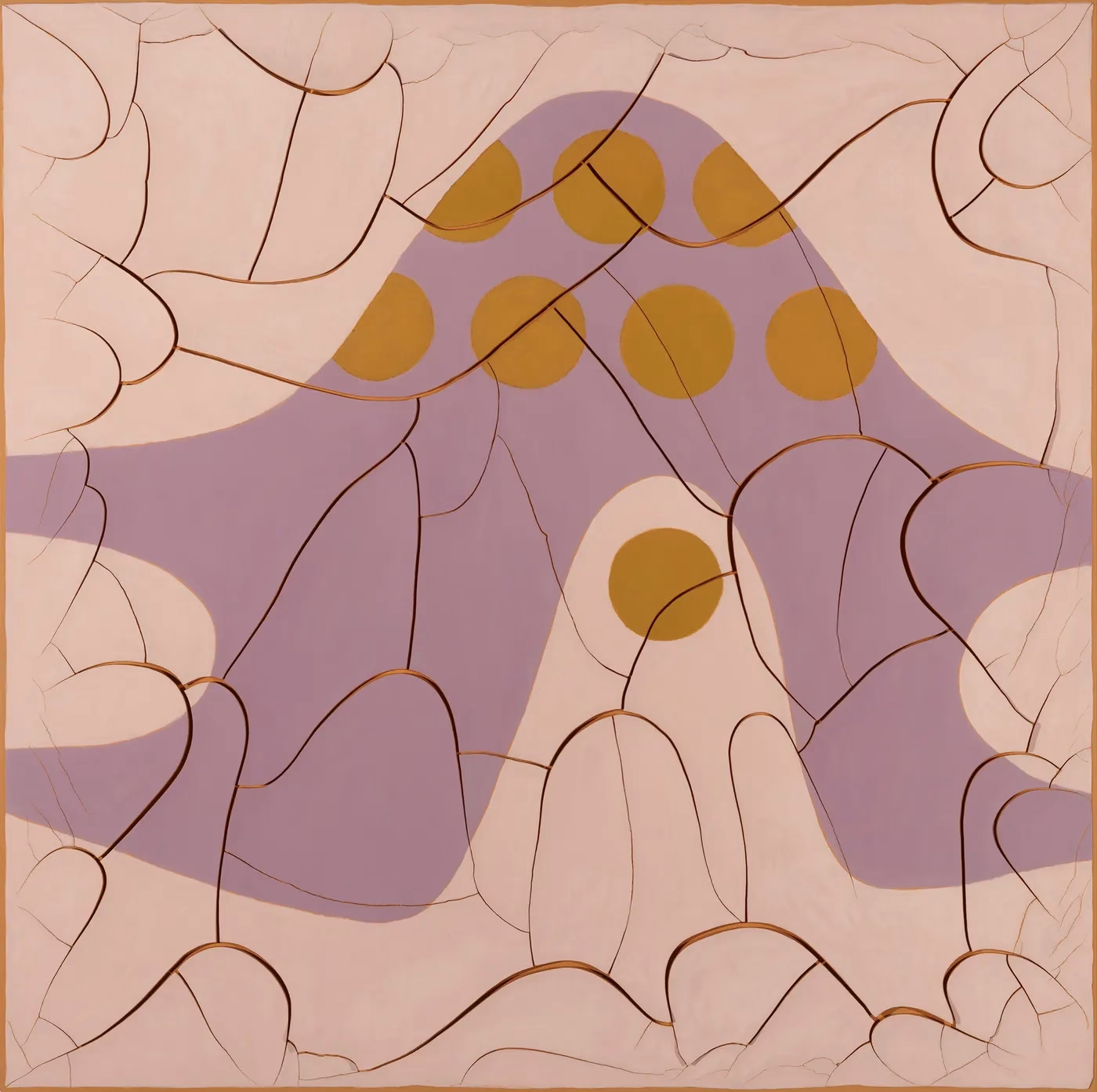
Stepping through the doors of Victoria Miro—leaving behind the water-reflected, centuries-worn historic fabric of Venice—you are abruptly transported to a concrete utopia illuminated by the Brazilian sun. Adriana Varejão’s new exhibition, Modernisms, draws the viewer directly into this cinematic contrast.
Currently capturing the art world’s gaze at the 61st Venice Biennale with her monumental, ceiling-suspended installation in the Brazilian Pavilion, Varejão shifts her camera angle at Victoria Miro. Moving away from the celebrated 18th- and 19th-century Baroque Portuguese tiles (azulejos) steeped in colonial history that have defined her output for over three decades, she turns her lens toward the growing pains and optimism of Brazil’s modernization.
From Symbols of Power to the Rhythm of the Street: The Transformation of Tiles
The cadence felt while moving through the gallery is, at its core, the story of a nation reinventing its visual identity. The ceramic patterns on Varejão’s new canvases no longer whisper authoritatively of power and permanence from church walls. Instead, they form a joyful, geometric, and anonymous chorus that once adorned apartment facades, swimming pools, lightwells, and the daily lives of ordinary people across 1940s, 50s, and 70s Brazil.
Brazilian modernism reclaimed the tile—once a symbol of colonial dominance—and forged it into a distinctly contemporary national vernacular. Championed by figures like Oscar Niemeyer, Lúcio Costa, and notably Athos Bulcão, tiles ceased to be mere nostalgic drapery applied onto buildings, establishing themselves at the very heart of architecture as an organic component of the street. Modernisms places this ubiquitous, everyday aesthetic—hiding in plain sight—under a grand magnifying glass.
A Two-Year Investigation and Personal Nostalgia
Beneath an exhibition as engaging to read as it is captivating to behold lies what is essentially a detective story. Varejão spent the last two years wandering the streets of Rio de Janeiro, São Paulo, Salvador, and Belo Horizonte, tracing twentieth-century tiles worn by time yet stubbornly resistant. Her process involved yellowed magazines, archival photographs, and an exhaustive street-by-street visual survey.
Yet this archaeological excavation holds a far more intimate, deeply felt dimension for the artist. “Much of my childhood was spent in Brasília, the symbol city of Brazilian modernism,” Varejão reflects. The works in this exhibition stem from the visual memory of a child who grew up playing amid Oscar Niemeyer’s fluid architecture. Geometric forms, repeating motifs, and vibrant colors filter through the artist’s consciousness to find new life on the walls of Victoria Miro.
More Than an Exhibition: A Salvage Operation
Modernisms is far from the dry, distant historical retrospectives we so often encounter. It functions as a salvage operation for Brazil’s urban memory and the visual imagination of its middle class. Varejão takes the invisible—that which has lost its recognized value through sheer ubiquity—and installs it front and center as an artistic object. In doing so, she builds a living, breathing, colorful bridge between past and present.
If you happen to be in Venice before 31 October 2026, Victoria Miro offers the perfect antidote to Biennale fatigue—a chance to go on a warm afternoon stroll through Brazil’s modernist streets. These ceramics, after all, have remarkably vibrant stories to tell.