

From the sixth century until the fall of 1453, Constantinople reigned as the undisputed artistic capital of the Orthodox Christian world. Spanning nearly nine centuries—from Justinian’s radical rebuilding campaign following the crisis of 532 to the final, radiant flourishes of the Palaiologan era—this survey examines the empire’s visual legacy through its surviving monuments, contemporary textual sources, and modern art-historical scholarship.
The central premise is clear: Byzantine art did not merely preserve the heritage of Late Antique Rome; it relentlessly reconfigured it, forging a singular visual idiom that radiated from imperial and patriarchal workshops across the Balkans, Kievan Rus’, Sicily, and Venice. Beset by the ideological rupture of Iconoclasm and the catastrophic sack of 1204, the city repeatedly demonstrated an extraordinary capacity for aesthetic renewal. Tracing this trajectory chronologically, we examine the Justinianic watershed and Hagia Sophia, contemporaneous sixth-century monuments, the Iconoclastic controversy, the Macedonian and Komnenian renaissances, the Latin Interregnum, the Palaiologan twilight, and the indelible imprint Byzantium left on the wider world.
Justinian and the Nika Riot of 532
The first golden age of Byzantine art rose directly from the ashes of urban catastrophe. In January 532, long-standing factional violence in the Hippodrome between the rival Blues and Greens (demoi) escalated into an unprecedented insurrection against Emperor Justinian I (r. 527–565). Uniting under the battle cry “Nika!” (“Victory!”), the rebels declared Hypatius rival emperor and laid siege to Justinian within the Great Palace. As the contemporary historian Procopius of Caesarea recounts, it was Empress Theodora’s unyielding resolve that dissuaded the emperor from flight. The revolt was ruthlessly extinguished when imperial forces under Belisarius and Mundus trapped and slaughtered an estimated 30,000 citizens within the Hippodrome.
The accompanying conflagration devastated the civic and imperial core. The original Great Church (Megale Ekklesia), dedicated in 360 by Constantine’s son Constantius II, had already burned in 404 during riots following the exile of Patriarch John Chrysostom; its replacement, erected in 415 under Theodosius II, was completely consumed by the flames of 532. The Senate House, the Baths of Zeuxippus, and the Chalke—the ceremonial bronze portal to the Great Palace—were likewise reduced to rubble.
Justinian swiftly seized this void as an ideological opportunity, turning infrastructural ruin into an unprecedented assertion of imperial sovereignty. The destruction of the Theodosian basilica cleared the canvas for an architectural undertaking designed to eclipse every sanctuary in the Mediterranean and Roman worlds. On 23 February 532, merely weeks after the suppression of the revolt, the foundations of the new Hagia Sophia were laid.
Our principal witness for this monumental campaign is Procopius’s Peri Ktismaton (De Aedificiis or Buildings), a panegyric composed in the late 550s and early 560s. Yet because Procopius penned a virulent denunciation of the same monarch in his clandestine Anekdota (Secret History), his laudatory accounts of Justinian’s architectural patronage must be read critically, through the discerning lens of imperial rhetoric.
Hagia Sophia: The Church of Holy Wisdom
Erected with astonishing velocity between 532 and 537, Hagia Sophia was consecrated on 27 December 537 in a lavish imperial liturgy presided over by Justinian. For nearly a millennium—until the completion of Seville Cathedral in 1520—it stood as the largest cathedral in Christendom, serving for over nine centuries as the seat of the Ecumenical Patriarchate and the ceremonial stage for imperial coronations.
The Designers: Anthemius and Isidore
Rather than commissioning conventional master masons, Justinian entrusted the daring project to Anthemius of Tralles and Isidore of Miletus. Tellingly, contemporary records refer to them not as mere architects (architektones), but as mekhanikoi—theoreticians immersed in geometry, higher mathematics, and physics. Procopius celebrated Anthemius as an intellectual prodigy far ahead of his peers, noting his command of geometric draftsmanship and logistical orchestration. Anthemius was already renowned for treatises on conic sections and burning mirrors, while Isidore was celebrated for his critical editions of Archimedes.
The Structural System
Hagia Sophia’s revolutionary stature in the canon of architecture stems from its seamless synthesis of a centralized dome with a three-aisled basilican longitudinal plan. The great dome rests upon spherical triangles, or pendentives, which mediate between a circular rim and a square infrastructural bay. The colossal deadweight of the vault is channeled down through these pendentives into four colossal masonry piers, creating the enduring optical sensation that the dome floats unanchored over the nave. Deep semi-domes along the east-west axis, flanked by tiered lateral exedrae, progressively expand the interior void, generating an expansive spatial volume unparalleled in classical antiquity. Today, deformed by centuries of seismic activity and structural consolidation, the dome spans an elliptical diameter of approximately 31 to 33 metres, soaring to an apex of 55.60 metres—narrower than the Roman Pantheon’s 43-metre vault, but vastly more daring in its vertical elevation.
Light and the “Suspended” Dome
A ring of forty arched windows piercing the dome’s base bathes the interior in light, visually dematerializing the masonry transition below. Procopius famously observed that the canopy seems not to rest on solid earth at all, but rather appears suspended by a golden chain directly from the heavens. To the contemporary Byzantine mind, this soaring dome was an earthly microcosm of the cosmos itself. The lower elevations were dressed in exquisite, book-matched marble revetments mined across the empire—from Proconnesus (Marmara Island), Thessaly, and Caria—their mirrored veins unfolding like organic tapestries. The original Justinianic decorative scheme remained deliberately aniconic: vast expanses of gold mosaic framing Latin crosses alongside geometric and stylized vegetal bands, traces of which survive intact across the upper galleries and narthex vaults.
The 558 Collapse and Reconstruction
Pushed to completion with breakneck speed, the original dome was compromised by successive earthquakes in 553 and 557 before suffering a catastrophic partial collapse in May 558. Chronicles by the historian Agathias indicate that this initial dome was considerably shallower in profile than the present structure. Isidore the Younger, nephew of the original engineer, was tasked with the redesign, raising the vault’s pitch to achieve greater lateral stability. The cathedral was rededicated on 24 December 562. During the subsequent epiphytic festivities of January 563, the imperial official Paul the Silentiary declaimed his celebrated verse Ekphrasis, a poetic catalogue detailing the marbles, acoustics, and radiant polycandela of the sanctuary. This poem, together with Procopius’s prose, provides our foundational visual record of the sixth-century interior.
The structure weathered subsequent structural failures following major tremors in 989 and 1346; the tenth-century restoration was entrusted to the celebrated Armenian royal architect Trdat. Yet despite these successive interventions, the monument standing today remains essentially the spatial masterwork conceived between 532 and 537.
Architectural Legacy
The ingenious spatial logic of Hagia Sophia—expanding a centralized dome through cascading semi-domes—re-emerged a millennium later to define classical Ottoman architecture, serving as the explicit template for Mimar Sinan’s imperial complexes and the seventeenth-century Sultan Ahmed Mosque.
Other Justinianic Monuments
Hagia Sophia was merely the crown jewel in a comprehensive restructuring of the capital’s sacred landscape. Contemporaneous foundations underscore how rigorously the imperial court experimented with centralized, vaulted sanctuaries.
An Aristocratic Rivalry: St. Polyeuktos and Little Hagia Sophia
Justinian’s architectural ambition was fueled in part by aristocratic rivalry. Between 524 and 527, Anicia Juliana, a scion of the late Roman imperial dynasty, erected the church of St. Polyeuktos at Saraçhane. Unearthed in the 1960s, its deeply undercut, Sasanian-influenced palmette capitals—now divided between the Istanbul Archaeology Museums and the Basilica of San Marco in Venice—attest to an astonishing standard of sculptural luxury. In A Temple for Byzantium (1989), excavator Martin Harrison argued that Juliana had engineered the building’s proportions to replicate the biblical Temple of Solomon.
Justinian’s commission of Saints Sergius and Bacchus between 527 and 536 is widely read as a counter-assertion of imperial supremacy. Legend claimed the emperor founded the shrine in gratitude after the two soldier-martyrs appeared in a vision to rescue him from capital charges, while the famous eighth-century myth of Justinian exclaiming “Solomon, I have surpassed thee!” at the dedication of Hagia Sophia reflects this same cultural competition.
Known colloquially as “Little Hagia Sophia,” the church is dedicated to Sergius and Bacchus, whose cult was anchored at Syrian Resafa. Its spatial core is an irregular octagon wrapped in a rectangular masonry perimeter, terminating in a projecting polygonal apse to the east. Within, piers alternate with pairs of colored marble columns supporting straight and curved exedrae, capped by an umbrella dome spanning 50 Byzantine feet—precisely half the diameter of Hagia Sophia’s central vault. Lacework Corinthian capitals bear an intricately carved epigraphic frieze that runs unbroken along the entablature. Art historians view this idiosyncratic gem as an immediate spatial precursor to Hagia Sophia, and its structural vocabulary almost certainly informed the roughly contemporaneous octagonal layout of San Vitale in Ravenna.
The Basilica Cistern (Yerebatan Sarnıcı)
Constructed beneath the monumental Stoa Basilica, which had been destroyed in the 532 uprising, this subterranean reservoir holds roughly 78,000 cubic metres of water. The vaulted ceiling is supported by a forest of 336 marble columns arranged in twelve rows of twenty-eight. The vast majority of these shafts and their weathered Corinthian and Composite capitals are spolia salvaged from classical pagan temples, accounting for the marked stylistic and petrographic discrepancies throughout the hall. The most striking manifestation of this pragmatic repurposing lies in the northwest corner: two colossal Gorgoneia (Medusa heads) serving as inverted and lateral column plinths. Serving the water needs of the Great Palace and the Patriarchate, the cistern slipped from collective memory following the Ottoman conquest until its rediscovery in 1545 by the French humanist Petrus Gyllius. It remains a striking monument to sixth-century civil engineering, where programmatic utility meets an improvised, monumental aesthetic.
Hagia Irene
Standing just north of Hagia Sophia within the imperial palace precinct, the Church of Holy Peace (Hagia Eirene) was the historic site of the Second Ecumenical Council in 381. Gutted in the 532 fires, it was rebuilt by Justinian as a domed basilica. Substantially restructured following the severe earthquake of 740, its apse retains a colossal, austere black-line cross mosaic on an unadorned gold ground—a rare, monumental survivor from the Iconoclastic era. Because the building was retained as an Ottoman military arsenal rather than converted into a mosque, its cavernous late-antique proportions remain exceptionally legible today.
The Church of the Holy Apostles (Apostoleion)
Originally founded as a mausoleum for Constantine the Great, the Holy Apostles was comprehensively rebuilt under Justinian and consecrated in 550 as a cruciform basilica surmounted by five separate domes. For centuries the resting place of Byzantine emperors, it fell into disrepair during the Latin occupation and was demolished following the Ottoman conquest to clear the site for the Fatih Mosque complex. Despite its physical erasure, its five-domed, Greek-cross footprint lived on, serving as the direct prototype for the eleventh-century design of the Basilica of San Marco in Venice.
The Great Palace Mosaics
Excavated beneath the Arasta Bazaar during the 1930s by the University of St Andrews and expanded in the 1950s, these sprawling peristyle floor mosaics have provoked substantial chronological debate, with proposed dates ranging from the fifth to the late seventh century. Rather than rendering sacred Christian iconographies, the pavements celebrate rustic pastimes, hunting scenes, mythological encounters, and pastoral vignettes. The mosaics reveal with astonishing vitality how the secular aristocratic culture of the imperial court nurtured the naturalistic traditions and dynamic foreshortenings of Greco-Roman antiquity deep into the Christian era.
Iconoclasm (c. 730–843)
The Iconoclastic controversy was a protracted political and ideological convulsion concerning the legitimacy and sanctity of religious imagery (eikones). Spanning more than a century, its significance for art history is twofold: it precipitated the widespread destruction of early Christian figurative monuments, while paradoxically forcing a rigorous theological defense that codified the formal rules, spatial hierarchies, and devotional functions of all subsequent Byzantine art. Our primary windows into the pre-Iconoclastic pictorial world remain the fragile sixth-century encaustic panels preserved at Saint Catherine’s Monastery at Mount Sinai, which survived untouched beyond the empire’s administrative reach.
The First Phase (c. 726/730–787)
Orthodox tradition attributes the outbreak of the crisis to Leo III (r. 717–741), who around 726 or 730 ordered the removal of the monumental icon of Christ displayed above the Chalke Gate of the imperial palace. This act inaugurated a systematic purge of sacred portraiture and the persecution of image-venerators (iconodules). Contemporary sources link Leo’s measures to the cataclysmic submarine volcanic eruption off Santorini in 726, an omen the emperor interpreted as divine displeasure with the adoration of painted panels.
Under his son, Constantine V (r. 741–775), anti-iconic policy crystallized into aggressive state ideology. At the Council of Hieria in 754, attended by more than 330 bishops, the emperor engineered the formal condemnation of icons as idols and secured the anathema of their defenders. Notably, these imperial polemics did not reject art itself: Constantine V famously excised depictions of the Ecumenical Councils from the Milion monument, replacing them with dynamic secular imagery of chariot races.
The Seventh Ecumenical Council (Nicaea, 787)
Following the death of Leo IV, the Empress Regent Irene convened the Seventh Ecumenical Council at Nicaea in 787, formally revoking the decrees of Hieria. Rooted in the theoretical writings of John of Damascus, the council articulated a vital semantic and theological distinction: the veneration (proskynesis) offered to an icon passes directly to the sacred prototype, and must never be conflated with the absolute adoration and worship (latreia) owed exclusively to God.
The Second Phase and the Triumph of Orthodoxy (815–843)
Leo V (r. 813–820) reinstituted the imperial ban on sacred portraiture in 815, reinstating the acts of Hieria. Spanning the reigns of Leo V, Michael II, and Theophilus, this second wave was pursued with noticeably less systemic violence than the purges of the eighth century, during which Abbot Theodore the Studite emerged as the foremost intellectual defender of sacred images.
With the death of Theophilus in 842, his widow, Empress Theodora, acting as regent for the infant Michael III, moved decisively alongside the court eunuch Theoktistos to appoint the iconophile Methodios as Patriarch. On the first Sunday of Great Lent in 843, the public restoration of icons was solemnized in Hagia Sophia, an event commemorated ever since across the Eastern Church as the “Triumph of Orthodoxy”—an iconic milestone immortalized in a celebrated late fourteenth-century panel now in the British Museum.
Visual Traces in Istanbul
The material footprint of Iconoclasm within the modern city is exceptionally sparse but revealing. The apse semidome of Hagia Irene retains its stepped, monochromatic cross set against an unyielding expanse of gold tesserae—the quintessential statement of iconoclastic visual austerity. Within the small sekreton (secretariat) of Hagia Sophia, the 1977 investigations of Robin Cormack and Ernest Hawkins identified structural lacunae where early figurative medallions had been chiseled away and substituted with plain cross motifs.
Historiographical Revision
Because nearly every surviving textual account was authored by the triumphant iconophiles, modern scholarship has radically re-evaluated the era. The landmark study by Leslie Brubaker and John Haldon (Byzantium in the Iconoclast Era, c. 680–850, Cambridge, 2011) demonstrated that many foundational narratives—including the initial Chalke Gate confrontation—were retroactively embellished or invented, and the physical destruction of art was markedly exaggerated. Contemporary historians favor a nuanced view: rather than an absolute annihilation of figurative culture, Iconoclasm functioned primarily as a contested administrative curtailment of public religious imagery.
The Macedonian Renaissance (867–1056)
The consolidation of power under Basil I (r. 867–886), founder of the Macedonian dynasty, inaugurated an era of profound cultural and artistic renewal. While the designation “renaissance” remains a subject of periodic academic debate, this period was characterized by a deliberate, humanistic revival of Hellenistic and Late Antique classicism that ran alongside the Ottonian revival in Western Europe.
The Hagia Sophia Apse: The Triumph of the Image
The definitive visual manifesto marking the close of Iconoclasm is the monumental mosaic of the Enthroned Virgin and Child in the apse semidome of Hagia Sophia. Dedicated on Holy Saturday, 29 March 867, by Patriarch Photios, the work is anchored by his famous Seventeenth Homily, which explicitly conceptualizes the enthroned Virgin as the material validation of the Incarnation and a visual trophy over heresy (see Cyril Mango, The Homilies of Photius and The Art of the Byzantine Empire 312–1453).
The composition is stunningly monumental: set against an unbroken golden field, the Theotokos sits on a jeweled throne cradling the Christ Child, who extends a hand in blessing. Her deep blue maphorion contrasts crisply with Christ’s luminescent, gold-threaded tunic. The theological articulation is absolute: because the divine Word became flesh, God can legitimately be portrayed. Stylistically, the subtle modeling of the faces and the cascading, organic folds of drapery celebrate a conscious return to the naturalism of classical antiquity.
Imperial Panels of Hagia Sophia
In the narthex, positioned directly over the central Imperial Door, a tenth-century mosaic depicts an emperor prostrating himself (proskynesis) at the feet of an enthroned Christ. While scholars continue to debate the imperial identity (Leo VI or Basil I), the most compelling interpretation views it as Leo VI (r. 886–912) performing acts of public penance in the wake of the political crisis provoked by his uncanonical fourth marriage.
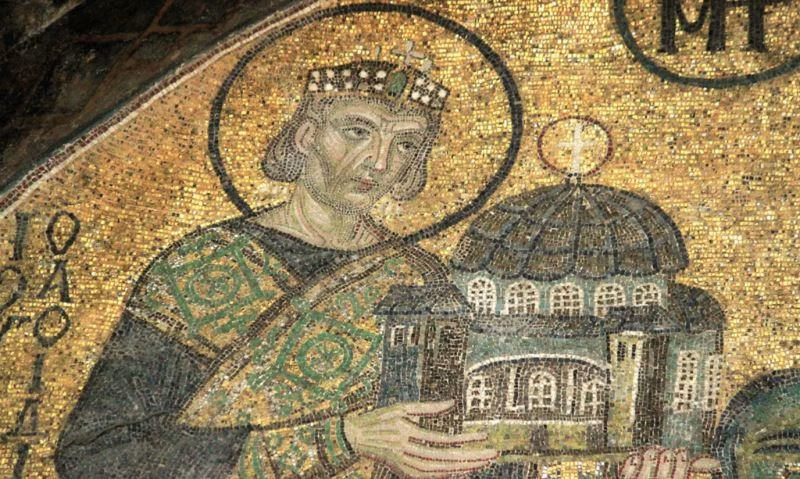
In the Southwest Vestibule, a late tenth-century lunette mosaic brings together the empire’s mythic past: Constantine the Great offers a model of the walled capital, while Justinian presents a domed model of Hagia Sophia to the Enthroned Mother and Child. The tableau is a consummate visual synthesis of statecraft and sacred devotion, placing the city’s civil and religious foundations under perpetual divine guardianship.
Manuscript Illumination and the Classical Repertoire
The sophisticated humanist ethos of the Macedonian court is nowhere more evident than in the Paris Psalter (BnF MS gr. 139), executed in the mid-tenth century. Its full-page miniature of King David composing psalms portrays him seated like an ancient pastoral poet, accompanied by an allegorical personification of Melody (Melodia) leaning on his shoulder and the personified landscape god of Mount Bethlehem reclining below. Similarly, the contemporary Joshua Roll (Vatican Library) adopts the continuous pictorial frieze tradition of classical triumphal monuments, such as Trajan’s Column, translating imperial narrative conventions onto parchment.
Ivory Carvings
With monumental stone sculpture largely abandoned across the medieval empire, the carving of luxurious ivory panels reached an unsurpassed pinnacle of refinement. Micro-carved triptychs intended for private aristocratic devotion, such as the Harbaville Triptych in the Louvre, present a pristine Deësis and ranks of saints rendered with exquisite classical proportion. Concurrently, secular caskets, such as the Veroli Casket in the Victoria and Albert Museum, are populated by putti, centaurs, and rape of Europa motifs, proving the uninterrupted currency of pagan mythological cycles among the Constantinopolitan elite.
Architectural Standardization: The Cross-in-Square
During this epoch, the “cross-in-square” (quincunx) emerged as the definitive template of middle Byzantine religious architecture. In the capital, this typological maturity is best exemplified by the northern church of the Lips Monastery (consecrated in 907; today part of the Fenari Isa Mosque). Within this compact architectural shell, decorative cycles crystallized into an immutable cosmic hierarchy: the formidable bust of Christ Pantokrator presiding over the central dome; the Virgin Mary enthroned in the apse semidome; and the canonical cycle of the Twelve Great Feasts (Dodekaorton) distributed systematically across the vaults and upper elevations—a program that would disseminate across the entire Orthodox Commonwealth, as evidenced at Hosios Loukas in Greece.
The Late Macedonian and Komnenian Eras, and the Cataclysm of 1204
The eleventh and twelfth centuries witnessed a shift toward aristocratic patronage, heightened linear elegance, and deep, psychological pathos in sacred representations. Around 1200, with a population hovering around half a million, Constantinople was the wealthiest and most populous metropolis in the Christian world—an accumulated inheritance that was violently plundered during the Fourth Crusade.
The Imperial Panels of the South Gallery
High in the south gallery of Hagia Sophia, two mosaic panels commemorate imperial patronage and financial gifts to the Great Church.
The earlier panel, dating to the late Macedonian era, shows Empress Zoe flanking an enthroned Christ alongside her third husband, Emperor Constantine IX Monomachos (r. 1042–1055), who holds a purse of gold coins (apokombion). Close physical analysis confirms that the panel was originally commissioned during Zoe’s first marriage to Romanos III Argyros (r. 1028–1034); following his death and her subsequent nuptials, the inscription and the heads of the emperor, Zoe, and even Christ were deliberately chiseled out and resurfaced. The mosaic offers an extraordinary demonstration of a public monument acting as a living, editable piece of political and dynastic documentation.
Nearby stands the Komnenian panel, completed between 1118 and 1122. It portrays John II Komnenos and his consort, Empress Irene, offering gifts to the Virgin and Child, with their ill-fated young son Alexios depicted on an adjacent pier. Irene’s pale features and braided red-blonde hair reflect her birth as the Hungarian princess Piroska, pointing to an unusual degree of naturalistic, individual portraiture within the conventions of middle Byzantine mosaic.
The Pantokrator Monastery (Zeyrek Mosque)
Founded by John II Komnenos and Empress Irene, the Pantokrator complex was an immense monastic foundation comprising three interconnected churches, an imperial hospital, and a dynastic mausoleum (heroon). The monastery’s surviving foundation charter (typikon) of 1136 provides an invaluable operational record of medieval Byzantine medical care. Today known as the Molla Zeyrek Mosque, the complex remains the largest standing Middle Byzantine ecclesiastical monument in the city, retaining fragments of its intricate opus sectile marble floor and early shards of figurative stained glass.
The Rise of Affective Pathos
Twelfth-century Byzantine painting is distinguished by a move toward emotional intensity and tragic human vulnerability. The supreme exemplar of this stylistic transition is the icon of the Virgin of Vladimir, executed in a high-caliber Constantinopolitan workshop around 1130 before being dispatched to Kyiv (today in the Tretyakov Gallery, Moscow). Rendering the Virgin pressing her cheek against her child with melancholic foreknowledge of his Passion, this Eleousa (Virgin of Tenderness) type profoundly reshaped the devotional and aesthetic sensibilities of Eastern European and Russian icon painting.
1204: The Fourth Crusade and the Great Dispersal
Originally proclaimed by Pope Innocent III to reclaim Jerusalem, the Fourth Crusade was diverted through a nexus of crippling Venetian debts, the controversial capture of Christian Zara (Zadar) in 1202, and the seductive political and financial overtures of the exiled prince Alexios Angelos. Art historians and medievalists continue to debate whether this diversion was the product of a deliberate Venetian conspiracy or, as Donald Queller and Thomas Madden contend, a disastrous “chain of accidental contingencies.”
Between 12 and 15 April 1204, Crusader and Venetian forces breached the sea walls, subjecting the imperial capital to three days of savage, systematic plunder. Eyewitness chronicler Niketas Choniates recorded the destruction with despair: the gem-encrusted silver and gold altar of Hagia Sophia was hacked to pieces, holy chalices were turned into drinking vessels, and pack animals were driven directly into the sanctuary to haul away looted ecclesiastical treasure. The imperial tombs within the Church of the Holy Apostles, including the porphyry sarcophagus of Justinian, were violated and stripped of their regalia.
For art history, the most devastating cultural loss was the systematic melting down of the monumental bronze statues that had adorned the public fora and the Hippodrome. Choniates left behind a sorrowful inventory of obliterated classical treasures, including a colossal Herakles attributed to Lysippos and monumental statues of Helen of Troy.
The Venetian Spoils
Venice claimed the most exceptional artistic spoils, which remain embedded in the fabric of the Basilica of San Marco:
-
The Horses of San Marco: The four gilded copper horses removed from the Hippodrome’s kathisma and mounted on the basilica’s western façade. Their origins—whether fourth-century BC Greek originals or second-century AD Roman imperial castings—remain contested. Looted by Napoleon in 1797 and returned in 1815, the weathered originals are today preserved in the basilica museum, replaced on the loggia by modern replicas.
-
The Portrait of the Four Tetrarchs: A fourth-century porphyry sculptural group carved in Egypt, violently detached from its setting at the Philadelphion and wedged into the southwest exterior corner of San Marco. In the 1960s, archaeological digs near the Bodrum Mosque (Myrelaion) in Istanbul uncovered the missing foot and plinth fragment of the group—now in the Istanbul Archaeology Museums—providing incontrovertible material proof of the sculpture’s provenance.
-
The Pilastri Acritani: Two intricately carved marble pillars installed adjacent to the south flank of the Venetian basilica. Long romanticized as trophies captured from Acre, 1960s excavations at Saraçhane definitively proved they were wrenched directly from Anicia Juliana’s sixth-century Church of St. Polyeuktos.
-
The Icon of the Madonna Nicopeia: The revered, enamel-framed palladium icon of the Virgin, historically carried into battle by the Byzantine emperors.
-
The Treasury and the Pala d’Oro: A dazzling collection of liturgical hardstone chalices, reliquaries, and hundreds of masterwork Byzantine émail cloisonné plaques incorporated directly into the high altarpiece of the basilica.
Countless sacred relics were scattered across the cathedrals of Western Europe. The Crown of Thorns, pawned by the destitute Latin Emperor Baldwin II to Venetian bankers in 1238, was purchased by King Louis IX of France, who erected the crowning masterpiece of High Gothic architecture, the Sainte-Chapelle (1242–1248), as an imperial reliquary to house it.
Throughout the Latin Empire (1204–1261), monumental patronage in the capital ground almost completely to a halt. One profound exception was unearthed during the 1960s inside the Kalenderhane Mosque: a fragmentary fresco cycle executed around 1250 illustrating the Life of Saint Francis of Assisi—the earliest known narrative cycle of the Franciscan founder anywhere in the world.
The Palaiologan Renaissance (1261–1453)
Reclaimed by Michael VIII Palaiologos in 1261, the restored empire faced profound territorial contraction and financial instability. Chroniclers describe the capital of 1261 as a desolate shell, its churches stripped and its urban fabric fractured. Yet against this bleak geopolitical horizon, the Palaiologan twilight ignited one of the most innovative and humanistic chapters in the history of Mediterranean art. Crucially, patronage shifted: the burden of monumental foundation was taken up not only by impoverished emperors, but by cultivated civil aristocrats and court humanists.
The Deësis Mosaic of Hagia Sophia
Commanding the south gallery of Hagia Sophia, the monumental Deësis panel depicts a towering Christ flanked by the Virgin Mary and John the Baptist interceding for the salvation of humanity. Widely dated to the immediate wake of the 1261 reconquest, the mosaic is celebrated as the zenith of Byzantine tessellated art. Though the lower register has been lost, the preserved faces exhibit an exquisite psychological delicacy and tonal modulation. The artists abandoned flat, linear conventions in favor of minute tesserae laid in painterly, fluid trajectories, inaugurating the naturalistic, humanistic sensibility of Palaiologan painting.
The Chora Monastery (Kariye)
Perched against the land walls at Edirnekapı, the Church of the Holy Saviour in Chora preserves the most cohesive and radiant ensemble of Late Byzantine narrative art in existence. The building itself is an architectural palimpsest: initially constructed between 1077 and 1081 by Maria Doukaina, rebuilt around 1120 by the sebastokrator Isaac Komnenos, and completely transformed in the early fourteenth century through the private patronage of Theodore Metochites. The name Chora (“in the Countryside” or “Fields”) originally designated its sixth-century topographic location outside the Constantinian walls. In Metochites’s sophisticated program, however, the word was elevated into a metaphysical pun: mosaics in the narthex designate Christ as the Chora ton Zonton (“Land of the Living”) and the Virgin as the Chora tou Achoretou (“Container of the Uncontainable”).
Theodore Metochites
Statesman, philosopher, poet, and court astronomer, Theodore Metochites (c. 1270–1332) served as megas logothetes (grand chancellor) under Andronikos II, rising to become the wealthiest and most influential intellectual of his day. He was the first non-imperial patron granted the imperial privilege of serving as ktetor (founder) of a monastery of this stature. Metochites substantially expanded the church, adding an inner and outer narthex and a lateral funerary chapel (parekklesion). While the renowned mosaics and frescoes have traditionally been dated to 1315–1321, recent archival research by Kyriakos Smyrlis pushes the inception of the program slightly earlier. Following the palace coup of Andronikos III in 1328, Metochites was stripped of his wealth and exiled, only to return two years later to his beloved monastery as the humble monk Theoleptos, dying there in 1332.
The Narrative Mosaic Program
Above the interior entrance to the nave, the donor mosaic depicts Metochites kneeling in formal humility before the enthroned Christ, offering a scale model of the rebuilt church while sporting the voluminous, striped skiadion cap indicative of his high bureaucratic rank. In the inner narthex, two fluted domes frame the genealogies of Christ and the Virgin. The surrounding walls unfold the Life of the Virgin based upon the apocryphal Protoevangelium of James, incorporating deeply human vignettes seldom rendered with such tenderness, such as The First Seven Steps of the Virgin.
The outer narthex is dedicated to the Infancy and Public Ministry of Christ. In the sprawling lunette illustrating the Census of Quirinius, the imperial tax collector is wittily depicted wearing a headdress virtually identical to Metochites’s own—a subtle self-referential pun on the founder’s day job as the empire’s supreme financial administrator. Within the nave itself, only three monumental icons survive: Christ Pantokrator, the Virgin Hodegetria, and, directly above the central portal, a serene Dormition of the Virgin (Koimesis).
The Parekklesion and the Anastasis
Flanking the nave to the south, the parekklesion was designed as a private mortuary chapel for Metochites and his circle. Here, the patron dispensed with expensive mosaic work in favor of fresco—a swift, cost-effective medium that betray his strained personal resources in later life.
The apse semidome is crowned by the Anastasis (The Harrowing of Hell), universally acknowledged as the supreme triumph of late Byzantine monumental painting. Clad in radiant white, Christ strides dynamically across the shattered gates of Hades, grasping Adam and Eve by their wrists and bodily hauling them from their stone sarcophagi—a direct, visual promise of physical resurrection addressed to the patrons entombed in the niches below. The dynamic, diagonal thrust of Christ’s billowing drapery, set beneath a monumental Last Judgment in the adjacent vault, demonstrates the dramatic emotional urgency reached by Palaiologan art.
Style and Workshop
Epigraphic analysis of the mosaic inscriptions indicates the hands of at least seven distinct master craftsmen, demonstrating the vitality of Constantinopolitan ateliers in the early fourteenth century. This same workshop simultaneously executed the mosaic program in the nearby Pammakaristos Church, as well as the Church of the Holy Apostles in Thessaloniki. The spatial depth, classical architectural backdrops, and lyrical humanism of the Chora masters have long invited comparison with contemporary Trecento innovations by Cimabue and Giotto in Italy. Rather than suggesting direct derivative influence, modern art historians view these contemporaneous developments as parallel, independent manifestations of a shared Late Antique and Byzantine inheritance.
Pammakaristos (Fethiye Mosque)
Perched above the Golden Horn in the Çarşamba district, the south mortuary chapel (parekklesion) of the Pammakaristos was erected around 1310 by Maria (Martha) Doukaina Glabas to commemorate her husband, the general Michael Glabas Tarchaneiotes. The central dome retains a masterwork mosaic of Christ Pantokrator surrounded by twelve standing Old Testament prophets, executing the same refined, calligraphic draftsmanship witnessed at Chora. The chapel operates today as an open-air museum, while the main church functions as an active mosque.
The Fall: 1453
The revered palladium of the capital, the ancient icon of the Virgin Hodegetria attributed to the hand of Saint Luke, had been moved to the Chora Monastery for safekeeping during the Ottoman siege of 1453. Chroniclers record that on the morning of 29 May 1453, early Ottoman contingents breached the Edirnekapı walls and descended upon the monastery, stripping the venerated icon of its repoussé silver plating and hacking the sacred wooden panel into pieces.
Global Impact: Byzantium and the Wider World
The workshops of Constantinople cultivated a sacred visual lingua franca that resonated far beyond the borders of the empire. This aesthetic influence flowed through three primary channels: the recruitment of imperial master craftsmen by foreign courts, the circulation of portable luxuries such as illuminated manuscripts and micro-mosaic panels, and the mass relocation of artistic spoils across the West after 1204.
Venice
The Basilica of San Marco remains the most explicit architectural and decorative monument to Byzantine influence in Western Europe. Begun in 1063 on a Greek-cross plan lifted directly from the Church of the Holy Apostles, its soaring brick domes, vast gilded expanses, and narrative revetments were initiated by master mosaicists invited from Constantinople. Following the 1204 Crusade, the systematic integration of looted spoils transformed San Marco into a magnificent, physical treasury of middle and late Byzantine imperial art.
Norman Sicily
Across twelfth-century Norman Sicily, Roger II and his successors deployed Byzantine visual idioms to legitimate their eclectic royal style. The mosaics of the Cappella Palatina in Palermo, alongside the monastic cathedrals of Cefalù and Monreale, were largely executed by Greek-speaking mosaicists dispatched from Constantinople. Consecrated by William II between 1180 and 1190—some forty years after Cefalù—the vast interior of Monreale translates the austere Byzantine iconographic program into a narrative cycle spanning hundreds of biblically densely packed figures. To cement domestic production, the Norman kings systematically abducted Byzantine silk weavers from Greece to establish royal textile ateliers in Palermo.
Kievan Rus’ and the Russian School
Following the official Christianization of Kievan Rus’ in 988, eleventh-century architects imported imperial craftsmen from Constantinople to build and decorate Saint Sophia Cathedral in Kyiv, adopting its dedicated dedication and hierarchical mosaic program wholesale. The twelfth-century arrival of the Virgin of Vladimir established the canonical gold standard for devotional art across the East Slavic lands. By the late fourteenth century, the Constantinopolitan master Theophanes the Greek had migrated to Novgorod and Moscow, executing profound, expressionistic frescoes that directly shaped the celebrated icon school of Andrei Rublev.
The Balkans
Commissioned in 1164 by the imperial Comnenian dynasty near Skopje, the Church of Saint Panteleimon at Nerezi contains a stunning fresco cycle painted by artists summoned from the capital. The celebrated Lamentation (Threnos), in which the Virgin collapses in agonizing grief across the corpse of her son, captures an emotional intensity that anticipates the affective devotions of the Palaiologan era and the Italian Trecento by more than a century.
The Early Italian Renaissance: Reassessing the Maniera Greca
Until Cimabue and Giotto fundamentally reoriented Tuscan painting in the late thirteenth century, the dominant aesthetic across Italy was the maniera greca (“the Greek manner”). Icon types, tempera techniques, and formal hierarchies entered the workshops of Pisa, Lucca, and Florence directly through Byzantine contact. Writing in his foundational Lives of the Artists (1550), Giorgio Vasari framed the birth of the Renaissance as an outright repudiation of this “crude, stiff Greek manner.”
Modern historiography has largely overturned Vasari’s partisan polemic. His aggressive insistence that Tuscan masters surpassed their Greek tutors is now understood as an inadvertent acknowledgment of how profoundly Byzantine art anchored Italian visual culture; Giotto’s dramatic spatial and psychological naturalism was directly preceded by developments at monuments like Nerezi. As art historian Anastasia Drandaki has observed, labels like maniera greca and “Italo-Byzantine” often obscure far more than they reveal. The near-exact chronological concurrency between the Chora mosaics and Giotto’s Arena (Scrovegni) Chapel in Padua (c. 1305) is no longer dismissed as mere coincidence, but celebrated as two parallel, autonomous modernizations rooted in a shared classical and medieval Mediterranean continuum.
The Post-Byzantine Cretan School
Following the final collapse of 1453, the traditions of Constantinopolitan painting survived under Venetian rule in the workshops of Candia (Heraklion) on Crete. The Cretan School manufactured thousands of hybrid, highly sophisticated panels for export across the Mediterranean and Western Europe. It was from within this rigorous guild environment that Domenikos Theotokopoulos—the master who would achieve international renown in Spain as El Greco—received his early training as a master icon painter.
Conservation, Historiography, and Present Status
For more than nine centuries, Constantinople stood as both the supreme engine and critical benchmark of Christian Orthodox visual culture. Four defining moments structure this legacy: Justinian’s Hagia Sophia, which resolved the central dome into the basilican plan to produce a spatial prototype unchallenged for a thousand years; the Iconoclastic crisis, which forced an intellectual clarification of the image that yielded the cosmic hierarchy of middle Byzantine decoration; the Macedonian and Komnenian dynasties, which balanced classical humanism with tragic spiritual pathos; and the Palaiologan renaissance at Chora, which demonstrated that even in structural decline, the imperial workshops operated at the cutting edge of Mediterranean artistic innovation.
Far from remaining locked within the city’s walls, this visual language served as the primary catalyst for sacred art in Venice, Norman Sicily, Kievan Rus’, the Balkans, and Tuscany. Vasari’s dismissive framing of the maniera greca has been dismantled by modern scholarship to reveal the foundational debt the European Renaissance owed to Byzantine masters.
Current Status and Conservation Realities
Today, the vast majority of Constantinople’s surviving Byzantine monuments function as active mosques, fundamentally framing both daily visitor access and contemporary conservation ethics:
-
Hagia Sophia: Converted into a mosque in 1453, designated a secular museum by the Turkish Council of Ministers in 1934, and reinstated as an active mosque in July 2020.
-
The Chora Monastery (Kariye): Converted into the Kariye Mosque around 1511 under Grand Vizier Hadım Ali Pasha, secularized as a museum in 1945, opened to the public following extensive conservation in 1958, formally redesignated as a mosque in 2020, and reopened for Muslim worship on 6 May 2024.
-
Hagia Irene: Utilized as an Ottoman military depot and imperial arsenal; today operates as a state museum and public concert hall, its interior unencumbered by modern devotional interventions.
-
Little Hagia Sophia (Saints Sergius and Bacchus): Converted into a mosque approximately fifty years after the conquest, a function it maintains today.
-
Pammakaristos (Fethiye Mosque): The main nave functions as an active mosque, while the southern funerary chapel is maintained as an open museum housing its original mosaics.
Historically, the Ottoman conversion of these sanctuaries entailed plastering or whitewashing rather than systematically chiseling away figurative mosaics and frescoes—an act of religious masking that paradoxically preserved the delicate surfaces for centuries beneath layers of lime. The monumental mosaics of Hagia Sophia were systematically uncovered and documented between 1847 and 1849 by the Swiss-Italian architects Gaspare and Giuseppe Fossati during a major structural consolidation commissioned by Sultan Abdülmecid. Beginning in 1948, the Byzantine Institute of America and Dumbarton Oaks undertook the forensic cleaning and scientific stabilization of the decoration within Chora and Hagia Sophia. Today at Kariye, visitors can observe the mosaics of the narthexes and the frescoes of the parekklesion, while the figurative imagery of the central naos is veiled behind motorized textile screens during prayer times.
Crucial academic questions remain contested: the precise structural elevation of Hagia Sophia’s original 537 dome, the exact motivations behind the recut portraits of the Zoe panel, and the identification of the individuals originally entombed within the arcosolia of the Chora chapel. Negotiating an ethical equilibrium between the living devotional demands of active worship, unfettered scientific access, and international conservation protocols will form the central challenge for the custody of these monuments in the decades ahead.