

On the Fragile Boundary Between Truth and Fiction: When Does an Author Write “Themself”?

In The Shards premiering on FX, Bret Easton Ellis wanders through the privileged and uncanny streets of 1981 Los Angeles as a 17-year-old character bearing his own name. In Apple TV+’s Dark Matter, physicist Jason confronts “another self” in a parallel universe.
One is pure autofiction, the other a high-concept sci-fi thriller… Two different genres, two distinct narrative forms; yet both revolve at the very center around the same existential question: To what extent can a human represent “their own self”?
Dual Contract: “This Is My Real Life, But It Is Also a Fiction”
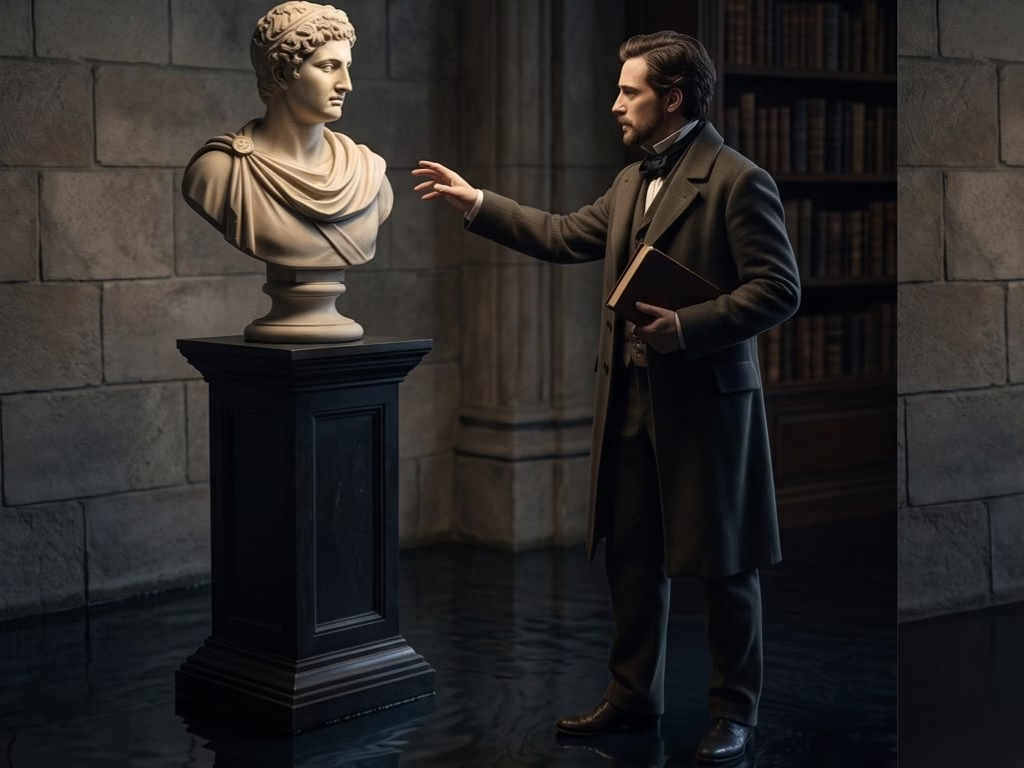
Autofiction signs two different contracts with the reader simultaneously: “These events are entirely from my real life” and “These events consist merely of a fiction.” This two-sided move places both the author and the reader on an uncanny and slippery slope.
French author and critic Serge Doubrovsky, while coining the term autofiction in 1977, defined it as “the reprocessing of strictly real events and facts through fiction.” However, this definition draws a boundary that is extremely difficult to maintain in practice.
That dominant “I” in the texts of masters like Annie Ernaux, Karl Ove Knausgård, or Maggie Nelson belongs both to the flesh-and-blood existence of the author and to the imaginary character space created by fiction. Consuming the text, the reader is left with that inevitable question: Did this really happen, or is it a trick of memory?
Why Did Autofiction Become the Most Popular Genre of Our Era?
The irresistible rise of autofiction in literature and television over the last two decades is no coincidence. Two main dynamics lie behind this shift:
-
Social Media and the Culture of “Self-Presentation”: In the Instagram era where people curate and display their own lives, the reader is already accustomed to the intertwining of reality and fiction. There is an organic continuity between today’s digital self-presentation and Ernaux’s autobiographical texts; both rely on the performance of the “self.”
-
Identity Politics and the Need for Representation: As questions like “Whose voice are we hearing?” and “Whose experience is accepted as universal?” took center stage, first-person narrative became both necessary and legitimate. Marginalized experiences needed the power of first-hand testimony as much as the flexibility of fiction to express themselves.
A Trick of Memory: The Unreliable “Self” of the Narrator
The most fascinating aspect of autofiction is simultaneously its most fragile point: Even if the author promises to write their own life verbatim, that “I” is, by nature, an unreliable narrator.
In Knausgård’s massive six-volume My Struggle (Min Kamp) series, although events are based on real people and documents, the subjective filter of consciousness bends, twists, and reconstructs everything. The temporal shifts in Annie Ernaux’s The Years (Les Années) construct the past through the adult eyes of today.
This unreliability is not a flaw of the text, but on the contrary, its very essence. That gap left between reality and fiction opens up a space where the reader can produce their own world of meaning.
Parallel Selves: From Dark Matter’s Speculative Mirror to Ellis’s 1981 LA
Blake Crouch’s novel Dark Matter and its series adaptation carry the existential questions asked by autofiction onto a speculative ground: The question “Who am I?” turns into a confrontation with “the other me,” who changed their choices in another universe and lived a completely different life.
In fact, every autobiographical novel is also a speculative parallel universe investigation: Unlived lives, unmade decisions, and persons not become are tested through the filter of fiction.
The character “Bret” in Bret Easton Ellis’s The Shards operates in the exact opposite direction: The reproduction of a lived high school period 40 years later through a fictional serial killer thriller. Real venues, real dates, and the author’s own name… Yet a memory transformed with that unlimited freedom offered by fiction.
Ethical Dilemma: The Right to Fictionalize Others’ Lives
Perhaps the most controversial dimension of autofiction is ethics. While writing your own life, you inevitably draw real people (family, lovers, friends) who are part of that life recognizably into the text.
When Ernaux placed her father at the center of the narrative in A Man’s Place (La Place) or when Knausgård’s family wanted to read the texts before My Struggle was published, this tension climbed to its peak. Does an author’s freedom to write their own life require the consent of other people in that life? This question is the most honest and difficult turn the genre still seeks to answer.
Frequently Asked Questions About Autofiction
What exactly is autofiction (autobiographical fiction)?
-
It is a literary genre in which the author reprocesses real people, places, and events from their own life using fictional techniques. Standing between biography and novel, it carries both the claim of reality and fiction simultaneously.
Who are the most important representatives of the genre in the literary world?
-
In addition to Serge Doubrovsky, who first used the term, Nobel laureate Annie Ernaux (The Years), Karl Ove Knausgård (My Struggle), Maggie Nelson (The Argonauts), and Bret Easton Ellis (The Shards) are the names who have given the strongest examples of the genre.
NO-26 Editor’s Attic Note
Aura: Intellectual, questioning, an analysis bringing together literature and screen culture.
Autofiction is a paradoxical space where the “self” is represented in the most unreliable manner, yet is demanded with the greatest appetite by the reader. That ambiguous middle distance between reality and fiction is the most fertile production ground where both author and audience search for their own truth. As Bret Easton Ellis returns to the dark Los Angeles of 1981 and writes himself as a character, Dark Matter’s Jason struggles with the same identity crisis in another universe. At the end of the day, the “self” is not a frozen truth, but merely a constantly rewritten fiction.