

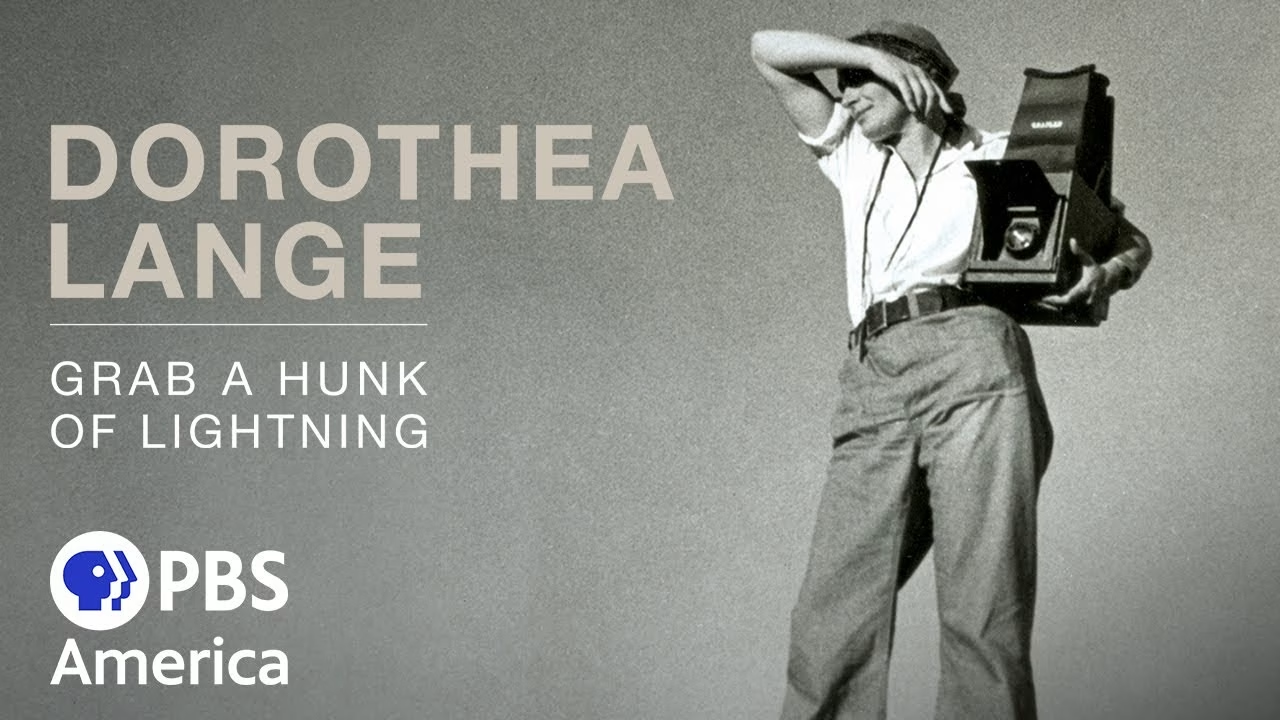
Mention the Great Depression—the defining economic collapse of the twentieth century—and the singular image that immediately surfaces in the public imagination is virtually universal: the worn, etched face of a woman flanked by children burying their heads against her shoulders, her gaze fixed resolutely on an uncertain horizon. Known to history as Migrant Mother, the photograph achieved such indelible ubiquity that the eye behind the frame was gradually eclipsed. Directed by Dyanna Taylor, the 2014 documentary Dorothea Lange: Grab a Hunk of Lightning trains its lens back onto the legendary photographer, filtering her narrative through the intimate prism of a granddaughter’s memory.
A Family Archive Through a Granddaughter’s Lens
Broadcast as part of PBS’s American Masters series, the film is helmed by Emmy-winning cinematographer Dyanna Taylor. Her lineage as Lange’s granddaughter lends the production an exceptional degree of intimacy. Taylor marshals family journals, personal correspondence, and previously unreleased audio reels; yet she deliberately keeps her directorial voice restrained, stepping back to let Lange and her work speak directly for themselves.
At the documentary’s spine lie the audio and film recordings captured by Phil Greene in the early 1960s with an aging Lange. Sifting through decades of negatives as she prepares for a landmark retrospective at the Museum of Modern Art (MoMA) in the twilight of her life, Lange undertakes an unsparing and remarkably candid reckoning with her past.
From Studio Comfort to the Open Dust
Rather than dropping Lange directly into the destitution of the Depression era, the film meticulously charts her formative trajectory: leaving New York as an adventurous young woman, arriving in San Francisco, and, after being robbed of her travel funds, opening a commercial portrait studio to survive. The comfortable bourgeois lifestyle she built in the 1920s by photographing the city’s elite shed its skin upon meeting her first husband, the painter Maynard Dixon. Spurred by Dixon to leave the cloistered studio behind and explore the vast skies of the American Southwest, Lange began testing and pushing beyond the boundaries of her own practice.
The documentary does not shy away from the acute friction between maternal duty and artistic drive. Those moments when she prioritized her career over her children are framed not as a rose-tinted tale of triumph, but as a deliberate choice carrying an exacting emotional toll. Her subsequent partnership with her second husband, agricultural economist Paul Schuster Taylor, injected vital sociological impetus into her imagery. Embarking on field expeditions together, Taylor interviewed displaced farmers while Lange documented the unfolding social devastation through her viewfinder. In one revealing vignette, Taylor engages a plantation manager in idle conversation while Lange quietly trains her camera on the uneasy Black sharecroppers standing just behind him—a moment emblematic of both the film’s incisiveness and Lange’s stealthy acumen.
Censored Negatives and Belated Reckoning
Refusing to linger solely in the shadow of Migrant Mother, the documentary also casts light on Lange’s commission to record the forced internment of Japanese Americans during the Second World War. Promptly impounded and suppressed for decades by the military command to conceal the reality from the public eye, these long-censored images demonstrate that Lange’s practice was never merely about aesthetic composition; she looked squarely, and without flinching, at the ugly truths of her era.
While its filial perspective occasionally verges on the protective, the film transcends the conventions of standard biography through astute expert insights and Lange’s own candid self-scrutiny regarding her methodology. Grab a Hunk of Lightning serves as an eloquent reminder of how sustained, compassionate attention can carry a subject’s voice across generations. When we encounter a photograph of human crisis today, it is worth pausing to consider the presence behind the viewfinder—and the quiet patience demanded to distill such weight into a single frame.