

Recall the parlor game popularized by the Surrealists in 1925: cadavre exquis, or the ‘exquisite corpse’. Folding a sheet of paper so that each participant sees only the faintest edge of what came before, the players take turns adding their own contribution; once unfolded, the composite image reveals a whole that is at once deeply uncanny and strangely organic. For artist and curator Loie Hollowell, this chance-driven yet intimately entangled mode of making serves as an overarching metaphor for how artists cross boundaries of time and geography to feed into one another’s practice.
Rooted in Hollowell’s abiding fascination with Austrian-American artist Kiki Kogelnik (1935–1997)—a defining figure of the postwar era—the project unfolds across the walls of Pace Berlin as a polyphonic conversation. Crystallized through discussions with peers Sascha Braunig and Veronika Pausova, whose respective practices share striking resonances with Kogelnik’s visual vernacular, Exquisite Corpse stages a vital cross-generational and transcontinental convergence of women artists.
A Body in Tension, Not at Rest
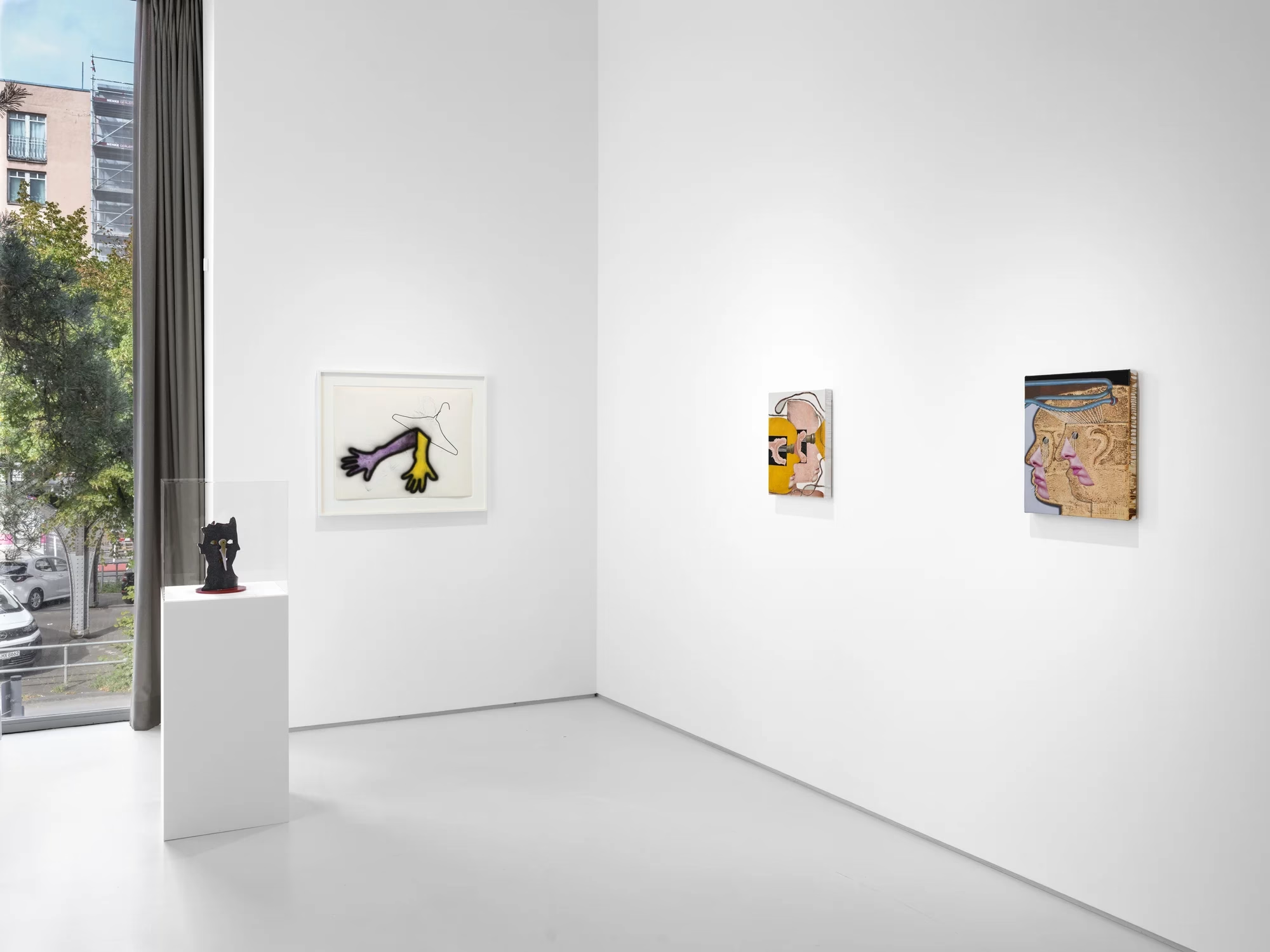
Bringing together painting, works on paper, and sculpture, the exhibition refuses to treat the body—most notably the female body—as a docile vessel. Instead, the corporeal form emerges as a site of friction: stretched, flattened, dismembered, and reconfigured in lockstep with technology. Saturated palettes and hyper-deliberate brushwork reimagine anatomy as an operative machine or a modular system.
Encountered through a cinematic lens, each artist’s contribution to this collective game constructs its own distinct micro-universe:
Sascha Braunig’s Uncanny Vice: Across Braunig’s canvases, the female form is pushed to its breaking point within lurid, unsettling environments. Figures cinched at the waist to the point of snapping, their limbs ensnared and obstructed, stage a biting parody of the stifling codes of gender performativity. Womanhood’s relentless labor of accommodation and conformity confronts the viewer with a surreal, disquieting magnetism.
Loie Hollowell and Rhythmic Geographies: In Hollowell’s own contributions, the body adopts the topography of an abstract landform. Having initially built a practice around meditative explorations of intimacy, sleep, and bodily fluids, the artist has progressively submerged this figurative vocabulary within rigorous geometry. Through an incandescent palette and outward-rippling silhouettes, Hollowell pulses sexuality into the gallery space like a rhythmic heartbeat.
Kiki Kogelnik’s Pop Cyborgs: Approaching Kogelnik—the quartet’s presiding lodestar—one meets graphic, flattened planes that seem plucked straight from 1960s New York. Moving in the same cultural slipstream as Andy Warhol and Roy Lichtenstein, Kogelnik injected a distinctly Pop coolness into the human silhouette. Her flattened geometries, bathed in vibrant color, read like dispatches from a retro-futuristic terrain.
Veronika Pausova’s Theatrical Microcosm: Stepping into Pausova’s territory, the mise-en-scène takes a sharp turn toward the eccentric. Varnished fruit flies, severed fingers, drooping blooms, and disembodied legs galloping through negative space populate the compositions. A photorealistic hand collides with the wet, porous imprints left by household sponges, as Pausova stitches absurdity and narrative together with dry, humorous precision.
Binding the abrasions carved into the body by time, labor, and technological advancement through the mechanics of a Surrealist exercise, Exquisite Corpse commands the industrial architecture of Die Tankstelle (Pace Berlin). This singular intergenerational dialogue runs from 10 September through 11 November 2026.