

Soft Inside the Ruin: Harriet Mena Hill Inscribes Domestic Memory onto Shards of Concrete

As the colossal Brutalist masses reaching into South East London’s grey skies are dismantled one by one, what remains is not merely rubble and dust; decades of accrued neighbourliness, potted plants lining windowsills, and echoes through walkways and alleys are slowly erased alongside them. Artist Harriet Mena Hill stands squarely along this frontline of demolition. As the Aylesbury Estate—one of the UK’s most contested social housing schemes—is razed to the ground, Hill gathers splinters of concrete from the wreckage, reweaving what is cold, rigid, and mechanical through thread, paint, and the warmth of memory.
Life Behind the Grey Monoliths
Erected across the 1960s and ’70s and sheltering over 11,000 residents at its height, the Aylesbury Estate was a sprawling complex of concrete slabs long stigmatised by the media and urban authorities as a hub of crime and decay. When the local council resolved in 2005 to demolish and redevelop the neighbourhood in phases rather than refurbish its existing structures, the personal histories of thousands were abandoned to the mercy of the excavators.
Having lived in South East London for over three decades, Harriet Mena Hill was no stranger to these streets. Yet a workshop conducted with local youth in 2018 shifted her relationship with the estate onto an entirely different plane. Hill initially produced the series Soft Concrete, blending and felting wool fibres to reconstruct cold stone, steel, and spray-painted surfaces through the tactile warmth of textiles. Viewed from a distance, these works read as hyperrealist paintings or photographs; drawn close, they whisper intimate vignettes of domestic life sheltered amidst handcrafted wool fibres.
From Stone to Canvas: The Debris of Memory
In 2020, as pandemic lockdowns confined everyone to their homes, the excavators on the Aylesbury never stopped. Faced with the claustrophobic helplessness of residents watching neighbouring blocks collapse from their windows, Hill began collecting fragments of concrete that filtered out from the demolition site.
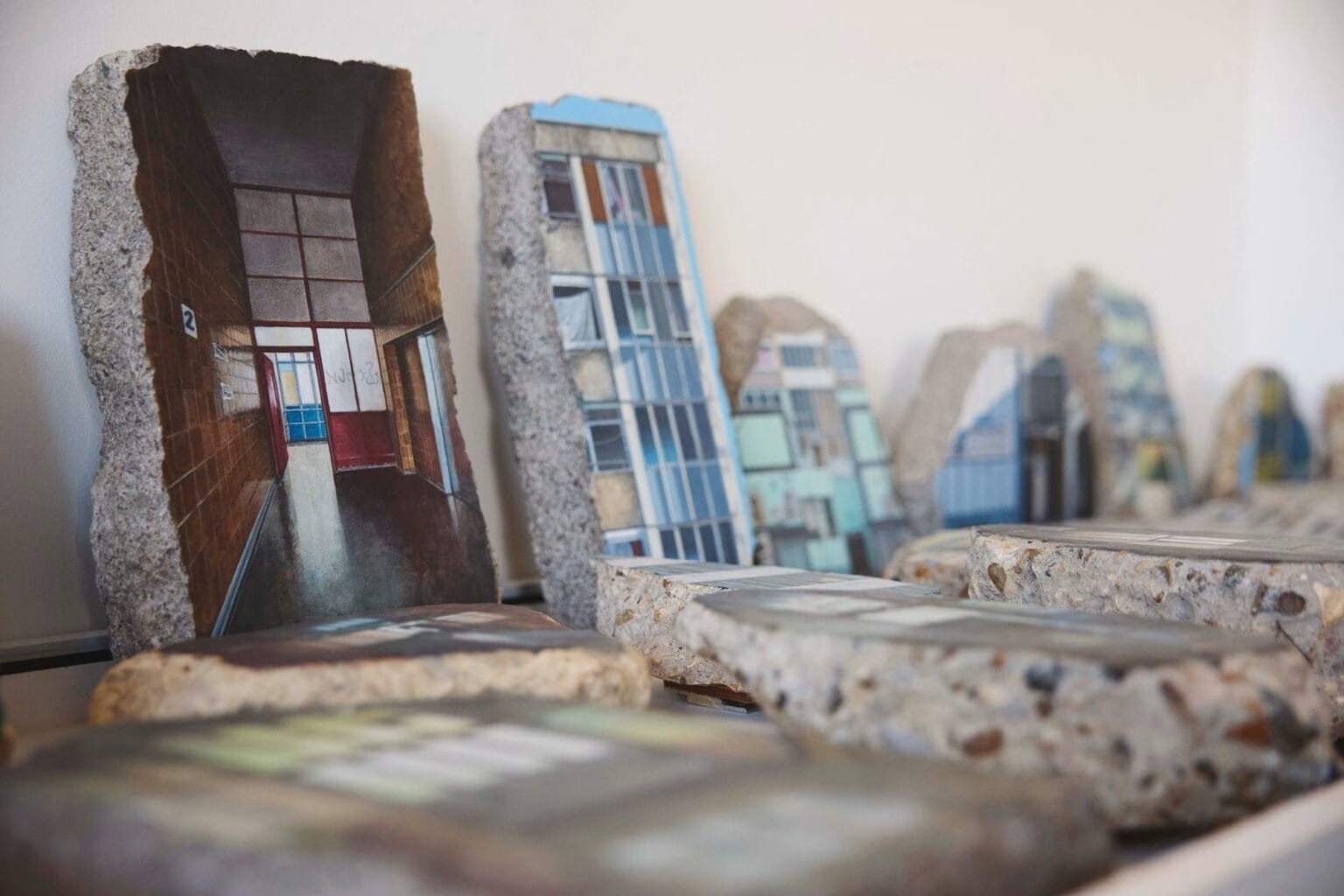
Out of this emerged The Aylesbury Fragments. Embracing the irregular edges of coarse concrete salvaged from the rubble as organic frames, the artist painted abandoned corridors, the glow of light behind curtains, cables swaying in the wind, and rainwater puddles across their surfaces. Each stone torn from the felled architecture was transfigured into a dislocated, microscopic cross-section of lived existence.
Living with Stone
Before ever taking up a brush, Hill lives alongside each fragment of concrete in her studio for months, sometimes even years. She does not apply a single stroke until she has fully absorbed the stone’s particular contours, fissures, and physical posture. While the area’s regeneration process stumbles fitfully along, the artist has to date imbued more than 150 pieces of concrete with memory.
To inscribe the presence of a community erased from the map back onto the very wreckage left in its wake—Harriet Mena Hill’s practice stands as a quiet, fragile, yet acutely determined artistic testimony against the unfeeling mechanics of the bulldozer. This petrified memory will continue to meet audiences in exhibitions across London and the UK throughout 2027.