

When we talk about Austrian art, Klimt comes immediately to mind. Egon Schiele, Kokoschka. But in the early 19th century, at the precise moment when the British Pre-Raphaelites were binding themselves so intensely to light and nature, an artist in Vienna was asking a similar question in a different language: Ferdinand Georg Waldmüller. His name had scarcely been heard in Britain until the National Gallery devoted its summer to him.
From the Prater to Sicily: The Anatomy of a Landscape Practice
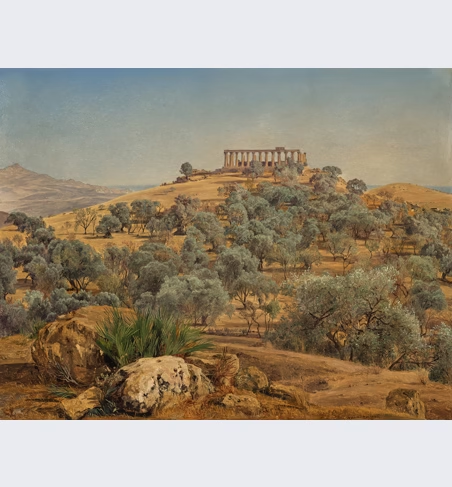
The exhibition is thematic rather than chronological. Waldmüller’s landscape practice is arranged around three main axes: his tree studies in Vienna’s Prater park, the scenes of lakes, mountains, and forests in the Alpine region of Salzkammergut near Salzburg, and the paintings made during his Sicilian visits capturing the island’s light and its ancient ruins.
Three different geographies and seasons, but a single unifying characteristic in Waldmüller: what critics have described as photographic clarity. Every element within a scene receives equal attention — the leaf of a bush and the silhouette of a mountain are rendered with the same depth of focus. This quality connects him both to the Austrian Biedermeier tradition of his period and, in parallel, to the British Pre-Raphaelites — though he was working in neither’s direct influence, but along a similar line of development.
The exhibition was produced in collaboration with Vienna’s Belvedere Museum, with the majority of the nearly fifty works coming from the Belvedere’s collection. Waldmüller has no presence in the National Gallery’s permanent collection; this exhibition closes that gap with the most substantial single introduction to his work Britain has ever seen.
What Makes Waldmüller Distinctive?
Born in Vienna in 1793 and dying there in 1865, Waldmüller came to painting late and by a circuitous route — first painting theatrical scenery, then working in a porcelain factory. He entered the Vienna Academy of Fine Arts late and quickly became both student and teacher.
But what makes him most interesting is something else: Waldmüller was an active critic of the academic conventions of his time. He argued that students should work directly from nature rather than copying plaster casts — a position regarded as scandalous in his era. He published his views, clashed with the authorities, was dismissed from his post, and eventually reinstated. When his naturalism is read against this backdrop — as both technical conviction and ideological position — it becomes considerably richer.
Early Connections with British Collectors
Waldmüller had some profile among British collectors during his lifetime; several works entered private British collections in the 19th century. But a museum-level systematic presentation had never been mounted in Britain. The National Gallery emphasises this as a first, and the exhibition’s approximately fifty works gathered together offer something that scattered individual encounters cannot: the opportunity to read Waldmüller’s practice as a whole.
Why Now?
The question of Waldmüller also carries a subsidiary question about art history: which European artists never entered the permanent collections of British museums, and why? That question reveals both cultural hierarchies and the selective mechanisms between national narratives. The National Gallery may not ask this question openly, but the fact that Waldmüller is being presented in this context for the first time already contains an answer.
FAQ: Waldmüller: Landscapes at the National Gallery
- When, where and is entry free?
*Waldmüller: Landscapes* runs from 2 July to 20 September 2026 at the National Gallery, Trafalgar Square, London WC2N 5DN. Free of charge.
- Who was Ferdinand Georg Waldmüller?
One of the most significant figures in 19th-century Austrian art, born 1793, died 1865. His practice, focused on naturalism and landscape painting, shaped the Austrian Biedermeier tradition of his period. His advocacy of direct observation over academic copying put him in conflict with the authorities and established him as both artist and pedagogue.
- How many works are in the exhibition and where do they come from?
Approximately 50 works. The majority come from the collection of Austria’s Belvedere Museum. The exhibition was produced in collaboration between the National Gallery and the Belvedere.
NO-26 Note
This exhibition is not simply a retrospective of a single artist; it is a reminder that European modernism is a more nuanced and polyphonic picture than the canonical version. Seeing Waldmüller before the Pre-Raphaelites in historical sequence allows you to notice how a Viennese voice was already resonating with similar questions before the British movement gave them its own name.