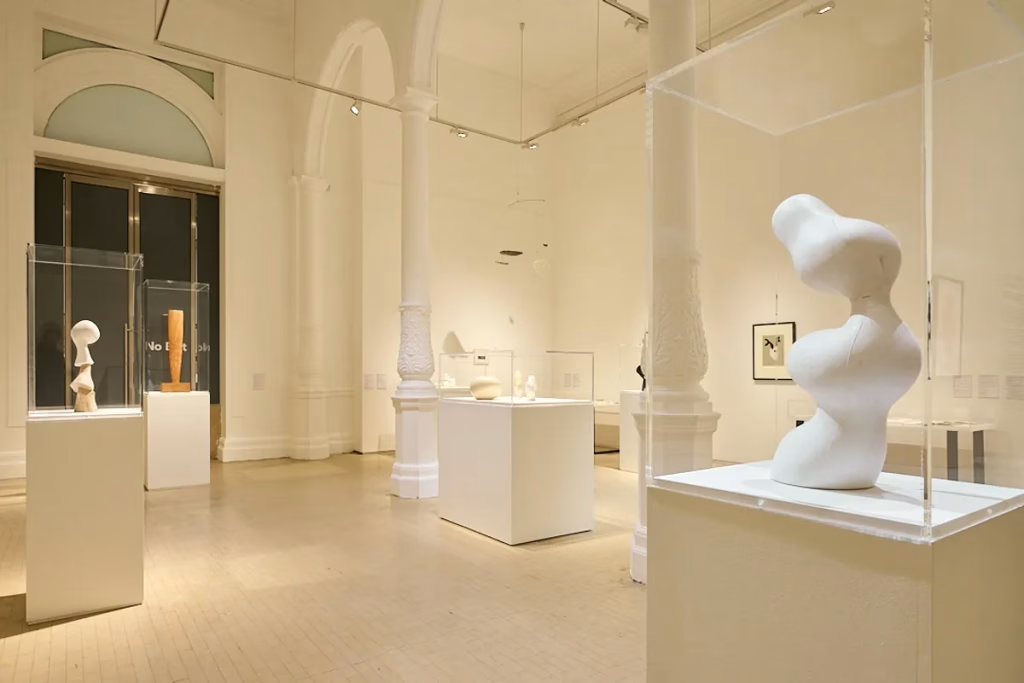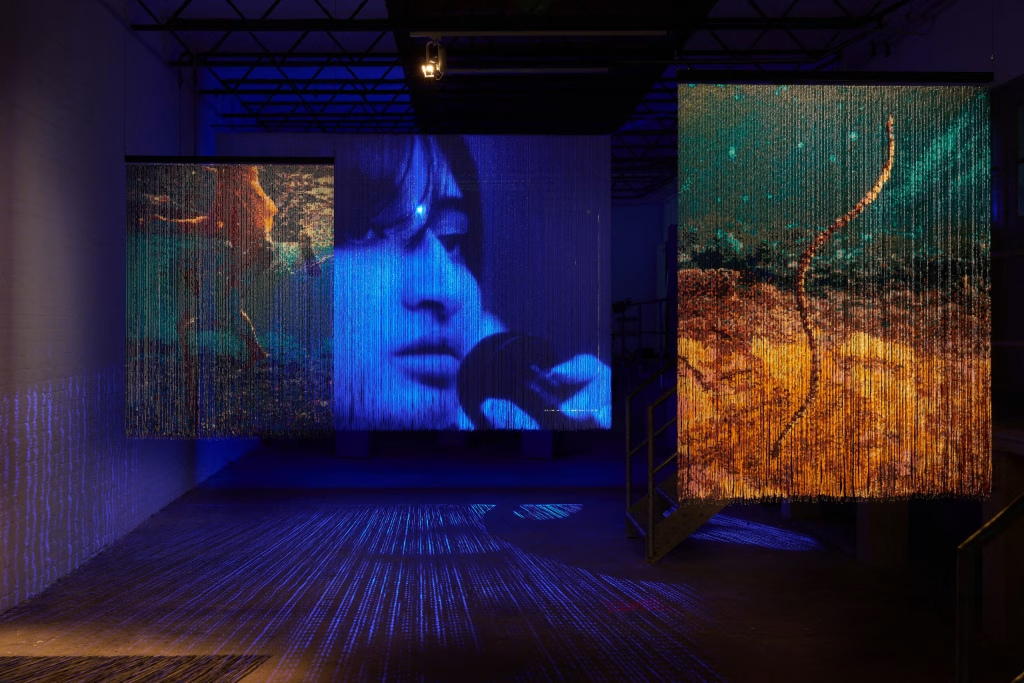


In the late 19th century in Paris, the Les Nabis movement radically transformed art, representing one of modern painting’s most exciting turning points with an aesthetic radicalism that pushed beyond the boundaries of the canvas. The Waddington Custot gallery in London brings this historical legacy together with contemporary production in its exhibition titled “The Nabi Shock,” running from June 24 to September 12, 2026. Displaying over 20 historic works from the Nabi group’s extraordinarily fertile period between 1888 and 1900, the gallery juxtaposes these pieces with new creations by seven contemporary artists, laying bare the vibrant echoes of Nabi aesthetics in today’s painting.
In a brief span of just 12 years, the Nabis redefined the possibilities of painting. Embracing the famous declaration of Maurice Denis, one of the group’s leading theorists—“Remember that a picture, before being a battle horse, a nude, or an anecdote of some sort, is essentially a flat surface covered with colors assembled in a certain order”—these artists initiated an artistic renaissance. Unmodulated flat areas of color, distinct outlines, and textured surfaces seen in works such as Pierre Bonnard’s Étude pour ‘Le Corsage à carreaux’ (1892) and Édouard Vuillard’s La Chambre verte, rue Truffaut (c.1900–01) form the characteristic rhythm and aesthetic shock of Nabi painting.
Intimate Interiors on the Trail of the Subconscious
Beneath the Nabis’ formal pursuits lay the deep influence of early theories of the subconscious being developed by Sigmund Freud. Aiming to convey the experience of being enveloped by the world rather than imitating reality as it is, the group succeeded in capturing viewers on an emotional level through a rich color palette and the tactile quality of their brushstrokes. Owing to this interest in inner life, Nabi subject matter was typically drawn from the most intimate and personal surroundings: wives, mothers, sisters, or secluded gardens… As seen in Ker-Xavier Roussel’s Femmes au jardin and Vuillard’s Femme lisant, figures mostly appear within quiet interiors or hidden gardens.
The Nabis’ interests were not confined strictly to canvas. They produced work across a wide array of mediums, ranging from theatre sets and posters to stained glass designs and textiles. Featured in the exhibition, Maurice Denis’s magnificent stained glass design Le Cheval blanc (1894), Bonnard’s illustrations for sheet music covers, and Paul Ranson’s Le Grand Tigre (1893)—a work inspired by Japanese prints that bridges paper and carpets—stand out as compelling evidence of this interdisciplinary vision.
An Aesthetic Bridge From Past to Present
As the rigid formalist tendencies of the late 20th century gave way to a poetic exploration of lived experience, contemporary artists are once again addressing the world with imaginative sensitivity. The contemporary artists included in Waddington Custot’s curation—Marcel.la Barceló, Ben Arpéa, Ian Davenport, Marcel Dzama, François Réau, Anne Rothenstein, and Fabienne Verdier—reinterpret the Nabi spirit through today’s visual lexicon.
While Barceló’s sinuous lines and Dzama’s watercolor surfaces evoke Denis’s Japanese print-inspired designs, Davenport’s explorations into color relationships nod to Charles Filiger’s chromatic studies. Arpéa and Rothenstein’s landscapes recall Félix Vallotton’s night and sunset scenes, whereas Réau and Verdier carry Vuillard’s unending dialogue between inner experience and external reality into the present day. “The Nabi Shock” brings together a historic movement that boldly transformed modern painting on the same stage with a new generation of visionaries keeping that spirit alive.
Exhibition Note from NO-26 Editor
Exhibition: The Nabi Shock
Venue: Waddington Custot (11 Cork Street, London)
Dates: June 24 – September 12, 2026 (Open to Visitors / Ongoing)
Historic Nabi Artists: Émile Bernard, Pierre Bonnard, Maurice Denis, Charles Filiger, Paul Ranson, József Rippl-Rónai, Ker-Xavier Roussel, Paul Sérusier, Édouard Vuillard
Contemporary Artists: Marcel.la Barceló, Ben Arpéa, Ian Davenport, Marcel Dzama, François Réau, Anne Rothenstein, Fabienne Verdier