

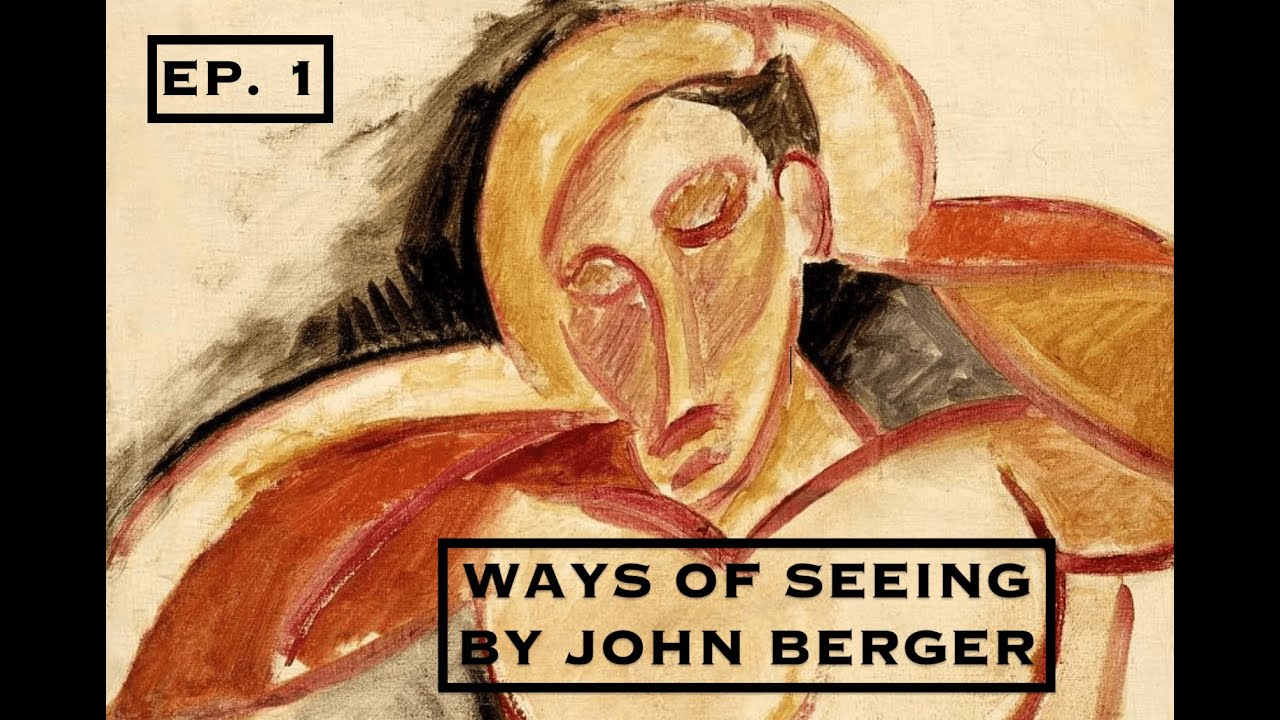
In January 1972, the BBC broadcast a four-part television series, each episode running just thirty minutes. More than half a century later, it remains a fixture on week-one syllabi in art schools worldwide. Once encountered—whether on screen or through its companion text—it becomes impossible to look at a museum gallery, a roadside billboard, or the stream of images flickering across a smartphone in quite the same way. Created by John Berger alongside director Mike Dibb, Ways of Seeing remains the definitive name for this radical shift in perspective.
A Critic and His Scissors On camera, Berger cut a starkly different figure from the aloof, didactic connoisseurs typical of the era’s arts broadcasting. Speaking directly into the lens, his delivery had the intimacy of an unvarnished conversation. In the opening episode, he executed a gesture seldom seen in art history documentaries: taking a pair of scissors to a printed reproduction of a Botticelli painting and cutting out a detail. The act was not mere provocation, but a vivid demonstration of Walter Benjamin’s seminal thesis: once an artwork is reproduced, its meaning shifts across new contexts, while the mystical “aura” of the original is reduced to a form of institutional prestige guarded at the museum gates.
The Looking Eye and the Surveyed Body In what is perhaps the series’ most widely discussed second installment, Berger turns his attention to the female nude in Western oil painting, posing a fundamental question: who are these images truly painted for? He draws a crucial distinction between being “naked” and being “nude.” To be nude, in Berger’s formulation, is to be displayed—painted with the awareness of being watched, crafted to satisfy a spectator who is almost invariably assumed to be male. His famous maxim resonates as sharply as ever: “Men act and women appear.” Looking at curated poses on an Instagram feed today, the observation hasn’t lost an ounce of its bite.
Property Gleaming on Canvas The third episode unpacks why oil painting became such a dominant medium in art history. It was, after all, the first technique capable of rendering private wealth—the texture of fine fabric, the weight of gold, the vastness of land—with unprecedented tactile realism. Thomas Gainsborough’s celebrated portrait of Mr and Mrs Andrews serves as a textbook example: while the couple poses beneath a majestic oak, the true subject of the painting is the expansive estate stretching behind them. Berger forces us to confront an unsettling truth that, once raised, is difficult to unsee: our admiration for a painting is often an admiration for the wealth it depicts.
Publicity: The Oil Painting of the Modern Age In the final episode, the narrative bridges past and present. Berger juxtaposes contemporary advertising imagery with traditional European masterworks, revealing a shared vocabulary of gestures, gazes, and underlying promises: “Buy this, and you will become enviable, lovable, desirable.” Publicity operates by convincing us of our current inadequacy, offering redemption only through the acquisition of a future, idealized self. Revisiting this analysis in the age of algorithmic social media feels less like history and more like an uncanny prophecy.
Learning How to Ask Ways of Seeing is not without its flaws; Berger’s rigid Marxist framework and sweeping generalizations remain open to debate. Yet the enduring legacy of both the broadcast and the book lies not in ready-made answers, but in cultivating the instinct to ask better questions. Standing before an artwork, it urges us to look beyond “Is it beautiful?” and ask instead: Who was this made for? Who funded it? And how am I being asked to view it?
The next time you walk through a gallery or pause over an image on your screen, consider this: what is the image revealing to you, and what is it keeping out of frame?