

From Somber Captivity to Absurd Burlesque – Ai Weiwei’s 24-Hour Performance in Manchester: “Sewing a Button”

World-renowned Chinese dissident artist Ai Weiwei delivered one of the most ambitious yet blunder-filled works in art history with his 24-hour non-stop performance titled “Sewing a Button” (2026) at Factory International in Manchester. Aiming to reenact the dark period when the artist was held in solitary confinement by the Chinese government for 81 days, this massive production evolved from a tragedy to an absurd comedy due to organizational amateurism and technical fiascos.
We have reviewed this extraordinary experience and what went on behind the scenes, as penned by Frieze writer Lou Selfridge.
The First Hours: The Heavy Reality of the Cell
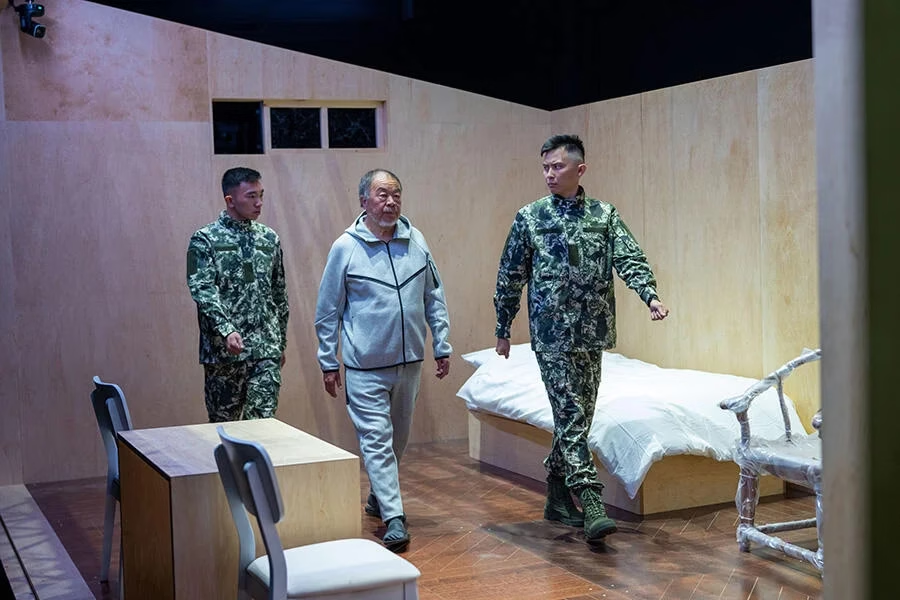
The first hours of the performance were highly promising, hypnotizing, and somber. On stage was an exact replica of the bare cell where Ai Weiwei was held in China. The artist’s every move was tracked millimeter by millimeter by actors playing guards dressed in military camouflage:
-
Step-by-Step Tracking: When Weiwei walked in the cell, two guards walked with him; when he sat down, they stood by his side; even when he went to the restroom, the guards accompanied him.
-
The Power of Silence: For the first four hours, the audience in the hall was practically transfixed by the guards’ watch-checking rituals, Weiwei sitting silently in his chair, and the rhythmic echo of footsteps in the cell.
However, it is difficult for a performance to maintain the same gravity for 24 hours straight—especially if the backstage crew has not done their homework.
The 16th Hour: The Dissolution of the Illusion and the “Perfume” Crisis
In the 16th hour of the performance, Irish writer Emma Dabiri entered the cell as an interrogator, and a Chinese-English interrogation session began with Weiwei. This was the exact point where everything went out of control:
-
Translation Fiasco: The simultaneous translation system projected onto the screen on stage and fed into Dabiri’s earpiece completely crashed. Made-up, meaningless words like “hemenoty” appeared on the screen, or nonsensical sentences like “Our desire is limited – infinite” poured from Weiwei’s mouth.
-
Banal Questions: Not knowing what to do amidst the translation crisis, Dabiri resorted to highly ordinary questions to save the situation: shallow questions like “What is your favorite book?” or “Why are there so many good Chinese restaurants in Manchester?” flew through the air.
-
The Charisma-Shattering Response: Visibly bored by the questions, Ai Weiwei suddenly switched to English and asked Dabiri what perfume she was wearing: “The smell is very strong, it overpowers the whole exhibition.” When Dabiri turned to the audience in bewilderment and asked, “Can you smell it?”, the hall, which had been dead silent until that moment, burst into laughter and applause. The illusion of captivity shattered to pieces at that very second.
As the Laughter Snowballed: A Stage Out of Control
Although radio presenter Nihal Arthanayake, who took the stage after Dabiri, tried to salvage the situation by telling Weiwei in a stern tone, “I ask the questions,” it was already too late. The dam of seriousness had been broken once, and the audience was ready to laugh at anything:
The audience began laughing incessantly at a ringing phone in the hall, a small joke about politician Andy Burnham, or an indifferent answer given to a serious question. Within an hour, a painful story of captivity turned into a bizarre cabaret show. When Weiwei corrected the scolded interrogator by saying, “You are an interrogator, you shouldn’t say thank you,” he no longer seemed like a prisoner of an oppressive state, but a relaxed, world-famous superstar running his own show.
The Final Fiasco and the Closing
At the end of the 24 hours, the production team made one last dramatic move and placed a black hood over Weiwei’s head. Two stagehands dressed in black tried to seal the fourth wall by closing off the front of the cell with wooden panels.
However, the panels did not fit into their slots. The crew wrestled with the panels on stage for minutes; when the time was up and the lights went down, they had only managed to hang 6 out of the 12 panels. In the final moment, the audience wasn’t thinking about censorship in China or freedom of expression, but only about those clumsy stagehands sweating on stage.
NO-26 Note
While we always appreciate Ai Weiwei’s visionary nature that sets out with grand ideas, quality of execution is everything in a piece that is so demanding and requests patience from the audience. Unrehearsed interrogations, untested translation systems, and non-functional stage sets can turn a striking drama into a tragicomic state.
Exhibition Info: The exhibition “Ai Weiwei: Button Up!”, of which the performance is a part, can be seen at Factory International in Manchester until September 6, 2026. If your path takes you there, we recommend giving the other physical works in the exhibition space a chance, as the residue of the live performance has left a bit of a disappointment.