

A Question in the Shadow of Notre-Dame: Kenneth Clark and the Mark Art Leaves on Humanity

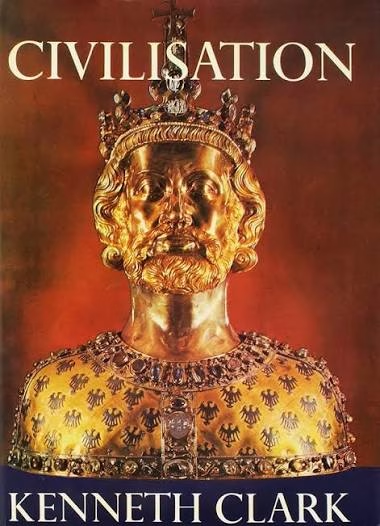
On the evening of 23 February 1969, a frame broadcast on BBC Two staged one of the most iconic openings in television history. The camera focused on a man in an impeccably tailored tweed jacket, standing before the monumental stone mass of Notre-Dame Cathedral as it stretched into the chilly Parisian sky. Looking squarely into the lens, Kenneth Clark posed a deceptively simple yet arresting question: “What is civilisation?” He admitted he could not define the concept in abstract terms, but insisted he would recognize it when he saw it. It was on this precise promise that Civilisation: A Personal View began.
The Triumph of Colour and a Gentleman’s Hesitation
The true architect behind the project was none other than David Attenborough, then head of BBC Two and tasked with introducing colour broadcasting to Great Britain. The most spectacular way to convey the power of colour television technology to viewers was to bring the grand canvases and architectural masterpieces of European art to the screen. Attenborough pitched the proposal to Lord Kenneth Clark, the leading art historian of the era. Though Clark was initially hesitant, Attenborough’s suggestion to frame the project under the title “civilisation” tipped the scales. Reflecting on that moment later, Clark would remark: “I didn’t know what civilisation meant, but I thought it was something preferable to barbarism.”
Thus began a mammoth three-year filming marathon spanning 13 countries and 117 locations. With a budget reaching £500,000, it was an astronomical production for its time. To offset the cost, Attenborough broadcast the 13-part series—comprising 50-minute episodes—twice weekly over its 13-week run.
A Narrowly Saved Heritage and the Fragility of Stone
The opening episode, “The Skin of Our Teeth”, transports viewers into the precarious six centuries following the fall of Rome. The camera sweeps from Byzantium’s luminous mosaics in Ravenna to the tempestuous shores of the Celtic Hebrides, and from the Norwegian fjords of the Vikings to Charlemagne’s chapel in Aachen. The tenacious monastic life clinging to the sheer cliffs of Skellig Michael and Iona brings into focus those quiet witnesses who carried the mortar of civilisation through dark times. The core thesis Clark establishes in these initial steps is crystal clear: no matter how grand, monumental, and unshakeable civilisation may appear, it is fundamentally a fragile structure, capable of being destroyed in an instant.
As the series unfolds, the viewer bears witness to Europe’s intellectual and aesthetic transformation:
-
The 12th-Century Awakening: A spiritual resurgence stretching from the abbeys of Cluny and Saint-Denis to the soaring stained glass of Chartres Cathedral.
-
The High Renaissance: A Rome reshaped by the fiery ambitions of Michelangelo, Raphael, and Leonardo.
-
The Discovery of Light and Detail: A new universe where the telescope and microscope expanded horizons, deepening on canvas through Rembrandt’s Dutch realism.
-
Baroque and Rococo Architecture: A musical aesthetic echoing off the ceilings of Bavaria’s ornate churches through the compositions of Bach, Handel, Haydn, and Mozart.
-
The Tension Between Nature and Industry: The ruins of Tintern Abbey, the rugged Alpine peaks, and the misty canvases of Turner and Constable.
-
The Threshold of the Modern Age: The materialism of the 19th and 20th centuries, defined by the clash between the technical genius of Brunel and Rutherford and the humanitarian pursuits of Wilberforce and Shaftesbury.
A Saga of “Great Men” and a Revolution in Art History
Though Civilisation captivated broad audiences, it could not escape becoming the target of editorial critique. The near-total exclusion of women artists from a narrative spanning centuries drew sharp criticism from classicist Mary Beard for its overwhelming “great man” bias. Meanwhile, the British Film Institute (BFI) characterized the series as a “saga of noble names and sublime objects” that overlooked the social and economic forces shaping art. Fully aware that the East, Asia, and non-Greco-Roman worlds were omitted, Clark had intentionally appended that crucial caveat to the series’ subtitle: A Personal View.
Yet this patrician editorial stance sparked a revolutionary counter-movement within art journalism and broadcasting. John Berger’s seminal series Ways of Seeing, which fundamentally altered how art is read, emerged as a radical counterweight to the stately, aristocratic authority that Clark embodied.
A Gentleman’s Manifesto
On camera, Clark never posed as a neutral transmitter of information; he openly declared himself a “hero-worshipper” and a “stick-in-the-mud from a bygone age.” Resisting the fashionable intellectual trends of his era, the words he set down form the very backbone of the series:
“I believe that order is better than chaos, creation better than destruction, gentleness better than violence, knowledge better than ignorance, and I am sure that human sympathy is more valuable than ideology.”
These sentences stand both as a confession of bias and as a romantic manifesto written for Western humanism.
A Legacy Overflowing from Screen to Gallery
Reaching 2.5 million viewers in Britain and 5 million in the United States, Civilisation set viewing records previously unimaginable for an art documentary. As The New Yorker noted, the mornings following each broadcast saw museums across both the UK and America inundated with an unprecedented influx of visitors. In 2018, seeking to address the blind spots of this legacy, the BBC launched a new sequel series (Civilisations) led by three presenters to encompass Asian, African, and Eastern cultures.
Ultimately, Clark’s legacy leaves us with a simple yet profound impulse: when standing before a cathedral, a canvas, or an ancient stone, do not rush. You may not be able to articulate it in formal terms, but you will unmistakably recognize the mark humanity has left upon it.