

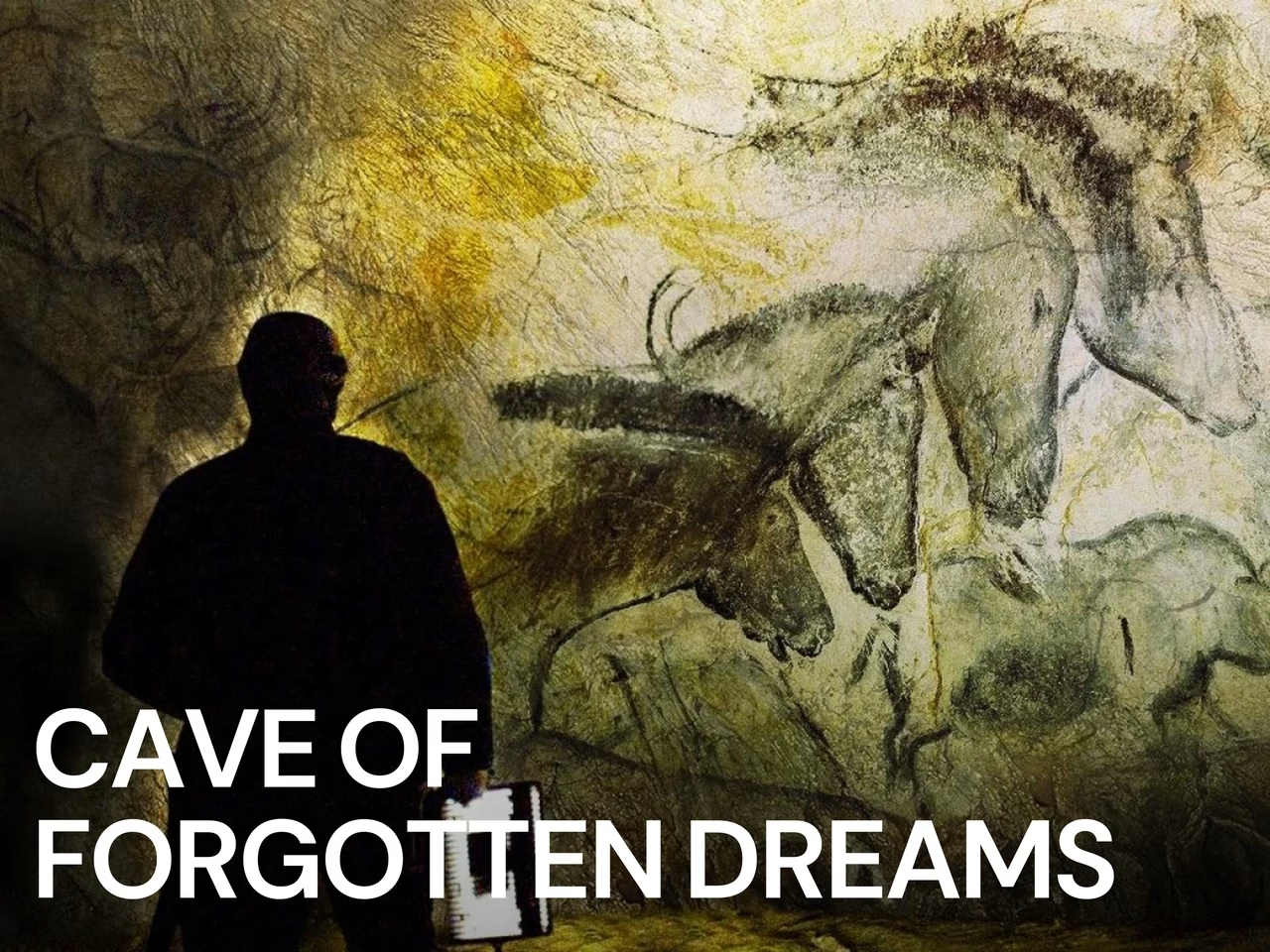
On December 18, 1994, while navigating the cliffs along the Ardèche River, three speleologists—Jean-Marie Chauvet, Éliette Brunel, and Christian Hillaire—detected a faint draft of air slipping through the rock formations. Sealed off from the outside world by a landslide millennia ago, this dark cavity opened into one of the Paleolithic era’s most captivating mysteries. Werner Herzog’s 2010 documentary, Cave of Forgotten Dreams, plunges the viewer into the very heart of this absolute darkness, offering an intimate encounter with humanity’s earliest imagery.
A Sanctuary Beyond Time The Chauvet Cave operates as a highly vulnerable sanctuary, almost entirely restricted from human access. Granted extraordinary permission by the French Ministry of Culture, Herzog and his skeletal crew of four (cinematographer Peter Zeitlinger, a sound recordist, and an assistant) operated under stringent limitations. They were confined to a mere four hours of daily shooting on a precarious 61-centimeter-wide walkway, with a strict prohibition against touching the walls or floor, relying solely on specialized, non-heat-emitting LED panels. Under this cold illumination, borne by Herzog himself, the frames were composed without disrupting the cave’s fragile, millennia-old ecosystem.
Rendering the Volume of Stone: Why 3D? Initially skeptical of 3D technology, Herzog reconsidered upon entering the cave at the urging of his cinematographer, Zeitlinger. He realized that the primordial artists who painted those walls 36,000 years ago had incorporated the natural contours, crevices, and volumetric presence of the rock into their line work like master architects. The stereoscopic footage, captured via custom-built, lightweight rigs assembled inside the cavern, translates the organic materiality of the stone onto the screen. Consequently, the film emerges as one of the rare instances where 3D transcends cinematic gimmickry to become a profound conduit for spatial truth.
Shadows and Traces upon the Wall Within a profound silence spanning over 30,000 years, herds of horses, bison, and rhinoceroses seemingly stride outward from the rock face. It is no coincidence that Herzog identifies a bison rendered with eight legs as a form of “proto-cinema”—a primordial urge to capture and synthesize motion.
Yet, the documentary’s true resonance lies in those minute, human details that effectively collapse time. Clusters of red palm prints—identifiable as the work of a single artist due to a congenitally crooked little finger—reappear across various recesses of the cave. The footprints of an eight-year-old child trailing alongside those of a wolf, or a cave bear’s skull placed deliberately atop a limestone block like a votive offering, provide a testament to our collective memory that is infinitely more profound than language.
Poetic Testimonies and Uncanny Encounters Herzog does not merely yield the floor to scientific experts; he actively excavates the uncanny and oneiric dimensions of the human psyche. Whether it is the archaeologist—and former circus unicyclist—Julien Monney recounting how he began dreaming of lions after entering the cave, or a master perfumer invited to map the site’s subterranean olfactory landscape, these digressions form part of the director’s idiosyncratic pursuit of the ultimate question: What constitutes our humanity?
The film’s epilogue is quintessential Herzog. Shifting his lens to mutant albino alligators thriving in the warm wastewater runoff of a nearby nuclear power plant, the director leaves the audience with a provocative inquiry: What would these mutated creatures perceive if they were to eventually slither into the cave and observe those frescoes? This polarizing, yet fiercely defended surreal coda constructs a bizarre bridge between the indelible traces of the ancient past and the looming ambiguity of the future.
Returning to audiences in April 2026 through a pristine 6K IMAX restoration, Cave of Forgotten Dreams serves as a mesmerizing portal into a physical space we will never be permitted to enter. To observe the corporeal presence of a human being—left behind in a single handprint tens of thousands of years ago—remains one of the most aesthetically profound ways to confront our own impermanence.