

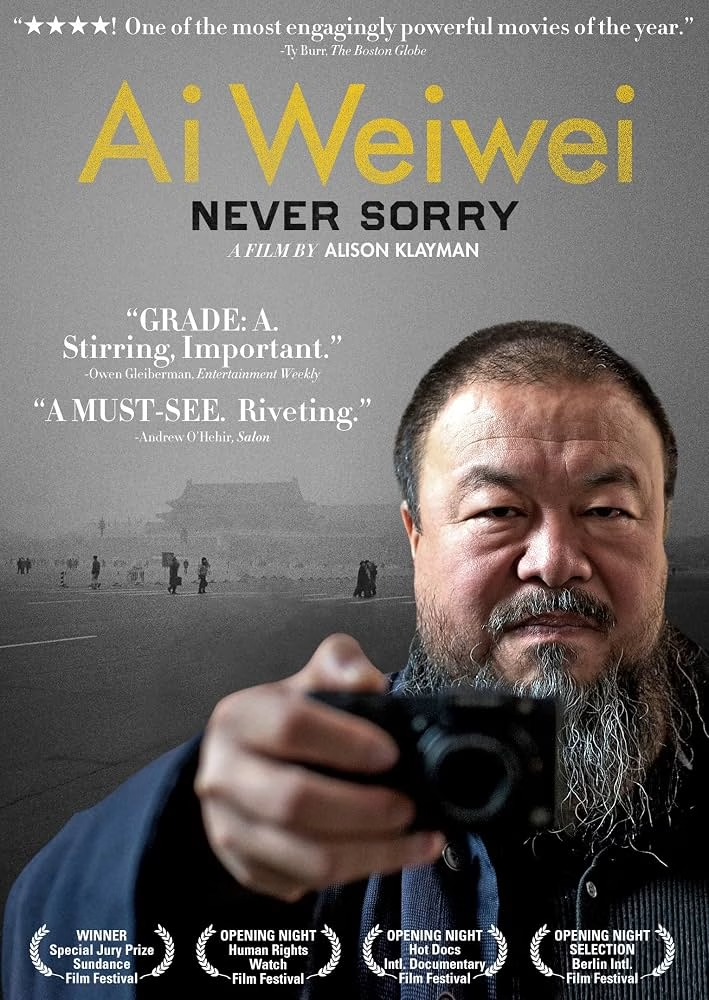
In a studio nestled within Beijing’s Caochangdi district, claws scratch against timber. Trapped inside, a cat works persistently at the latch until the barrier yields, slipping out through the narrow gap. It is with this fragile yet dogged gesture that Alison Klayman’s 2012 documentary, Ai Weiwei: Never Sorry, opens. This modest act encapsulates Ai’s posture against the formidable walls of state power and censorship: boring an aperture behind every shuttered entrance, transmuting iron bars and surveillance cameras into poignant aesthetic instruments.
When Alison Klayman, then a young journalist working in Beijing, first crossed paths with Ai in late 2008, she could hardly have anticipated the immersive pursuit that would follow. Shadowing the artist over the course of two years, her camera bore witness to every turn: from the preparations for his Munich retrospective to the monumental installation Sunflower Seeds at Tate Modern, and through an escalating gauntlet of police harassment and midnight raids. Klayman’s 91-minute debut feature did not leave the Sundance Film Festival empty-handed, clinching a distinction that captured the very ethos of the work: the Special Jury Prize for Spirit of Defiance.
A Polyphony That Humanises the Portrait
Rather than leaning on a detached voiceover or a didactic narrative stance, the film tunes into an ensemble cast that knows Ai intimately and moves fluently through the capillaries of both the city and the art market. Experts on contemporary Chinese art Karen Smith and Philip Tinari, The New Yorker’s Evan Osnos, painter Chen Danqing, filmmaker Gu Changwei, along with Ai’s mother Gao Ying and his wife Lu Qing—this collective chorus rescues Ai Weiwei from the pedestal of an idealized icon of dissent, rendering him a flesh-and-blood figure animated by his own stubbornness and anxieties. The lens captures him not as a flat folk hero, but as an impassioned practitioner whose art remains indivisible from his physical presence and political agency.
Art, Politics, and the Gravity of Backpacks
One of the documentary’s most compelling threads is its articulation of how artistic production and political activism collapse into a singular gesture within Ai’s practice. In the wake of the 2008 Sichuan earthquake—as authorities moved to conceal the identities of more than 5,000 schoolchildren crushed beneath substandard, shoddily constructed classrooms—Ai’s grassroots “Citizens’ Investigation” inscribed an indelible counter-archive into the historical record. The colossal installation swathing the facade of Munich’s Haus der Kunst, composed of 9,000 colorful children’s backpacks, transformed bureaucratic silence into a deafening roar. Whether co-designing the Beijing Olympic Stadium (“Bird’s Nest”) only to boycott the opening ceremony in protest against its co-optation into state spectacle, or raising an irreverent middle finger toward authority across Tiananmen Square, humor, in Ai’s hands, acquires the subversive firepower of an explosive device.
Circumventing Censorship in the Digital Era and 81 Days of Darkness
Klayman’s lens also deftly chronicles the shifting modalities of dissent in the networked age. When the Chinese government shuttered the artist’s blog, the front line migrated to Twitter (@aiww), where each dispatched character operated as a micro-installation beamed directly to his followers. Yet the toll of this digital insubordination proved severe: in 2011, Ai was detained incommunicado for 81 days in an undisclosed cell, subjected to psychological coercion, and subsequently slapped with a fabricated $2.4 million tax penalty. Time magazine’s decision that same year to rank him runner-up for Person of the Year speaks to the global reverberations of the fire ignited within those cloistered interrogation rooms.
Behind the Scenes of an Unfinished Struggle
Cinematographically, Ai Weiwei: Never Sorry disdains the pretense of dispassionate neutrality; it plants its frame squarely within the pulse of the artist’s living and working quarters. As critics have noted, the narrative deliberately resists tidy cinematic resolution. The struggle it traces is inherently open-ended, extending well past the final credits into an ongoing, unresolved arena of confrontation. Rather than serving up packaged conclusions, Klayman leaves the viewer in intimate proximity to the arduous, jarring, and slyly humorous endeavor of sustaining creative vitality under authoritarian duress.