

The Half-Life of the Divine: Jeremy Shaw’s “Half-Life of Grace” at Galerie Neu, Berlin

Crossing the threshold of Galerie Neu, visitors are met first by an eerie stillness, then by the cold gleam of glass and metal. In Half-Life of Grace—his debut solo exhibition with the gallery—Canadian artist Jeremy Shaw orchestrates a confrontation between the yearning for transcendence, the dispassionate vocabulary of science, and the relics of faith. Running through 7 November 2026, the exhibition interrogates humanity’s pursuit of the sublime through an assembly of radioactive materials, decommissioned liturgical artifacts, and psychoactive residues.
In the first gallery, three delicate glass sculptures hang mounted on the wall. Flame-formed from borosilicate glass, these works take the shape of Klein bottles—four-dimensional topological concepts embodying mathematical infinity. Within the transparent chambers of these self-folding, boundaryless structures lies an invisible yet palpable residue: vaporized DMT (dimethyltryptamine). The chemical trace of this potent psychoactive compound, known for dissolving cognitive boundaries and altering perception, lingers inside the infinite glass loops like a suspended vision.
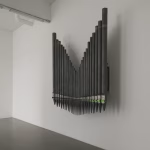
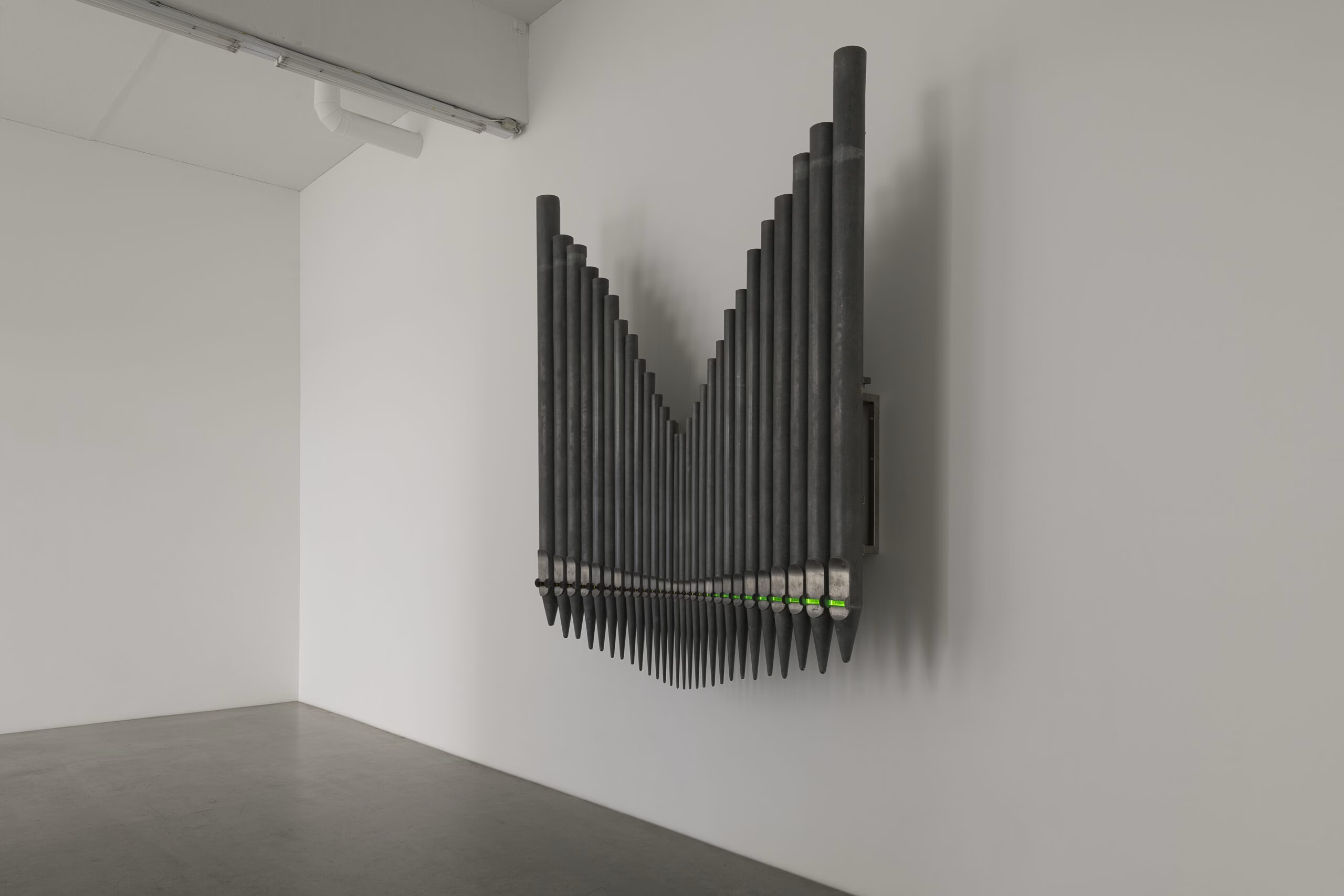
Moving into the second room, the monumental installation from which the exhibition takes its name dominates the space. Mounted along the wall is an array of 28 zinc-alloy facade pipes, salvaged from the organ of a decommissioned 1959 church. The dents, scratches, fingerprints, and oxidation marring their metallic skins bear physical witness to decades of devotion, ritual, and decay. Shaw, however, has retrofitted these ecclesiastical relics with hand-blown uranium glass sleeves and concealed ultraviolet lighting mechanisms.
Triggered by circuit-board commands, the hidden UV lights illuminate the pipes, bleeding a nuclear-green glow from their open mouths. Uranium glass—a material popular in decorative arts until the 1940s—floods the darkness with neon hue upon activation, while pulsating soundscapes emanate from speakers embedded within the zinc bodies. Once conduits for sacred hymns, these metallic forms are transformed into instruments of an unsettling, light-and-sound ritual.
Following major presentations at institutions such as the Centre Pompidou, Palais de Tokyo, and the Julia Stoschek Collection, the Berlin-based artist turns Galerie Neu into a laboratory for tracing the chemical, mathematical, and architectural residue of ecstasy. Suspended on the volatile threshold where faith and empirical science converge, Half-Life of Grace offers a hypnotic attempt to measure the decay rate of the sacred.