

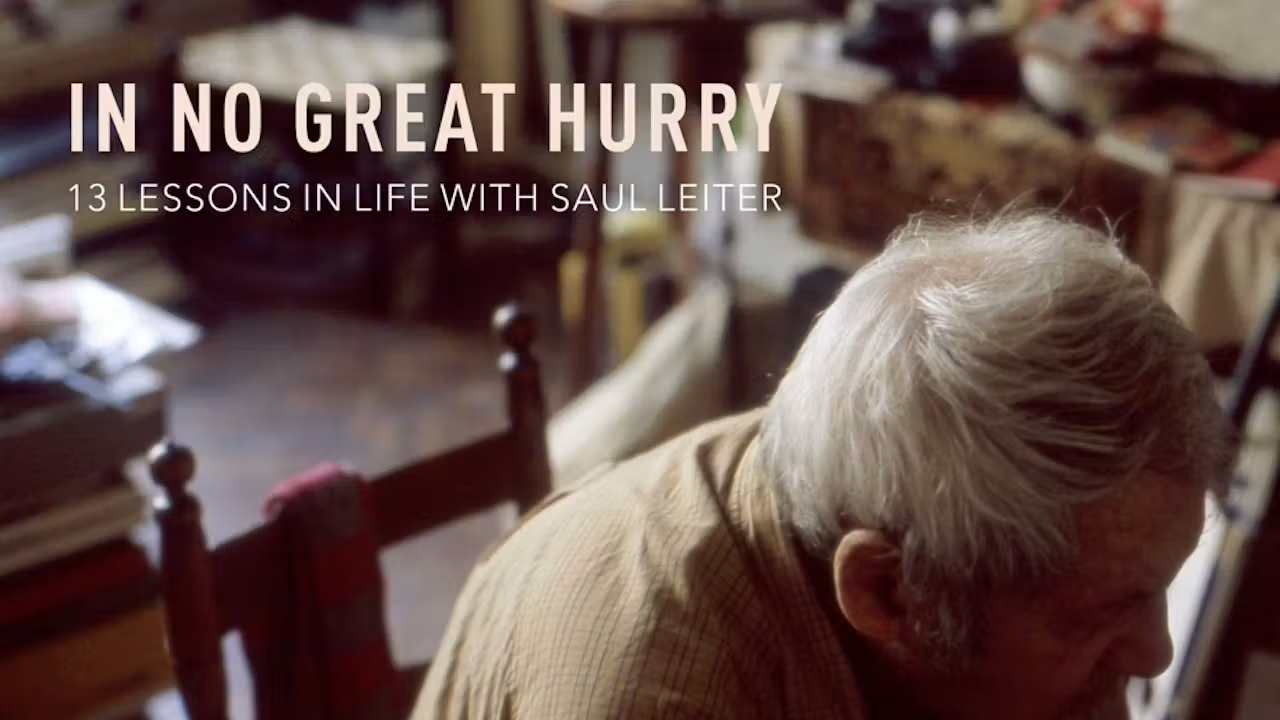
Documentaries chronicling the lives of photographers typically traffic in a well-worn narrative of ascension: the early discovery of singular talent, the romanticized struggle, and the eventual coronation of critical acclaim. Tomas Leach’s 75-minute documentary, Saul Leiter: In No Great Hurry, charts an entirely opposite course. Here, we encounter an endearing, disarmingly modest master who openly disavows any appetite for careerism, visibility, or leaving a historical legacy—preferring instead to drink coffee, listen to music, and paint only when the impulse strikes.
A Curmudgeonly Seclusion at the Doorstep
According to director Tomas Leach, coaxing Saul Leiter in front of the lens was no straightforward task. When Leach first flew to New York and knocked on his door, Leiter, then in his late eighties, peered through the crack, asked with a sly chuckle, “Why do people always want something from me?” and slipped back inside. Following a patient, eighteen-month courtship, filming finally commenced in the photographer’s cluttered, object-strewn East Side studio. Though Leiter regards being the subject of the film with a lingering, gentle suspicion, his playful wit never falters.
Painting with Colour in a Black-and-White Era
Born in Pittsburgh in 1923, Leiter began shooting colour transparencies in the 1940s and ’50s, a period when virtually every photographer around him remained tethered to monochrome. Yet this was never framed as an avant-garde manifesto or an ambition to pioneer; indeed, when asked directly in the film whether he considers himself a trailblazer, he hesitates, fielding the premise with characteristic skepticism. A painter by training and disposition, Leiter approached the camera through the textural possibilities of the canvas: soft blooms of pigment, steamed glass, rain-streaked windows, and the sudden punctuation of a solitary red umbrella under downpours. Drifting through the streets of Manhattan with deliberate, unhurried steps, he recorded the quiet universe tucked beneath the city’s frantic surface.
As Martin Harrison, editor of Saul Leiter: Early Color, emphasizes, Leiter’s New York departs decisively from the agitated, confrontational street photography of contemporaries like Robert Frank or William Klein. His city is distinctly slower, contemplative, and steeped in poetic stillness.
Thirteen Unassuming Life Lessons
The “13 lessons in life” teased in the film’s subtitle offer neither sweeping epiphanies nor didactic prescriptions. Instead, they emerge unforced from Leiter’s everyday banter as modest, unvarnished observations. Recalling his family, he reflects on a household where worldly achievement was sanctified while basic kindness was seldom cultivated; he touches briefly upon luminaries he once photographed, such as John Cage and Jackson Pollock. Noting that holding a camera teaches one to genuinely observe the world and savour its minute details, he articulates his technique with equal spareness: simply shooting what one sees, devoid of staging or calculation. The editing sessions alongside his archivist and assistant, Margit Erb, illuminate the eccentric, singular rigour that governed his process of culling negatives.
An Intimate Vignette That Leaves Much Unsaid
While the film has drawn criticism for sidelining scholarly art-historical analyses and bypassing an in-depth survey of the New York School context, this very omission fosters a direct, unmediated communion between the viewer and the artist. Rather than refracting Leiter’s imagery through academic dogma, the documentary simply invites us to look and to feel.
Leach’s tender portrait stands as an exquisite testament to the possibility of a lifetime of creative production lived entirely indifferent to the machinery of recognition. Indeed, Leiter remained steadfastly unswayed even by the wave of international rediscovery that crested in his final years; he passed away on November 26, 2013, at the age of 89, shortly after the documentary was completed. Stepping away from the film, should you encounter a fogged windowpane on a rainy afternoon, it is impossible not to glimpse an exquisite Leiter frame waiting silently in the mist.