

The Art of Dust on Canvas: Beltracchi: The Art of Forgery and the Great Illusion of the Market

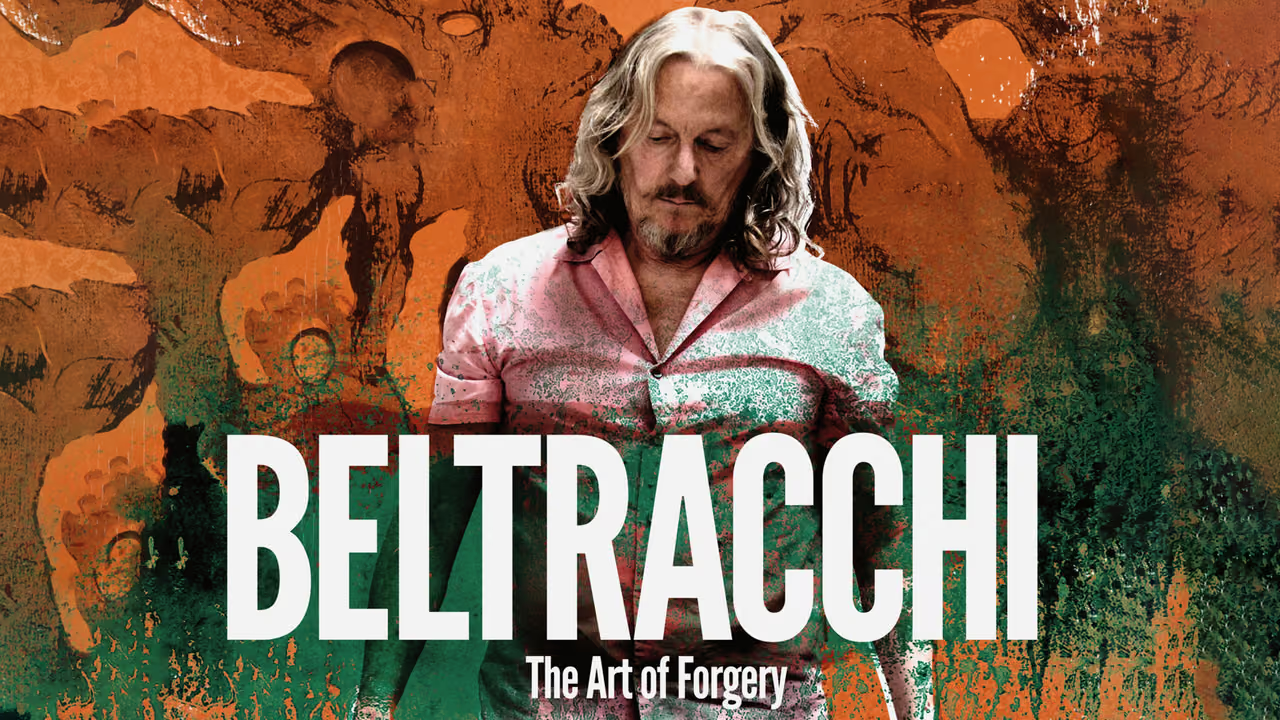
When actor Steve Martin paid €700,000 in 2004 for a painting attributed to Heinrich Campendonk in the dim light of a Paris gallery, he was oblivious to the fact that the canvas before him was part of a monumental fabrication destined to rattle modern art history. Two years later, he parted with it at Christie’s for €500,000. The work was a fake; Martin was simply one among hundreds of collectors beguiled by the art world’s expertly oiled machinery of the era. Arne Birkenstock’s 2014 documentary, Beltracchi: The Art of Forgery, hands the microphone directly to the master orchestrator of this grand illusion.
Not a Stylistic Thief, but an Architect of Non-Existent Works
Wolfgang Beltracchi—born Wolfgang Fischer—first picked up a brush in the workshop of his father, a mural painter and restorer. Though he claims to have completed his first Picasso copy at fourteen, what set him apart from commonplace counterfeiters was his refusal to merely imitate existing paintings. Instead, Beltracchi infiltrated the minds of the masters, conjuring entirely original compositions in their idioms. He materialized lost works that existed only as titles in exhibition catalogues, weaving apocryphal brushstrokes directly into the art-historical canon.
Birkenstock’s camera tracks this meticulous, almost forensic process as though observing performance art: period canvases scavenged from flea markets, antique wooden frames, hand-mixed historical pigments. Beltracchi’s virtuosity resided in his obsessive precision—down to calculating the exact volume and texture of dust settled on the back of a stretcher bar.
Black-and-White Photographs and Historical Lacunae
A painting’s value relies as much on its documented history as on its paint. Beltracchi and his wife, Helene, concocted a seamless provenance for their fabrications, claiming the works belonged to a collection acquired in the 1920s by Helene’s grandfather, Werner Jägers, from the legendary dealer Alfred Flechtheim. Distressed “Flechtheim Collection” labels were affixed to the stretchers. Glaring logical flaws marred the narrative—Jägers was merely a teenager in the 1930s and later a member of the Nazi Party—yet the market swallowed the story uncritically for years. The archival photos proffered as indisputable proof were staged by Wolfgang himself in his studio: Helene dressed in her grandmother’s clothes, posing in front of the forged canvases hanging on the wall.
A Tube of Industrial White and the Downfall
In November 2006, Rotes Bild mit Pferden (Red Picture with Horses), attributed to Campendonk, was auctioned through Lempertz to a Malta-based corporate entity for €2.88 million. Laboratory analysis in 2008 revealed traces of titanium white in the paint layer—a pigment not yet discovered in 1914. Impatient that day, Beltracchi had reached for an off-the-shelf tube of Dutch white paint rather than mixing his own.
Arrested in Freiburg on August 27, 2010, the couple stood trial for 40 days before confessing to 14 forged works attributed to Campendonk, Max Ernst, Derain, van Dongen, Léger, and Pechstein. In a legal case involving forged works valued at $45 million, Wolfgang was sentenced to six years and Helene to four. These relatively lenient sentences were facilitated by a plea agreement reached with the court. Though Beltracchi claimed to have mimicked the styles of roughly 50 artists, police identified 58 suspicious works.
Whose Side Is the Camera On?
What renders the documentary editorially compelling is director Arne Birkenstock’s willingness to grant Beltracchi ample room to frame his own narrative. Yet a crucial detail demands attention: the director’s father, Reinhard Birkenstock, served as the Beltracchis’ defense attorney. While the film captures the fraudster’s peculiar charisma—oscillating between cunning and candor—it leaves the viewer confronted by the tacit complacency of the art market. Record-breaking auctions, the inadequacy of self-appointed experts, and the insatiable appetite of the institution provided the fertile soil for this deception. Indeed, the duped Malta-based company won its lawsuit, securing a €2 million settlement in December 2012 liquidated from Beltracchi’s real estate assets—marking his first formal restitution to a buyer.
The film offers no ready-made answers; perhaps its greatest strength lies in leaving the viewer to deliberate along the fine line separating financial valuation from aesthetic truth.