

Meyer Riegger Karlsruhe: Forecast Error — The Collapse of the Grid and the Aesthetics of Contingency


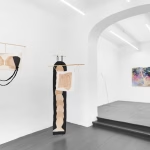
In these days when Karlsruhe is shrouded in winter fog and we enter the final, introspective turns of 2025, Meyer Riegger invites us to an uncanny exploration at the boundaries of rationality. The group exhibition titled “Forecast Error” centers on the grid system—modernity’s unshakeable symbol of order—the false certainty promised by financial and statistical models, and the generative void born from the collapse of these structures.
The Illusion of Order and the Poetics of Error
The grid system, the most radical form in modernist art history that severed ties with tradition, emerges as a structure that rejects spatial depth and rationalizes the plane. However, this selection at Meyer Riegger reinterprets the grid not merely as a static form but as a tool of prediction. In the financial world, “Forecast Error” denotes the inevitable deviation between the predicted and the actual; in the exhibition, this deviation is positioned not as failure but as a productive logic. Against modernism’s pursuit of perfection, the show embraces uncertainty and incompleteness as an aesthetic language.
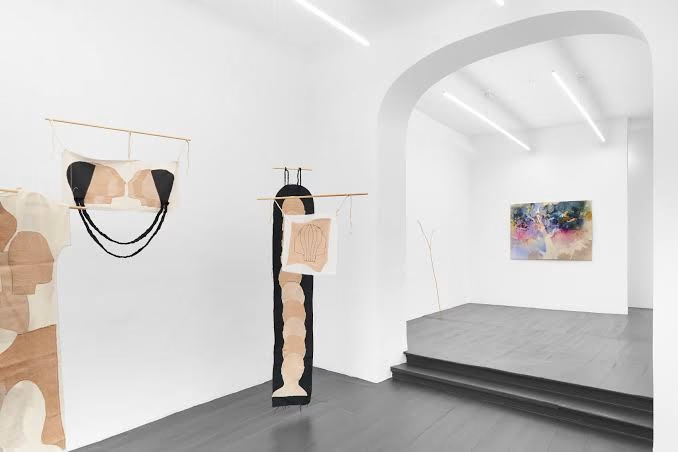
Bringing together works by Nancy Dwyer, Sheila Hicks, Jordan Madlon, Susanne Paesler, Gunter Reski, and Len Schweder, the exhibition oscillates on the thin line between order and openness through textile, text, and pictorial interventions. Sheila Hicks’ soft structures built with fibers flex the rigid geometry of the grid with organic resistance, while Nancy Dwyer’s typographic games destabilize the rational communication of text by turning it into objects. In this context, “Forecast Error” investigates the fragility beneath all systems promising certainty and the indefinable images seeping from that fragility.
An Ontological Inquiry: The Essence Within the Error
From the Apartment No: 26 perspective, the timing of this exhibition—meeting viewers at the very end of December, when projections for the future and analyses of the past are made—is no coincidence. The show places the rich “margin of error” offered by complexity in place of the clarity promised by predictive models. While surface explorations by names like Susanne Paesler and Gunter Reski defeat the grid system to birth new visual possibilities, the poetics of uncertainty dominating the exhibition overall opposes the closure of perfection. This is not merely a visual feast; it is also an investigation of the ontological bond that the contemporary subject, besieged by data, forms with the uncontrollable.
Visit Notes
Venue: Meyer Riegger, Klauprechtstrasse 22, Karlsruhe, Germany.
Exhibition Duration: Until January 31, 2026
Highlight: We especially recommend focusing on the dialogue that Sheila Hicks’ “tectonic softness” in textile forms enters with the rationality of the grid system.