

Stepping under London’s overcast skies, breaking away from the pleasant delirium of Frieze week to walk down Cork Street, entering No. 9 felt like an abrupt suspension of both geography and temporality. Brought from Dubai into the heart of London by The Third Line, Palestinian artist Jordan Nassar’s exhibition No History of Shapes / لا تاريخ للأشكال welcomes the viewer directly upon this threshold.
Upon entering, the prevailing sensation is one of deep-seated lived experience, whispered through the subtlety of fine craft. Nassar approaches Palestine’s aesthetic heritage and historical traumas not through declamatory slogans, but by tenderly reweaving them in the quietude of cotton thread and across the lustrous surfaces of glass mosaics.
A Geography Built Stitch by Stitch
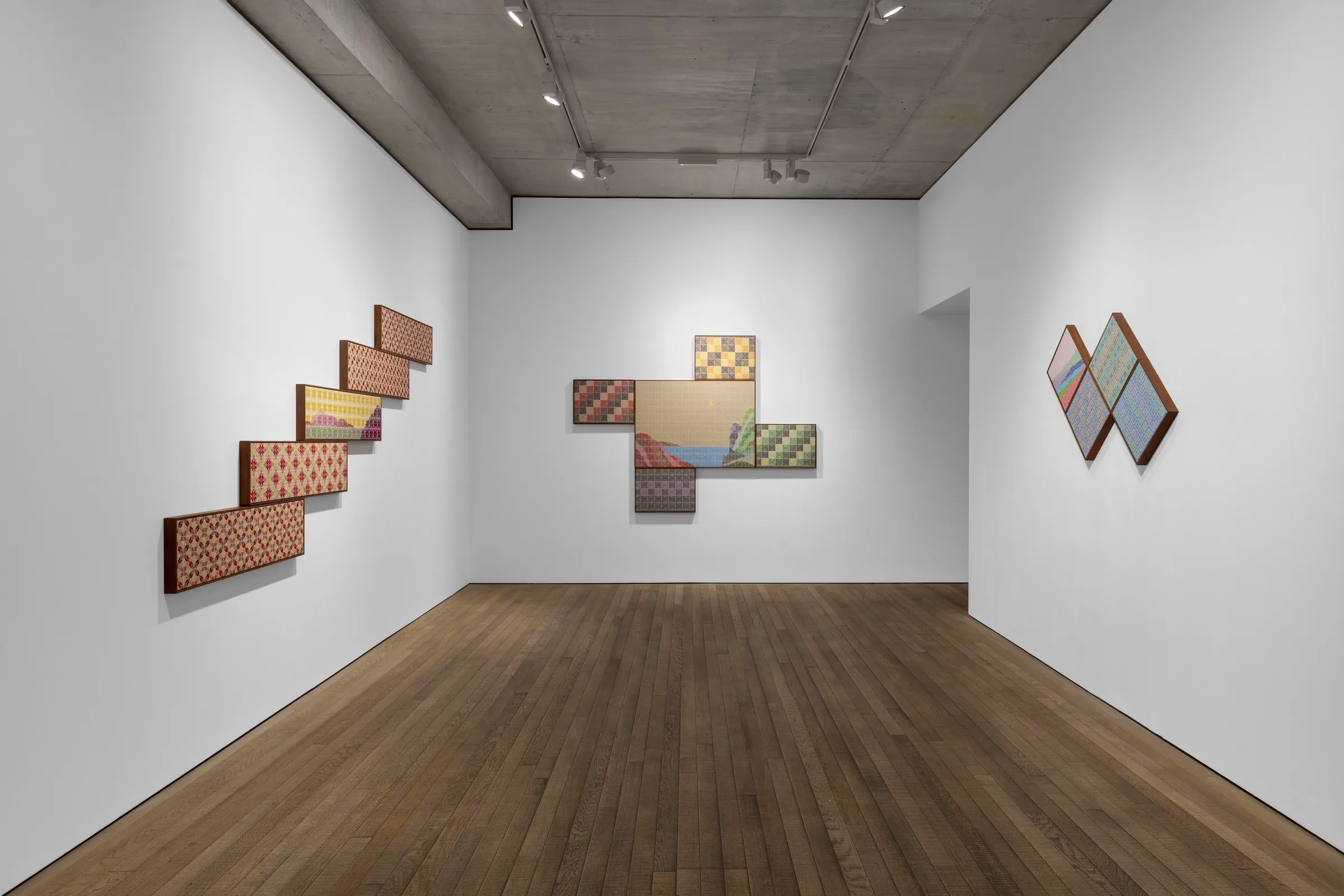
Lining the walls are monumental works realized in tatreez, the traditional Palestinian cross-stitch technique. Viewed from afar, pieces such as They Build Homes with Clouds or The Bursting of Shape register as cohesive, abstract, and luminous Palestinian topographies. Up close, however, one cannot help but become entirely absorbed in the dense, patient labor of the needlework.
In this body of work, Nassar makes a deft conceptual pivot: he transposes the modular logic of legendary Iranian artist Monir Shahroudy Farmanfarmaian’s Convertible series into his own embroideries. Composed of geometric panels, these works mirror the fragmentary nature of memory itself—capable of being dismantled and reconfigured into alternative combinations at will. Nassar effectively offers us the constituent fragments of a fractured landscape, prompting us to mentally reassemble the missing topography anew, underpinned by hope.
From Northern Gaza to London: Memory in Glass
Moving past the matte, tactile warmth of linen toward the opposite side of the gallery brings one to the exhibition’s most visceral, throat-tightening encounter: a series of intimate mosaics. Working line by line from low-resolution digital photographs sourced online, Nassar has meticulously reconstructed an ancient Byzantine-era mosaic from Jabalia in northern Gaza using traditional hand-cut glass (smalti).
Panels such as Jabalia (Tree) and Jabalia (Figure) reveal the original’s orange trees, lions, and figurative elements. Yet this is far from rote replication. It serves as an act of preservation—what the artist describes as a “tender gesture”—safeguarding a besieged cultural heritage under immediate threat of physical annihilation, without reducing it to nationalist rhetoric. Nassar bridges the lost voids with his own intuition. Tracing the glint of these tiny glass tesserae, one feels as though they are handling, piece by piece, a history salvaged from beneath the rubble of a razed landscape.
Clouds Have No Shape
The poignant line that lends the exhibition its title is drawn from Palestinian poet Mahmoud Darwish’s To Describe Clouds: “There is no final shape for this universe… / shapes have no history…”
Across this two-part presentation conceived in collaboration with Anat Ebgi gallery, Nassar channels the boundless possibilities of Darwish’s verse. In the shadow of devastation and loss, he constructs new dwellings out of clouds using needle, thread, and glass shards. Walking among them offers an acute, lingering testament to the stubborn endurance of memory.
Should you find yourself in London over the coming days, heed this quiet yet profoundly stirring summons before it closes on 24 October 2026, and pause where form dissolves and memory begins.