

“The good, the true and the beautiful”: Ash, Cosmic Dust, and the Melancholy of Two Dianas at Sprüth Magers

Slipping away from London’s familiar, rain-washed bustle and ducking past Mayfair’s polished shopfronts into Sprüth Magers, one encounters that rare sensation of the outside world suddenly dropping away. Lucy Dodd’s solo exhibition The good, the true and the beautiful—which opened on 18 September and prepares to draw to a close on 24 October—draws viewers into far more than an optical encounter; it is a cosmic rite where fire, earth, and celestial matter converge. With only days left before it shuts its doors, the urge to register the dense residue this show leaves behind while the impression is still raw is irresistible.
At the heart of the installation stands an unseen figure whose murmur reverberates across every canvas: Artemis, alias Diana—goddess of the wild, the hunt, and the moon. Through this mythic archetype, Dodd charts an incisive nexus between the personal and the collective. On one hand lies the name borne by the artist’s own grandmother; on the other, the untamed virgin huntress alongside her tragic mirror image, Diana Spencer, Princess of Wales. Where the mythic Diana was a formidable sovereign who renounced marriage, fiercely guarded her autonomy, and mercilessly destroyed those who transgressed her boundaries, Princess Diana became the quarry, relentlessly hunted down by the media for that very pursuit of self-possession and freedom. On the gallery walls, Dodd orchestrates a quiet, poignant collision between the spirits of these two women.
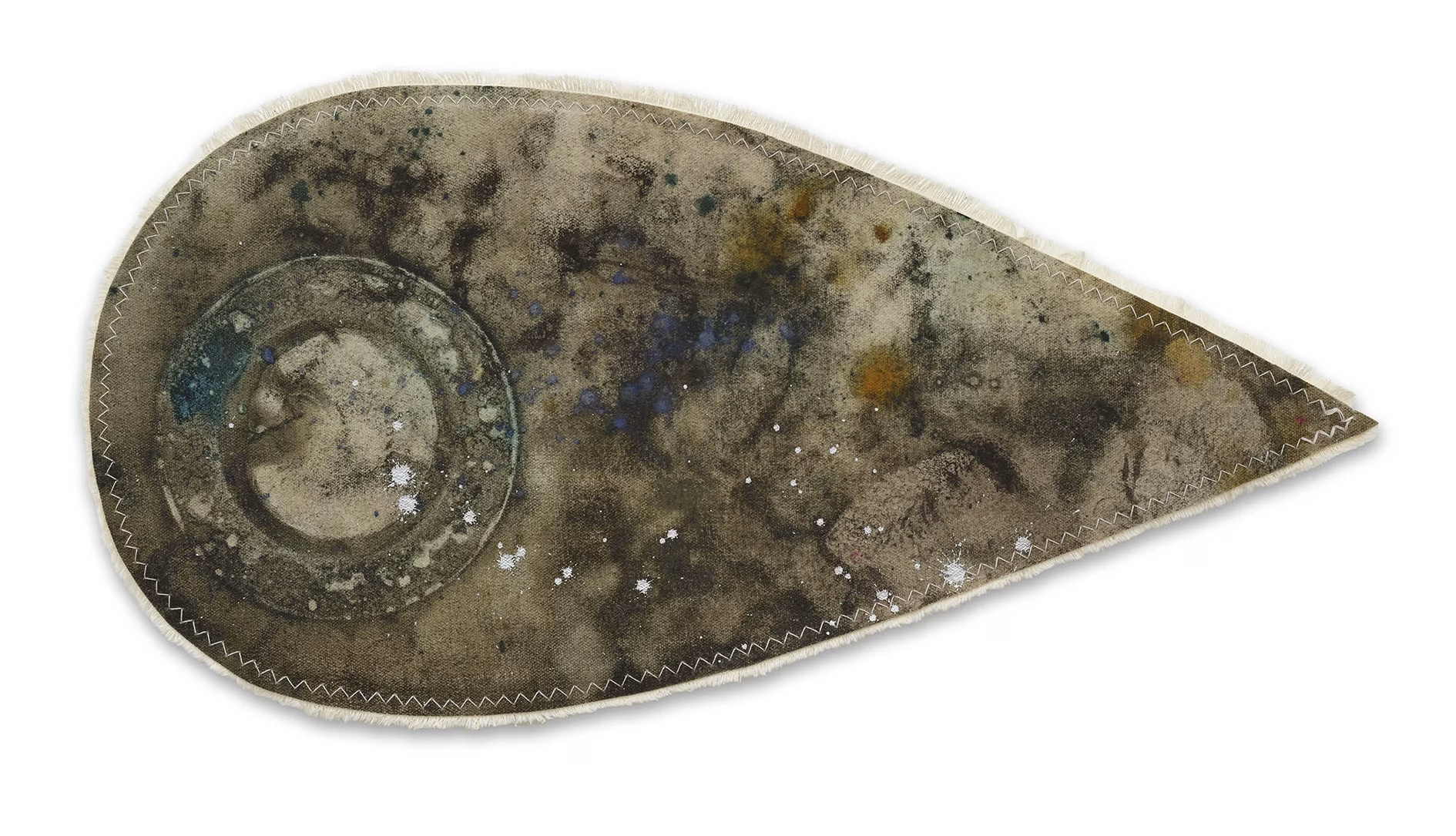
One of the most radical shifts in Dodd’s practice stems from her relocation from upstate New York to the wind-scoured coast of Moray in northeastern Scotland. The geography breathes directly through the texture of these works. Crucially, the charred peat salvaged in the wake of the catastrophic blaze that tore through Dava Moor in June 2025—recorded as Britain’s first official “megafire”—serves as the exhibition’s primary medium. Washed down the River Findhorn and gathered from the shoreline, this carbonized memory has been steeped and pulverized in the studio into raw pigment. Yet the alchemy extends far beyond burnt debris: copper ink, crushed cochineal insects, foraged flora, spirulina, and powdered meteorite older than the Earth itself, harvested from the fathomless reaches of deep space. Watching decaying forest mulch dissolve alongside celestial fallout on a single support yields an almost cinematic sense of scale.
Moving through the gallery, what strikes most immediately are Dodd’s circular formats, an unprecedented departure in her painterly vocabulary. The canvases morph before your eyes into lunar discs, archers’ targets, dilated pupils, or female breasts. Yet disrupting this immaculate circularity is the show’s most arresting piece: a monumental work conceived in the silhouette of a diving board. The painting references that iconic, melancholic photograph of Princess Diana sitting hunched and utterly isolated at the stern of a yacht shortly before her death. Dodd translates that liminal state between deck and open sea—the suffocating trap between public spectacle and private interiority—through visceral gestural splatters thrown outwards from a dense, darkened earthen core, fracturing into ashen greys, uncanny ocean blues, and fugitive flecks of turquoise. Standing before it, that solitude crashes over you like a physical swell.
The entire body of work was conceived in sync with the heightened lunar cycles of 2026, mounting a quiet yet uncompromising refusal of an era dominated by screens and blinded by artificial glare. In defiance of the slick, rectangular flatness of our digital existence, Dodd works some canvases into surfaces so dark and densely layered that one must squint and truly peer into the murk to discern the innate luminosity that Artemis carries into the night.
Turning back for a final glance on my way toward the exit, I noticed the deeply tender, human traces quietly grounding the exhibition’s overarching cosmic and mythic scale: a toddler’s footprint stamped in one corner, or a brush abandoned in the drying pigment, leaving behind a ghostly indentation. Dodd’s The good, the true and the beautiful dredges up layers of existence spanning ecological collapse and interstellar fallout to centuries-old mythologies, the solitary desolation of a woman, and the fragility of childhood.
Should your travels take you through London in the coming days, make the pilgrimage to Sprüth Magers before the tide recedes on 24 October. This is not merely an exhibition, but a quiet, stately act of resistance forged from stardust, ash, and the women who dare to seek their own light.