

Digital Gothic at No.9 Cork Street: P·P·O·W Presents Robin F. Williams’s ‘Act Natural’

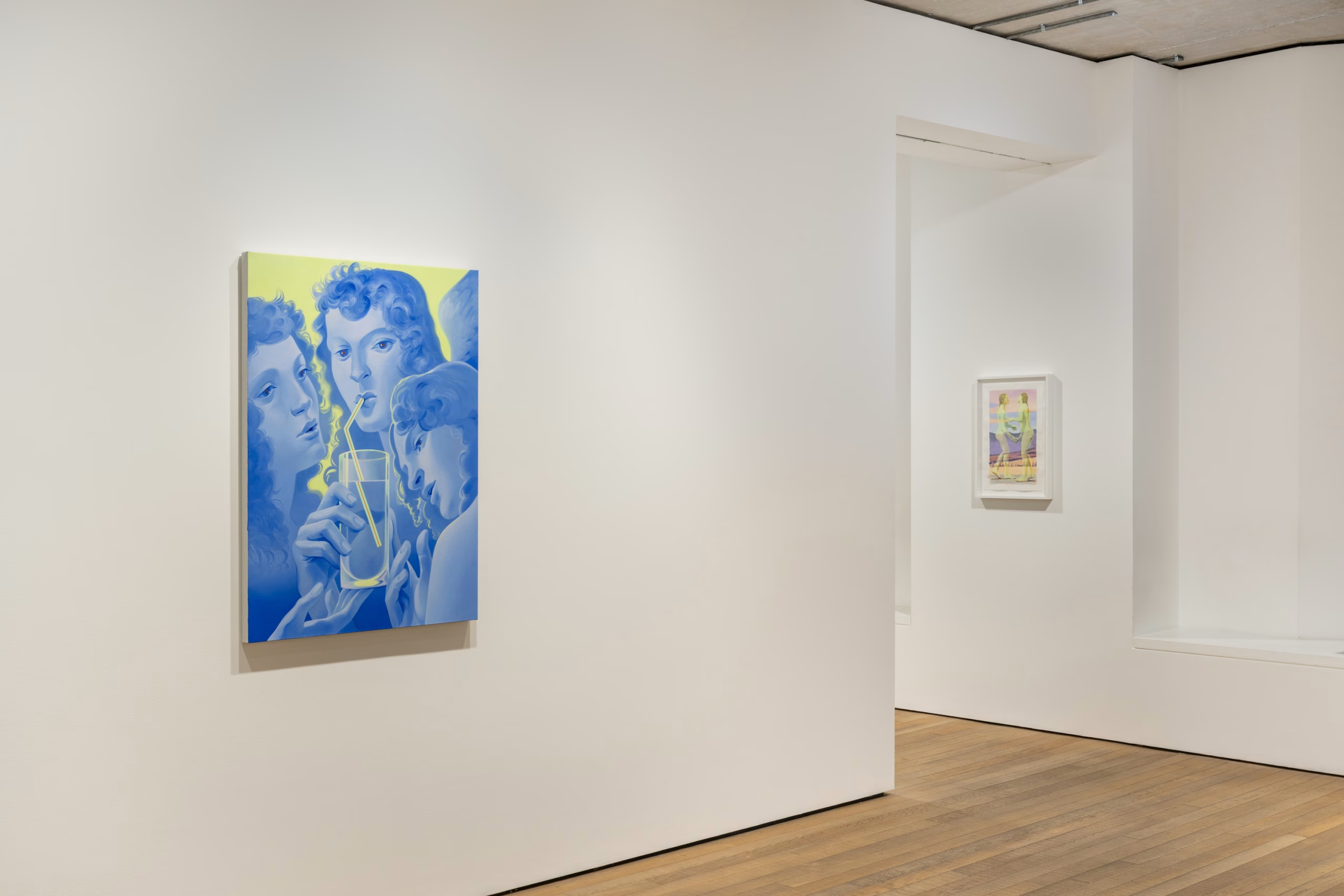
As the dizzying momentum of Frieze Week spills across the pavements of Mayfair, stepping into No.9 Cork Street feels akin to slipping into an uncanny, screen-lit reverie. For its inaugural international pop-up in London, New York gallery P·P·O·W presents Act Natural, the UK solo debut of American painter Robin F. Williams. Running through 24 October 2026, the exhibition arrests the viewer at the threshold through its title alone: that impossible imperative whispered to the modern subject frozen before an open camera or caught in the glare of algorithmic surveillance: “Act natural.”
Since 2018, Williams has interrogated the cultural tropes underpinning female-voiced virtual assistants like Siri and Alexa, entities that have discreetly colonized our smartphones and domestic peripheries. In this latest body of work, the artist cross-pollinates horror tropes with the collective anxieties mounting around artificial intelligence, transposing the eighteenth-century gothic sublime into the screen age. That historic frisson of dread and wonder—once provoked by raging tempests, fathomless abysses, or untamable nature—is recast beneath Williams’s brush against algorithmic forces that elude human comprehension.
Confronting the canvas at the heart of the show, Language Model (2026), the psychological charge of this hybrid condition fills the room. Suspended in a swirling, dark vortex, a female figure falters on the fault line between romance and horror, nativity and mortality, sentient flesh and synthetic construct. She appears at once elemental to nature and utterly severed from it. It is here that the exhibition’s central inquiry crystallizes with cinematic dread: is the subject before us a woman of blood and bone, or a language model trained on petabytes of scraped data to simulate what it feels like to be human?
On adjacent walls, Infinite Scroll and I Am Not a Robot lay bare the corporeal toll of digital dependence with unflinching nuance. Infinite Scroll, which nods to Will Barnet’s 1970 composition Woman Reading, bifurcates reality: on one side lies a sallow, tactile physical realm washed in acidic yellows; on the other, a frictionless digital screen trapped in an infinite loop and radiant with saturated chroma. The figure’s tresses coil like Medusa’s serpents, while her pupil, upon closer inspection, has mutated into the sharp, beveled rectangle of a smartphone screen.
I Am Not a Robot operates as an art-historical palimpsest refashioned into a contemporary icon. Visual citations ranging from Sandro Botticelli’s Madonna della Melagrana to Hilma af Klint’s mystic abstractions and Paul Klee’s Senecio fuse across the canvas into a single figure. This modern Madonna’s fingertips burn with an incandescent orange—the hydrostatic rush of blood caused by continuous scrolling. The ubiquitous checkbox we tick dozens of times a day becomes a weary, vulnerable sigh: the strain of flesh pressed relentlessly against glass.
In another corner of the space, the curatorial narrative pivots toward quantum physics and transcendentalism. Playing on Einstein’s famous quip regarding quantum entanglement, Spooky Action at a Distance (2026) renders two bodies entwined within a viridian pool. Williams regards both her painterly practice and the continuum of art history as forms of entanglement, tipping her hat to Agnes Pelton and the Transcendental Painting Group’s quest to depict spiritual realms beyond the material plane. The canvas functions as an open conduit, channeling not merely physical intimacy, but the subterranean affinities that tether us across distance and time.
Flanking the large-scale oils and acrylics, a suite of delicate gouaches on paper (Hand Eye Coordination, Optimized Angels) and an accompanying artist zine offer intimate insight into Williams’s visual vernacular, where popular culture and canonical art history intersect seamlessly.
Act Natural holds up an acute mirror to an era where spontaneity has long surrendered to performance, and physical presence blurs into pixelated representation. If you are in London ahead of 24 October, make your way to No.9 Cork Street to experience Williams’s luminous, screen-age gothic firsthand.