

Imagine stepping into a darkened room where the walls appear to breathe and the ground threatens to give way beneath your feet. Solid architecture dissolves into an uncanny choreography of light and shadow—precisely the perceptual rupture currently staged at London’s Victoria Miro. Fusing science with sculpture, and cosmology with philosophy, Conrad Shawcross’s latest exhibition, Shadows of the Mechanism (opening 26 November 2026), propels the viewer on a cinematic journey toward ground zero of time itself: the universe’s unfathomable first second.
Those familiar with Shawcross’s practice will know his penchant for working in close dialogue with scientific data. Yet here, the inquiry extends far beyond astrophysics; at stake are the very thresholds of human comprehension.
At the exhibition’s core lies Time Pebble, a new series debuting as a sculptural manifestation of an impossible paradox: stepping outside oneself to observe the cosmos from the exterior. Its conceptual lineage traces back to 2005, following Shawcross’s pilgrimage to the “Big Ear” radio telescope in New Jersey. The relic mapping generated by the instrument—which famously captured cosmic microwave background radiation, the primordial afterglow of the Big Bang, by sheer accident—sparked an enduring fascination, recently reignited by his observations of black hole mergers at the University of Nottingham.
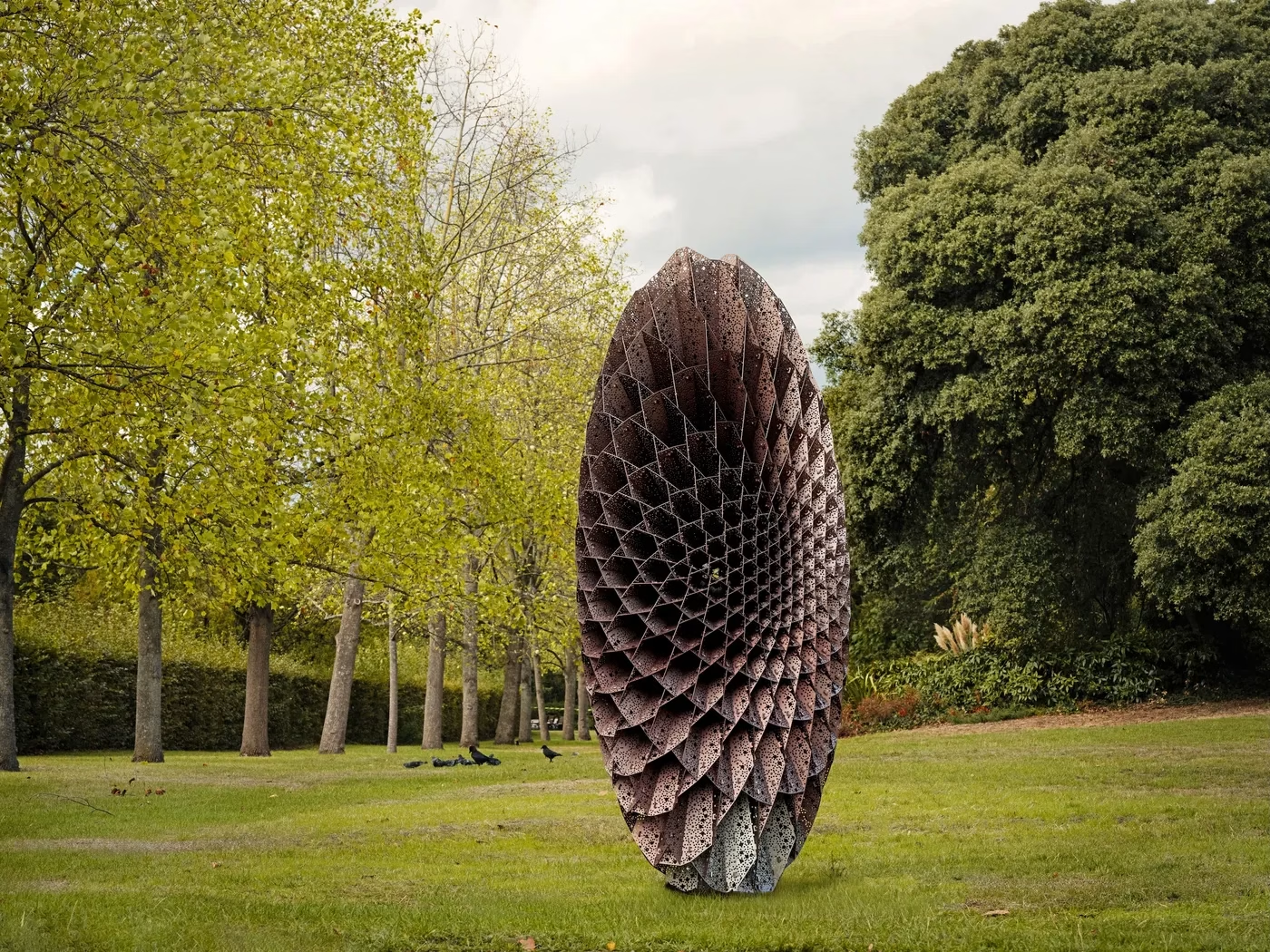
The resulting works are monumental, radiant forms composed of thousands of interlocking metal plates that fracture and refract light from every angle, recalling perforated constellations. Through these sculptures, Shawcross translates into physical space the sheer density of that inaugural millisecond—the violent inflationary epoch where the universe expanded from an infinitesimal singularity into the abyss. Where science exhausts its data and yields to imagination, Shawcross chisels that nascent flash directly into metal and light.
Yet the exhibition’s most disorienting experience lies within its counterpart: Slow Arc inside a Cube.
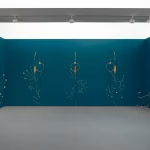
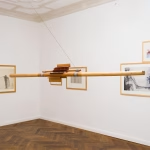
A kinetic installation in development since 2007 and refined with growing complexity over the years, the work arrives at Victoria Miro in its most monumental, all-encompassing iteration to date. Enclosed within a mesh cage, a halogen light source glides along a motorized arm, tracing a continuous parabolic arc. As it travels, the colossal silhouettes of the wire armature project onto the gallery walls, stretching and buckling in real time. The room’s architecture seems suddenly to liquefy; one feels thrust directly into Plato’s cave, confronted with that ancient allegory where reality is reduced to projected shadow.
Shawcross conceived the piece drawing inspiration from an analogy by British chemist Dorothy Hodgkin, a pioneer of atomic mapping: attempting to deduce the intricate structure of a tree solely by observing its cast shadow. Accompanied by an experimental piano soundscape composed specifically for the exhibition by Edward Chilvers, any lingering spatial stability dissolves completely into a hypnotic flux. As the artist notes, these works serve to “whittle away at our sense of certainty about knowledge,” reverberating across the uncanny rift between reality and perception.
While Shawcross has recently garnered widespread attention for his towering Cambridge monument Glance of the Sun and his striking presence at Frieze Sculpture, this presentation in London Gallery I at Victoria Miro’s Wharf Road space demands something far more visceral. It dismantles passive spectatorship, drawing the viewer into the belly of an immense, cosmic apparatus.
For those seeking to interrogate the contours of reality and view the dawn of the universe through an abstract lens, Shadows of the Mechanism runs until 23 January 2027—an arresting demonstration of how science and art converge in humanity’s perennial quest to grasp its own origins.