

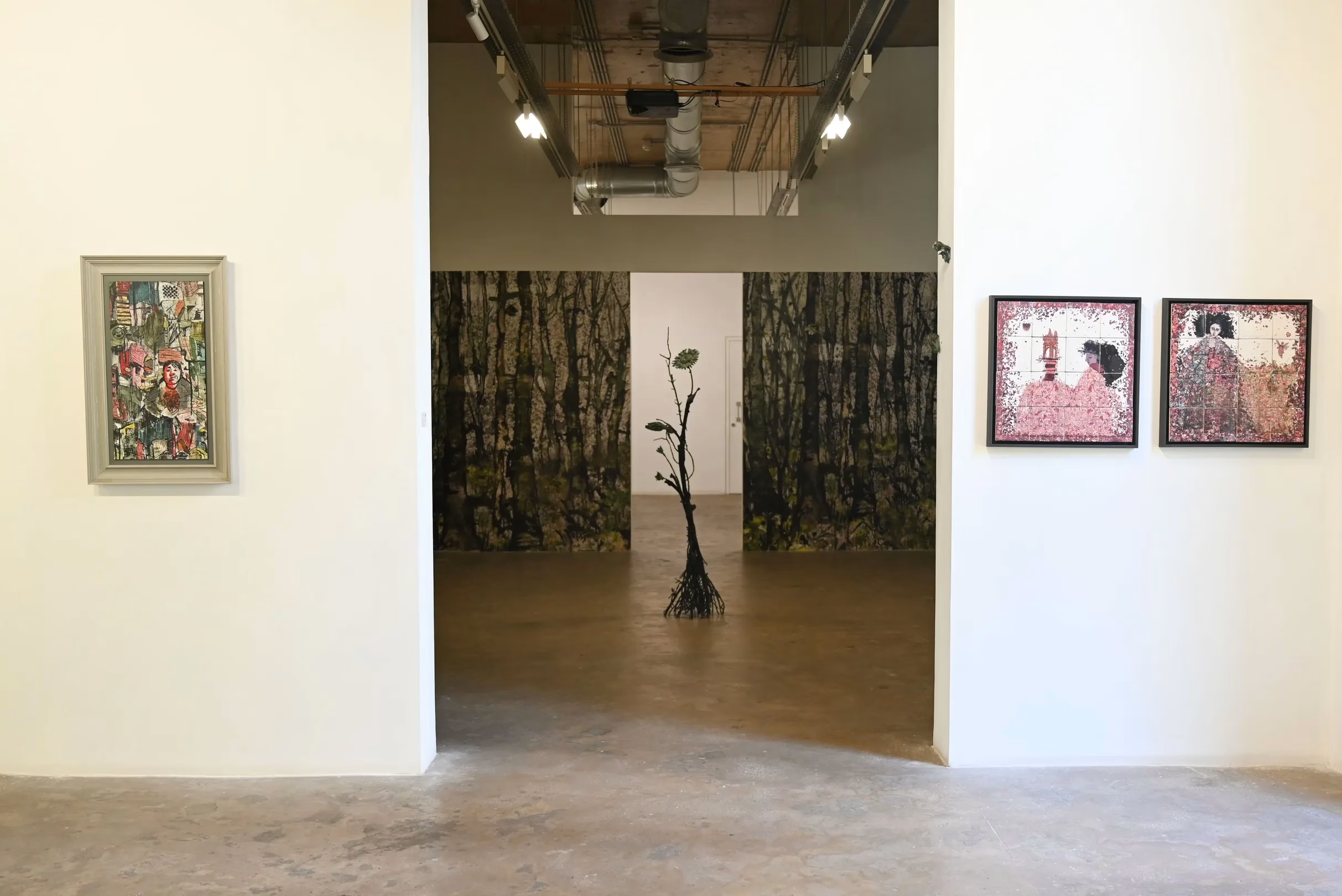
A whale gliding suspended above a city skyline, a solitary camel treading slowly across rooftops… On one side, domestic fixtures like teapots, armchairs, and lampshades; on the other, fighter jets and reconnaissance drones encroaching upon a delicate bouquet. Zena Assi’s latest solo exhibition, Ordinary Things, on view at Galerie Tanit in Beirut, anchors itself precisely upon this uncanny yet acutely familiar threshold.
Those who follow the trajectory of the Lebanese-born (b. 1974), London-based artist will readily recognize the thematic weight migration, displacement, and the portability of memory command within her practice. Here, however, Assi recalibrates the migrant condition through a different conceptual lens: psychoanalyst Donald Winnicott’s notion of “transitional objects.” These are the mundane articles that bridge psychic interiority with external reality, establishing a dialectic between the two. Imbued with the collateral weight of armed conflict, historical rupture, and collective grief, everyday objects are reconstituted under Assi’s touch into intimate registers of personal memory.
A Universe Where Temporal Registers and Dimensions Collide
Assi draws unreservedly from magical realism to articulate her narrative. Across her canvases, ceramics, and sculptures, an expansive bestiary—teeming with wolves, birds, fish, and insects—quietly infiltrates the human arena. In this hybridized cosmos, an ancient Phoenician artifact breathes the same charged air as contemporary soldiers, just as a young girl stands in precarious proximity to an imposing military tank (Red Tank).
This compositional logic is particularly pronounced in her cast-bronze, gunmetal, and concrete-accented Autoportrait on my Cigarette Break and the monumental Flower sculpture series. In these pieces, Assi elevates the sculptural poise of the everyday into something bordering on the monumental. Deliberately distorting scale, she dissolves the boundary between the mundane and the foreign, fashioning an intermediate space where domestic banality reaches its limit and the extraordinary is subtly domesticated.
Bottles Cast into the Sea
The cinematic register of the exhibition is sustained as much through Assi’s material handling as through her iconography. Inscribed with intricate urban skylines, dense crowds, and layered architectural topography, her ceramic vessels—titled Beirut I Love You—read like transatlantic messages cast into an uncertain future. Reminiscent of archaeological relics, these forms prompt an inquiry that extends beyond geography, traversing historical epochs, fallen civilizations, and art history itself. An eclectic constellation of references—from the flat planes of Japanese woodblock prints and Monet’s atmospheric hazes to Magritte’s surrealist inversions and the polished sheen of Pop Art—furnishes the theatrical mise-en-scène of her tableaux.
Bringing the banal into tense conversation with the supernatural, the immediate with the elsewhere, and the ominous with the comforting, Ordinary Things offers an astute site to confront personal memory in a world where objects are never simply inanimate.
Marking the latest chapter in Assi’s multifaceted practice, the exhibition is on view at Galerie Tanit, Beirut, through 17 October 2026.