

The Political Power of Sound and the Whisper of Nature: Lawrence Abu Hamdan’s “Zifzafa” Exhibition at The Common Guild


Arguing that sound is not merely something heard, but also a political power and a form of collective memory, “forensic listening” expert Lawrence Abu Hamdan presents art lovers with his brand-new project in the UK. Opening today at The Common Guild space in Glasgow in collaboration with the Edinburgh Art Festival (EAF), the “Zifzafa” exhibition invites visitors to a powerful auditory confrontation between August 20 and October 17, 2026.
The exhibition takes its name from Zifzafa, an ancient and resonant word used in Arabic poetry to describe a wind that shakes and rattles everything in its path. Defining himself as a “Private Ear” and investigating human rights violations through sound traces, Abu Hamdan zooms in on the practices of “green colonialism” and the devastating noise pollution that the 256-meter-high giant wind turbines planned in the occupied Golan Heights (Jawlan) will inflict on the local population. Presented under the guise of “green energy” but projected to be built as close as 35 meters to residential homes, the 70–90 dB sound mass generated by these turbines turns the area uninhabitable, effectively turning into an acoustic annexation.
Music, Sound, and Resistance: An Auditory Memory Beyond Canvases
Stemming from Abu Hamdan’s two-year field research, the exhibition brings together works shaped by the power of auditory layers rather than visuality through a fluid narrative.
Conceived as a game-engine simulation in the exhibition, Zifzafa: Livestream Audio Essay (2025) overlays the noise map of a similar turbine site in Germany onto the geography of the Golan Heights. This artificial noise mass collides with the sounds of bees, cows, children, wedding songs, and saxophone tones recorded by Jawlani composer Busher Kanj Abu Saleh, keeping a record of a nature and collective memory on the verge of disappearing.
Created by the artist in 2024, the work titled Wind Ensemble projects the performance of musician Amr Mdah playing the saxophone on the balcony of a house just 50 meters away from a planned turbine site onto stacked amplifiers. Through the bond between breath and nature, this installation offers an extremely simple yet striking visual of resistance.
Another work realized by Abu Hamdan in 2024, the three-channel video piece titled Tilting at Windmills i, ii & iii, derives its name from Miguel de Cervantes’ famous story of fighting windmills in Don Quixote. While questioning the act of fighting non-existent enemies and the mapping of giant turbine sounds across geography, the work draws the viewer into a deep space of audio-visual contemplation.
Live Performances and Gatherings
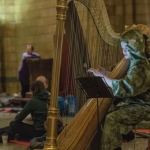
Throughout the exhibition, this impactful sound map will not remain confined to museum walls. In a live performance taking place at Leith Theatre on the evening of Saturday, August 29 as part of the Edinburgh Art Festival, Jawlani musicians Busher Kanj Abu Saleh and Amr Mdah will take the stage to bring this auditory resistance to life with live rhythms. Additionally, on the evening of Wednesday, August 26, Lawrence Abu Hamdan will give a free artist talk in The Common Guild library.
You can discover this impressive exhibition—where sound transforms into evidence, a sanctuary, and a form of resistance—in Glasgow until autumn.
Exhibition Note from NO-26 Editor
- Artist: Lawrence Abu Hamdan
- Exhibition: Zifzafa
- Venue: The Common Guild (5 Florence Street, Glasgow)
- Dates: August 20 – October 17, 2026 (Open to Visitors)
- Special Events: Live Performance (August 29, Leith Theatre, Edinburgh) & Artist Talk (August 26, Glasgow)
- Aura: A political, profound, and auditory contemporary art experience standing against green colonialism in the Golan Heights through sound research, game-engine simulations, and live musical interventions.