

Taking root, ripping those roots out from beneath the soil, and then sprouting anew in a completely different geography… Is memory not a linear timeline, but a rhizomatic network woven from raw materials where the past and the present seep into one another? Born in Seoul in the late 1980s and continuing her practice along the Berlin-Seoul axis, Jeewi Lee confronts us with that uncanny dialogue between nature, humanity, and cultural belonging through her solo exhibition titled Ground, which has opened at Gallery Meyer Riegger in Karlsruhe. On the no-26 art radar this week is a fascinating exhibition that transforms the internal memory of materials into living archives.
Jeewi Lee’s art practice makes the human-nature relationship and her own personal roots visible through traditional materials whose origins date back centuries. The artist feeds on the tension created by paradoxical dualities: damage and preservation, vulnerability and resilience, death and life. In this solo show at Meyer Riegger, three distinct periodic bodies of work dig into the artist’s cultural and creative foundations side-by-side.
A Reverse Painting Practice: “Past Tense”
One of the most impressive veins of the exhibition is the artist’s Past Tense series, which she has sustained since 2016. In these works, Lee works with hanji jangpan—a traditional Korean paper whose durability is enhanced with a special oil, traditionally used as floor covering in Korean homes.
In Korean culture, these floors are directly linked to ondol, the traditional underfloor heating system, and were the heart of domestic life until the 20th century. This flexible spatial practice, where people ate, socialized, and slept directly on the floor without furniture, is gradually disappearing with modern architecture.
Jeewi Lee literally cuts out the floors of old houses and hangs them on the gallery walls. She turns our gaze downward—toward the earth, the foundation, and the place where bare feet tread.
Treating the floor like a living archive, the artist makes visible the ghost traces left behind by the people and objects that have passed through those homes. Instead of adding paint to a blank canvas, she frames the floor bearing the traces of lived experience on the wall, executing a reverse act of painting. The flooring transforms into a massive abstract canvas painted by time and space itself.
Preservation Born from a Wound: The Shamanic Forest and “Ott”
Another vital element in the artist’s material repertoire is a raw resin/lacquer obtained from a lacquer tree native to East Asia: Ott (옻). Historically used to protect royal items and spiritual objects, strengthening them against time, this lacquer is an extremely arduous and precious material to obtain. This liquid, which trickles from incisions intentionally carved into the trunk of the tree, provides healing and protection, yet ironically possesses a highly toxic structure that causes severe allergic reactions on the skin in its raw form.
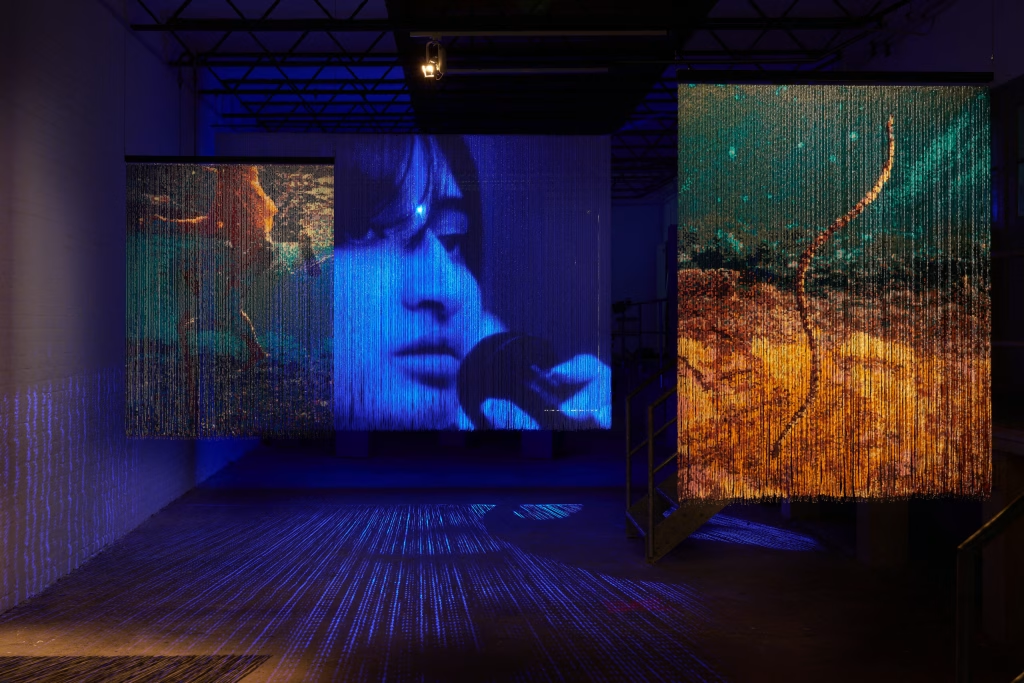
This uncanny duality gains physical form in the exhibition’s installation titled Illumination of the Tears:
- Radiant Wounds: A forest of tree trunks suspended in mid-air rises within the gallery space. The incisions carved into the trunks of the trees are illuminated with ultramarin blue LED lights.
- Tears of the Tree: The light focuses our gaze directly on the damage received by the tree and the tears—namely the resin—it secretes as a reaction to this damage. Nodding also to Korean shamanic traditions, this installation demonstrates how a protective shield can only be born in a moment of wounding and danger.
The silkscreen prints titled Silent Flame, which serve as a continuation of this series, offer abstract cross-sections of the tree’s inner layers. The sharp blue line settled at the bottom of the dark brown and crimson tones recalls roots, family trees, and ultimately, the ground once again.
Mirror of the Ashes: “Shades of Shadows”
In the Shades of Shadows series, Jeewi Lee works with charcoal, another of her signature materials. Born from the total destruction of wood by fire, charcoal merges in the artist’s hands with the aforementioned traditional ott lacquer.
Thus, the tension between destruction (charcoal) and healing/preservation (lacquer) climbs to its peak. The smooth, pitch-black surface of the work functions almost like a mirror, absorbing the gallery’s light and the viewer’s own shadow. A new reflection is born from annihilation.
Ground is a striking exhibition proving that nature’s physical materials are in fact the most faithful guardians of our past, our ghosts, and our memory. By bringing stains, secretions, fibers, and ashes to the surface, Jeewi Lee underlines a universal truth: all decay and all healing, in reality, feed on the exact same source. We highly recommend that anyone traveling to Karlsruhe before the end of July experience this profound ritual on the walls of Meyer Riegger.
Exhibition Details:
- Venue: Gallery Meyer Riegger, Karlsruhe, Germany
- Artist: Jeewi Lee
- Exhibition Title: Ground
- Closing Date: End of July 2026