

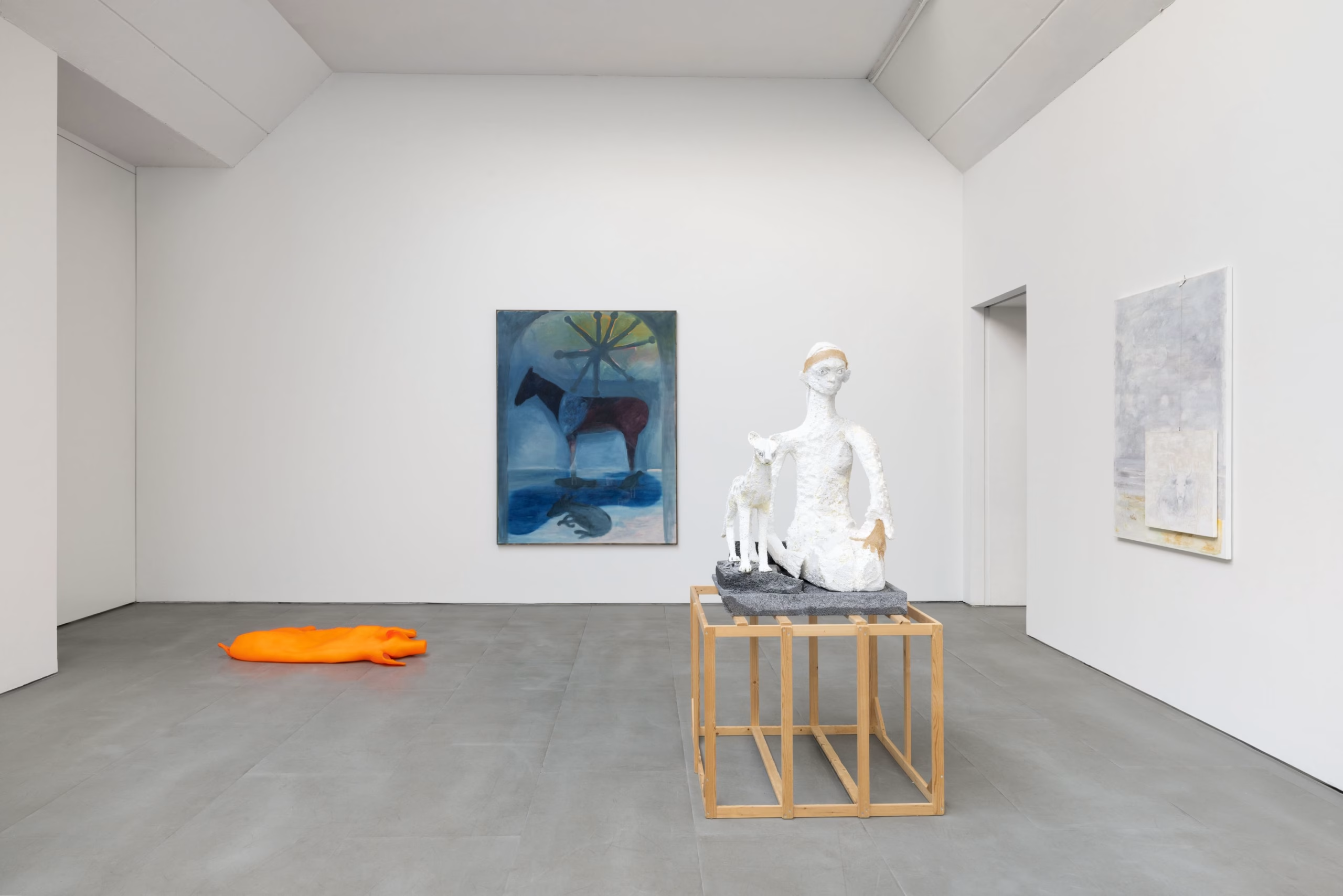
Few bonds on earth are as ancient, fraught with contradiction, and fundamentally unresolved as that between human and animal. Where does the invisible boundary lie between the cat curled at the foot of our bed and the meat on our plate, or between the mythological avatars we revere and the bodies dispatched to slaughterhouses? Gazing into their eyes in search of an answer that never arrives, we simply project our own anxieties, desires, and speciesist hubris onto their silence. Running at carlier | gebauer in Berlin from 10 September to 14 November 2026, the expansive group exhibition Animal Mirror pulls this uncanny fault line beyond zoological curiosity, staging a rigorous reckoning with human morality and existence. Bringing together fifteen artists, the presentation disperses the animal across the gallery space in multilayered guises: domestic companion and sacrificial victim, folkloric cipher and sovereign artistic subject.
Upon entering, one is first met by the photorealistic canvases of Jelena Bulajić. Nodding to Hiroshi Sugimoto’s museum dioramas, After Sugimoto, Polar Bear and Gemsbok (both 2023) deploy meticulous graphite and acrylic on linen to construct the illusion of an idealized ‘wilderness’. Yet these glassy, immaculate surfaces lead us not toward untamed nature, but straight into the human apparatus of spectatorship. Bulajić articulates the exhibition’s conceptual spine from the threshold: the gaze we direct toward the animal is never neutral, but permanently freighted with anthropocentric projections and repressed impulses.
Immediately adjacent, Cecilia Edefalk’s painting Ko (2011) abstracts this gaze further; through a strand of wire affixed to the surface and restrained tonal shifts, it interrogates the perceptual filter—the mental ‘screen’—through which we construct both animal and world.
Venturing deeper into the gallery, one arrives at a radical juncture where the animal ceases to be a passive object of observation and becomes an active collaborator in the creative act. From Aki Inomata’s series Why Not Hand Over a “Shelter” to Hermit Crabs?, a 3D-printed resin shell was engineered for a hermit crab carrying the contested borders of Jeju Island on its back. Scuttling about bearing a miniature architectural facsimile of human territoriality, the crab dismantles singular authorship, emerging as an active agent in the work’s realization.
This ethical sensitivity assumes a far more vulnerable physical form in Girl with Cat (2019) by the late Lin May Saeed, whose sculptural practice was long committed to animal liberation. Here, the industrial austerity of Styrofoam, jute, and steel softens into a gesture of unvarnished empathy as a sculpted figure embraces a feline companion.
Perhaps the exhibition’s most arresting rupture unfolds across hybrid rooms where biotechnology and organic morphology entangle. The artist duo Pakui Hardware’s installation Extrakorporal (2020)—fashioned from leather, latex, chia-seed-infused silicone, and glass tubes—evokes a cybernetic organism where prehistoric DNA sequences seem fused with contemporary obsessions with the fountain of youth. Corporeal boundaries dissolve so completely that delineating the synthetic from the living becomes impossible.
This somatic hybridization reverberates in Paloma Varga Weisz’s Nasenaffe (2017), carved from charred limewood, as well as her unsettling works on paper, Mouseman and Child (2000), where morphological borders between human and beast yield folkloric yet disturbing entities. Meanwhile, Thibault Hiss’s Doe giving birth to a duck (2025) and an accompanying sleeping figure with a raven materialize this metamorphosis in space through the textural transmutation of synthetic media such as polyurethane and carbon fiber.
In an adjoining room, Thomas Schütte’s Praying Dog (2022), cast in patinated bronze and steel, lays bare societal hierarchies through the ironic subservience of a canine in supplication, counterbalanced by Asta Gröting’s Dancing Queen (2024)—a vulnerable, tactile mass of cast pink silicone resting directly on the concrete floor.
On the facing wall hangs Julia Kowalska’s Dogs (2026), radiating the visceral immediacy of wet paint. Kowalska plucks figures from the subconscious to convey an ambiguous, almost suffocating emotional bond—an unsettling proximity where tenderness and dominion blur within an oneiric haze.
This dreamlike cadence carries into Diego Delas’s Atravesarás la noche (2023), set within a bespoke frame darkened with green tea, wine, and linseed oil, as well as Paolo Salvador’s Duna (2026), executed on handwoven alpaca wool. Both artists bind the physical grain of their supports to the tactile, corporeal presence of the animal, pulling the viewer beyond the confines of rationalism.
Resting on the floor like a dormant organic spine, David Zink Yi’s muted dark ceramic mass (Untitled, 2018) breathes with measured gravity, while Sequoia Scavullo’s canvas Low Paradise Bow (2026) introduces an ethereal, celestial lightness against these darker registers.
Before departing, one lingers before Erik Schmidt’s Day Grey (2025). Pigeons huddle against the city’s grey, mist-shrouded skyline. By centering creatures routinely dismissed or reviled as urban pests amidst consumerist routines and metropolitan rites, Schmidt exposes our own paradigms of social belonging and exclusion.
Within the gallery’s pristine white cube, Animal Mirror refuses to indulge in well-worn, romanticized panegyrics to nature. Instead, it exposes how every animal gaze reflects our own speciesist solipsism, capacity for ruin, and irrepressible yearning for compassion. For those willing to perceive the animal as an evolutionary kin, a co-inheritor of biological lineage, and ultimately a mirror reflecting humanity’s own shadow, carlier | gebauer delivers one of this autumn’s most penetrating visual encounters.