

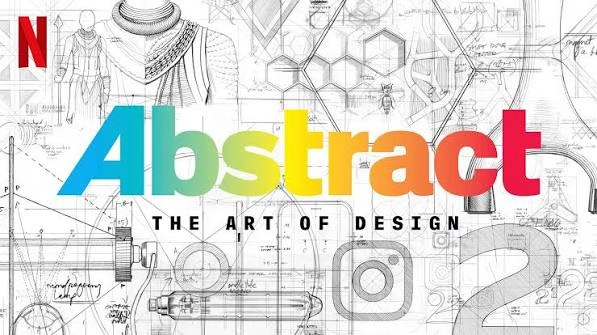
The ceramic mug cradled in the morning, the contours of the typography on a smartphone screen, the tread of a shoe, or the imposing architecture framed through a window… Every object that populates our immediate environment originated in the human mind, distilled through thousands of minute decisions into its present form. Premiering on Netflix in 2017, the documentary series Abstract: The Art of Design sets out to trace this taken-for-granted everyday miracle, probing the inventive intellects behind the material world.
One Discipline, One Director, One Visual Language
Conceived by former Wired editor-in-chief Scott Dadich, the series spans 14 episodes across two seasons. Each instalment centres on a practitioner who has fundamentally redefined their discipline, yet whose name frequently remains eclipsed behind corporate signage or product labels. Much of the series’ vitality stems from its directorial rotation, enlisting filmmakers such as Morgan Neville so that the cinematic grammar of each episode is recalibrated to mirror its subject’s creative ethos. In the portrait of illustrator Christoph Niemann, for instance, line drawings converse so organically with live-action footage that the term “illustration” feels entirely reductive for what takes place on screen.
From Power Plants with Rooftop Ski Slopes to Architecture You Can Wear
For those drawn to spatial thinking, the episode dedicated to Bjarke Ingels offers an invigorating study. Ingels is celebrated for his doctrine of “pragmatic utopia”—crystallized in projects like the Copenhagen waste-to-energy plant crowned with an artificial ski slope. Coined by the architect as “hedonistic sustainability,” this proposition argues that built structures must not simply perform functional duties, but actively introduce play and joy into civic life.
Perhaps one of the series’ most revelatory arcs belongs to Tinker Hatfield. Formally trained as an architect, Hatfield transposed his understanding of load-bearing structure and volume onto the athletic fields of Nike, establishing himself as a titan of footwear design. As the genius behind the Air Jordan and Air Max lineages, Hatfield treats the shoe as an exercise in micro-architecture. Observing the inner world of a designer who has archived every sketch, stray scribble, and prototype across decades fundamentally reorients the way one looks at industrial objects.
The Voice of Typography and the Architecture of Light
Asserting that graphic design is an autonomous communicative syntax rather than mere surface ornament, the episode focusing on Paula Scher radically recasts our relationship with typography. Scher’s posters and identity systems for New York’s Public Theater prove that letterforms can shout at pedestrians from street corners or dance alongside them in fluid choreographies.
Elsewhere, stage designer Es Devlin—who treats light as a kinetic, sculptural medium across arenas and Beyoncé’s Formation tour—and interior designer Ilse Crawford, whose empathetic approach interrogates how interior spaces make us feel, bridge the chasm between the ethereal and the tactile.
Expanding Horizons: From Artifacts to Modes of Thought
While the inaugural season anchored its narrative largely in tangible “objects,” the second season, released in September 2019, shifts its lens toward design as a cognitive methodology. Profiling Olafur Eliasson, Neri Oxman, Ruth Carter, Cas Holman, Ian Spalter, and Jonathan Hoefler, these six episodes traverse a continuum from contemporary art and bio-architecture to costume design, modular play, digital product interfaces, and type design. In doing so, the series demonstrates that design is no longer confined to the physical sphere, but unfolds across ecological and perceptual systems.
Beyond the Celebratory Register
One must, of course, concede the structural constraints of the forty-minute documentary format. The series leans into an unapologetically celebratory, occasionally hagiographic tone, bypassing any radical interrogation of the demanding labour conditions, environmental extraction, or exclusive socioeconomic accessibility underpinning these designs. Yet the most enduring gift Abstract imparts is a refined attentiveness. Once the screen goes dark, one pauses a moment longer before a brass door handle, the typesetting of a menu, or the rhythm of pavement underfoot. Discerning the trace of human deliberation in every mundane detail renders the surrounding world infinitely more layered.