

In the Cold, Crystalline Layers of Canvas: A Dialogue Between Birgitt Bolsmann and Kurt Haug in Berlin

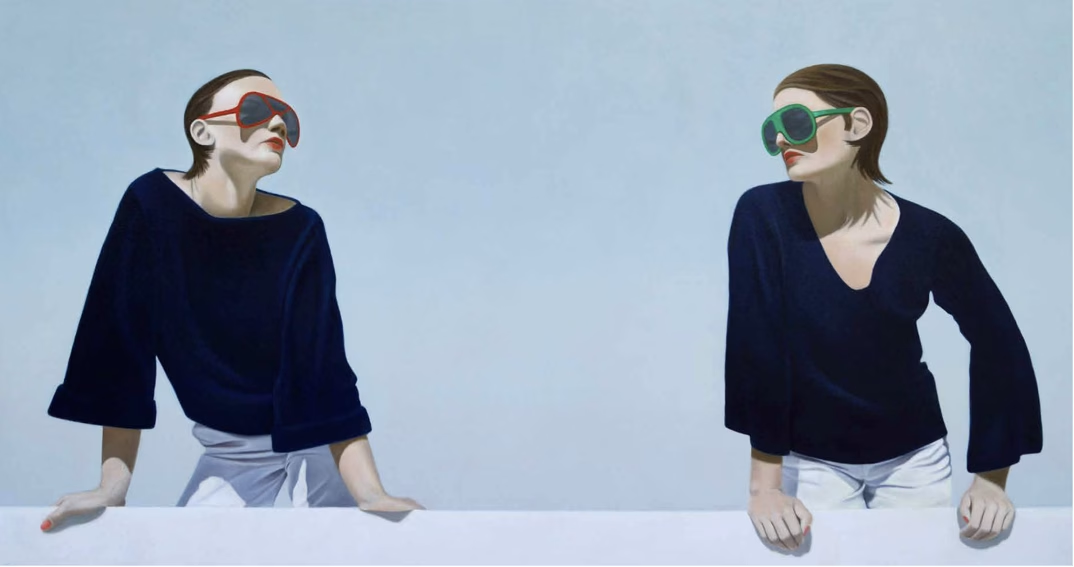
In the early 1960s, the European art scene had largely surrendered to abstract stains, uninhibited gestural mark-making, and the chaotic surfaces of Art Informel. It was during these exact years that two young painters, working side by side in the studios of the Hamburg University of Fine Arts, chose not to be swept up by the prevailing tide: Birgitt Bolsmann and Kurt Haug. For them, painting was not an unchecked outlet for inner catharsis, but a disciplined search for truth—one where painstakingly built layers of egg tempera and resinous oil paint achieved a glass-like clarity on canvas.
Presented at Kunsthandel Wolfgang Werner in Berlin from 10 September to 28 October 2026, the exhibition focuses on the artist couple’s output between 1970 and 1990. The exhibition’s most compelling narrative lies in demonstrating how Bolsmann and Haug, despite sharing the same technical foundation and commitment to objective realism, drifted toward intellectually divergent poles.
From Fashion Photography to Ancient Myths: Bolsmann’s Critical Lens
Birgitt Bolsmann (1944–2000) trained her gaze squarely on the glossy storefronts of consumer society and the female body as idealized by popular culture. Re-rendering imagery culled from fashion magazines and advertising posters with the technical rigor of the Old Masters, she upended a male-dominated art history and entrenched mythologies. In works such as Schönheitskonkurrenz (Beauty Contest, 1977) or Die Flucht aus dem Patriarchat (Escape from Patriarchy, 1986), Bolsmann playfully yet incisively deconstructs the societal gender roles and formal constraints concealed beneath polished surfaces.
The Object Stripped of Meaning: Kurt Haug’s Clinical Distance
Kurt Haug (b. 1941), by contrast, eschews narrative storytelling and political agendas altogether, approaching the subject with surgical detachment. As seen in Nähseiden (Sewing Threads, 1975), he places an everyday spool—an item casually overlooked in daily life—dead center on the canvas, parallel to the picture plane. For Haug, the objective is never to burden the object with symbolic weight, but to anchor its material texture, mass, interplay with light, and raw physical presence in their purest form.
The Line of Light and Monochrome
Alongside monumental canvas works, the exhibition accords a prominent place to pencil drawings produced concurrently with the paintings. Executed in the softest, most delicate gradations of gray tone, these works on paper demonstrate how line alone can acquire volume, assuming a near-sculptural weight.
Bolsmann’s pioneering path in feminist art—marked by the seminal 1986 Hamburg exhibition Frauen malen Frauen (Women Paint Women)—alongside Haug’s decades-long professorship at the Kassel Art Academy, stands as proof that both painters viewed realism not as a passing fashion, but as a lifelong stance.