

Lisson Gallery, 67 Lisson Street • June 4 – August 22, 2026
Memory is not a sterile object just sitting in a corner that you can touch; it is an uncanny frequency suspended in the air until it finds the right receiver. Sometimes a painting waits silently for exactly twenty-four years just to find its own voice. With its newly opened exhibition Zanzibar, Lisson Gallery in London reveals how this quarter-century of silence has transformed into a shattering noise. The project before us is the story of Magda Stawarska infiltrating, like a sound-artisan, a memory labyrinth left unfinished by Lubaina Himid.
Canvas Skeletons Waiting for Twenty-Four Years
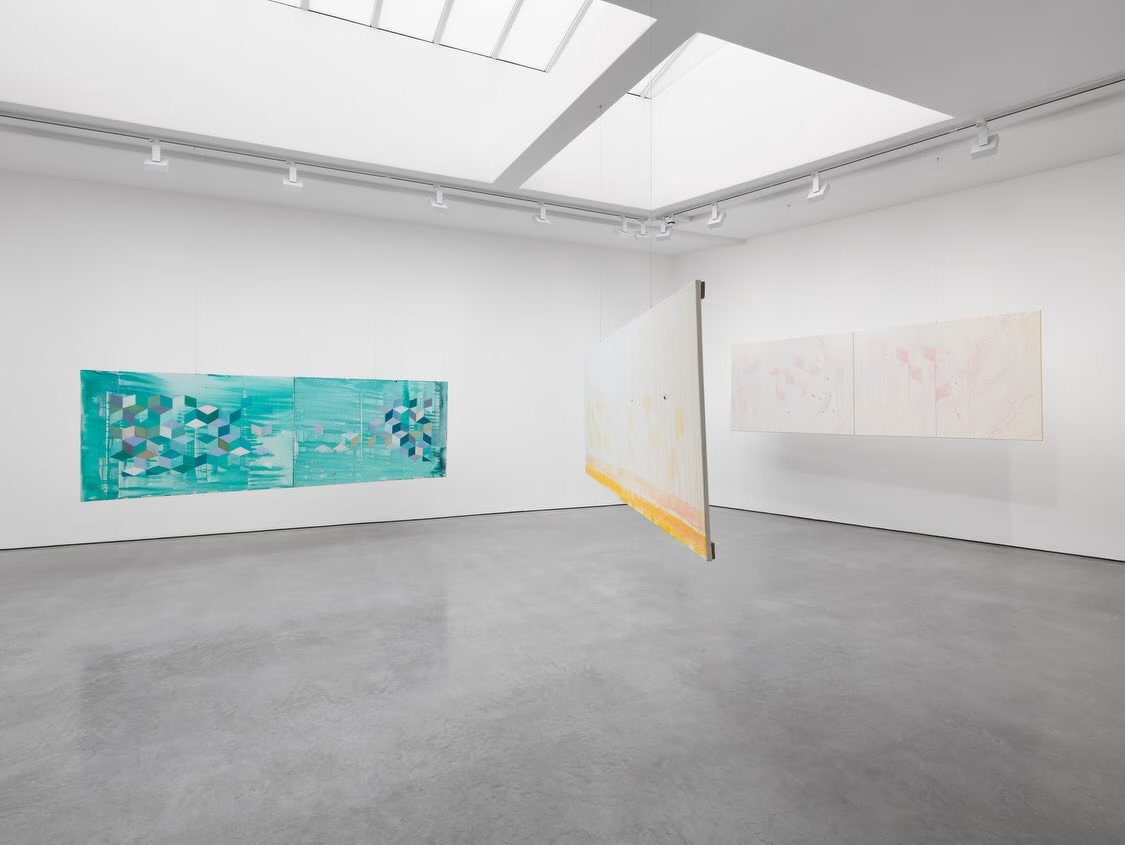
It all began in 1999. Lubaina Himid produced nine diptychs (dual canvases) that were considered a complete anomaly, a strange detour in her artistic practice at the time. In contrast to the figurative and intensely narrative language the artist was accustomed to up to that point, these paintings were completely figureless, silent, and abstract. These canvases, which even Himid cast aside noting, “They look like nothing I’ve done before or since,” remained locked to the past by an invisible bond for exactly twenty-four years.
That was until 2023, when Magda Stawarska heard the hidden rhythm inside those canvases. Stawarska wrote a powerful 38-minute, multi-channel sound composition—practically a libretto—for these silent layers of color, and thus Zanzibar was reborn.
An Olfactory Rather Than Visual Memory
Zanzibar is that misty childhood geography where Himid was born in East Africa, and which she was forced to abandon with her family without looking back following her father’s sudden death. The sharp cubic forms and zigzag motifs in the paintings may seem like mere geometric surface plays at first glance; however, as you approach the canvases, the material’s own memory begins to leak out:
- Cloves Numbing Warming Soothing Strong: Actual traces of cloves are printed one by one inside the geometric boxes; this is a powerful recollection of a local industry leaking out from olfactory memory rather than a visual image.
- Sprinkled Rosewater is Always Pink: It feeds on the uncanny, bitter background memory of rosewater being scattered around from a silver bottle.
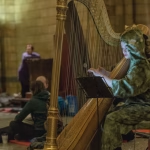
The eight-channel sound installation engineered by Stawarska hangs like a ghost between the canvases in the gallery space. When you listen closely, you hear Zanzibar’s traditional Taarab music, fragments of opera, whispered readings of an old travel guidebook left from Himid’s father to her mother, archival BBC radio recordings, and Himid’s own naked voice. The exhibition hall ceases to be a mere space for viewing paintings and transforms into a musical and uncanny intermediate zone that one steps into.
Contextual Impact & Details
This summer, the partnership between the two artists continues with different resonances at the British Pavilion of the Venice Biennale and at Kettle’s Yard. However, this gathering at Lisson Gallery is the rawest, most intense state of Zanzibar, because it bears the entire weight of that heavy bridge of time between 1999 and the present day.
To feel that memory is not something to be consumed merely by looking, but a living organism that possesses us only when we reach a certain frequency, you can direct your path to Lisson Gallery until August 22, 2026. It is well worth surrendering to the sounds and clove scents rising from the canvases with a naked mind.
Exhibition Details:
- Artists: Lubaina Himid & Magda Stawarska
- Exhibition Title: Zanzibar
- Venue: Lisson Gallery, 67 Lisson Street, London
- Dates: June 4 – August 22, 2026
- Components: 9 abstract diptych paintings (originally created in 1999), actual clove leaf impressions, and a 38-minute, 8-channel sound installation.
Core Themes: Olfactory memory, colonial/post-colonial geography, sensory art, and interdisciplinary collaboration across time.