

“My biography is very simple,” Daniel Buren once said: “Daniel Buren. Born March 25, 1938. Works and lives in situ.” This dismissal is not a narcissistic self-portrait; it is a fierce manifesto that wrenches art out of the comfortable isolation of gallery walls and hurls it into the naked reality of the street, space, and life. It is the shortest, most uncompromising programmatic text stating that art cannot exist in a sterile void independent of space.
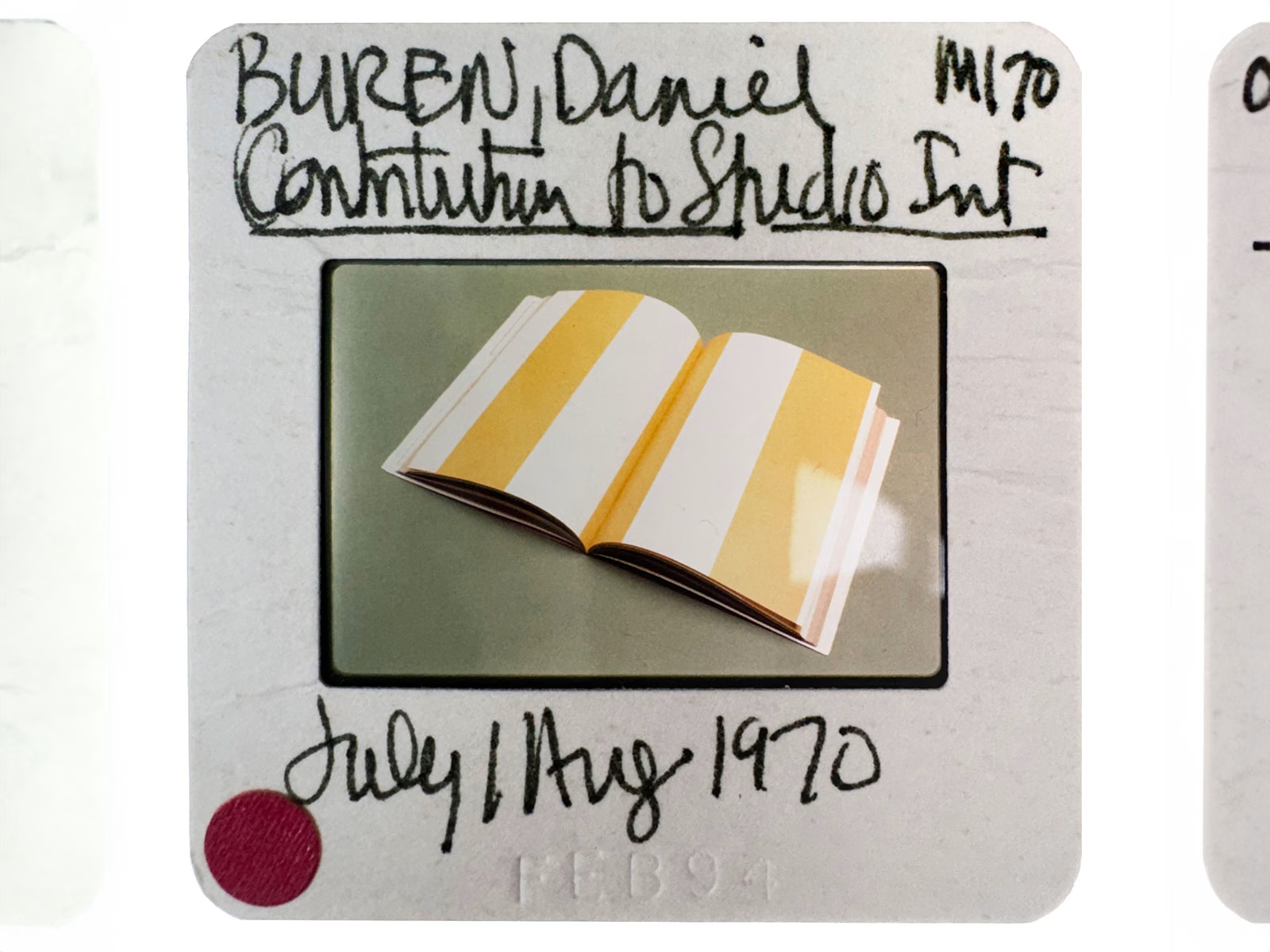
With its upcoming exhibition Pages in Situ, the Lisson Gallery (67 Lisson Street) in London tracks Buren’s famous 8.7-centimeter vertical stripe—which he has used without compromise for nearly sixty years—not within the massive architectural structures we are accustomed to, but within the micro-universe of print, books, and paper. On view from June 11 to August 22, 2026, this exhibition brings together more than 100 printed objects designed by the artist—including magazines, catalogues, invitation cards, and posters—through the lens of designer Fraser Muggeridge.
The Stripe as an Anonymous Sabotage Tool
For Buren, these stripes were never decorative signatures or aesthetic motifs. They were silent, profound objections raised against the institutional art framework, the invisible boundaries of galleries, and the homogenizing language of the publishing world. The artist smuggled most of these stripes into publications like an illegal passenger, leaving behind no name or explanation at the time:
- Prospect 68: He hacked the system from within by inserting a completely anonymous page composed of green stripes right into the middle of the exhibition catalogue.
- The Streets of Bern (1969): The moment he was excluded from Harald Szeemann’s famous Live in Your Head: When Attitudes Become Form exhibition, he demonstrated his reaction by pasting unauthorized posters on the streets of Bern, which led to his arrest because of these very stripes.
Pages in situ honestly documents how that famous 8.7 centimeters settled into newspaper columns, reproduction dimensions, and page margins as a unit of measurement and a tool for critique. The stripe appears sometimes completely out in the open, and at other times hidden within the width of a text column; but in both cases, it never refrains from asking that crucial question: Who prepared this page, and for whom?
Overflowing from the Gallery: The Walls of Camden
The exhibition does not confine itself to the white cube of the gallery but leaks into the uncontrolled rhythm of the street. Buren’s legendary billboard work, which he executed on Shaftesbury Avenue in 1972, is being reproduced in Camden on the occasion of this exhibition. Visible at 70 Eversholt Street from June 1 to June 28, this public intervention intends to refresh the street’s memory by replacing the purple color of the original with cyan this time. After examining the printed ephemera inside the gallery, one must step outside and look with the naked eye at the stripes rising on the raw ground of the street.
Lisson Gallery’s history of partnership with Daniel Buren stretches back to 1976. What makes this exhibition the strangest and most radical among exhibitions is that an artist has honestly permitted his own half-century history to be reread entirely through the lens of a graphic designer. The very fact that Buren handed the key to his own kitchen over to Muggeridge clearly demonstrates how willing he still is to mock established conventions.
Exhibition & Public Intervention Details:
- Artist: Daniel Buren
- Exhibition Title: Pages in Situ
- Curatorial Lens / Design: Fraser Muggeridge
- Gallery Venue: Lisson Gallery, 67 Lisson Street, London
- Gallery Exhibition Dates: June 11 – August 22, 2026
- Public Intervention Venue: 70 Eversholt Street, Camden, London
- Public Intervention Dates: June 1 – June 28, 2026
Core Elements: Over 100 printed works (catalogues, posters, invitations), the 1972 billboard reproduction in cyan, and the conceptual deconstruction of the 8.7 cm stripe.