

“I was born into a destroyed order, a landscape in ruins, and a shattered society.”
Uttered in 1995, these words are no mere retrospective reflection; they stand as the clearest manifesto for why Georg Baselitz wields his brush like a sledgehammer. Having witnessed firsthand the catastrophic human toll of that manufactured “order,” he held no interest in reconstructing the spurious systems imposed upon him. Now, one of the rawest, most visceral manifestations of this radical refusal confronts viewers amid the stately streets of London, framed within the historic walls of Ely House.
From 13 October to 18 December 2026, Galerie Thaddaeus Ropac hosts Georg Baselitz’s The Heroes 1965–66, revisiting the seminal body of work that decisively redirected the trajectory of postwar European painting.
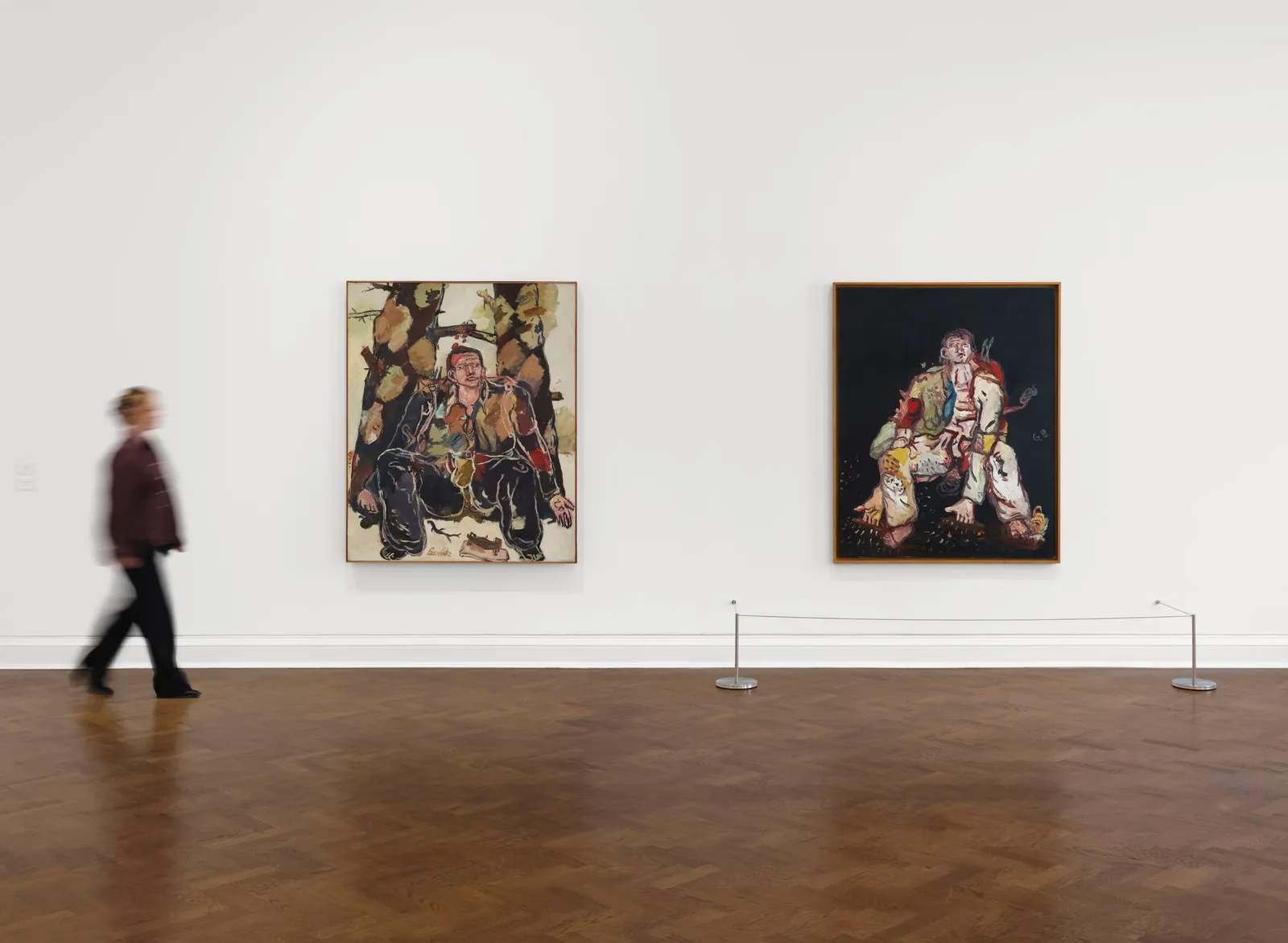
These “heroes” are neither caped crusaders nor paragons in gleaming armour. Threatening to spill past the confines of their frames, these figures—clad in frayed garments and weighed down by monstrously disproportionate hands and feet—are melancholic, broken, yet remarkably tenacious silhouettes. Painted when Baselitz was still in his late twenties, the series marks a crucial turning point where the artist gave tangible flesh to his own existential dread, his placelessness, and the spectres haunting postwar Europe. The seeds of his uncompromising practice and the commanding visual language synonymous with Baselitz today were planted in these very canvases.
Marking the first UK exhibition devoted exclusively to this pivotal phase, the show is an undeniable tour de force. Masterpieces drawn from major institutional collections—including the Tate, Berlinische Galerie, Museum Frieder Burda, and Museum Küppersmühle Duisburg—alongside private archives and the artist’s family collection, share a room for the first time in this constellation. Moving from canvas to canvas, the eerie, claustrophobic weight of the 1960s takes hold with visceral force; the curation strips away passive spectatorship, implicating the viewer directly in this fractured landscape.
We know Baselitz intimately through his radical inverted compositions, sweeping retrospectives extending from the Centre Pompidou to the Guggenheim, and his commanding 2024 presentation at Istanbul’s Sakıp Sabancı Museum. For an artist who has conquered virtually every institutional milestone—from the Venice Biennale to Documenta—and whose work continues to be mounted concurrently from Florence to Seoul, tracing this legacy back to its explosive inception requires a visit to Ely House. Notably, the exhibition is accompanied by an extensive monograph featuring an essay by Max Hollein.
On view through 18 December, the exhibition is an indispensable fixture on the London circuit: an opportunity to confront the raw, unbending pulse of postwar Europe’s scarred heroes and to witness one of contemporary painting’s most arresting chapters. For anyone seeking an encounter defined not by quiet contemplation, but by seismic disruption, this exhibition delivers entirely.