

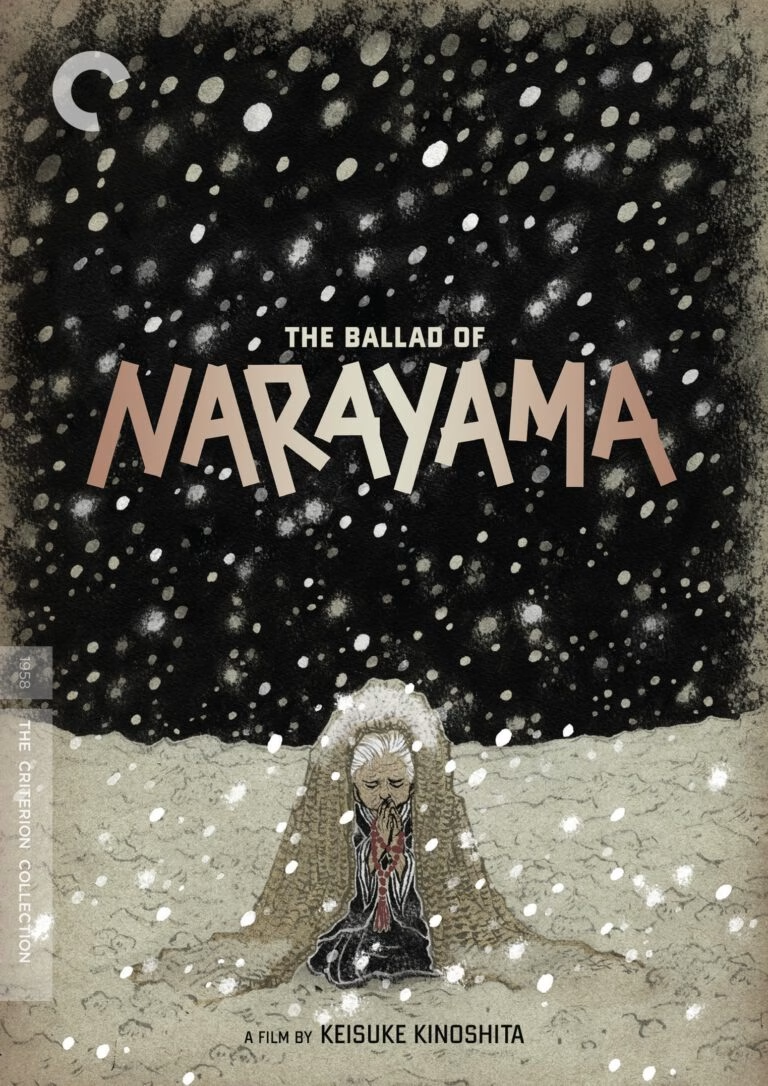
Very few films manage to combine beauty and cruelty in a single frame so strikingly and staggeringly. Keisuke Kinoshita’s 1958 masterpiece, The Ballad of Narayama, transports us to a misty mountain village in Japan and presents one of the most ruthless traditions of human nature with a rare visual grace: the practice of abandoning the elderly at the age of 70 on Mount Narayama to die of cold and hunger. As the master critic Roger Ebert pointed out, the film creates an immense abyss—a magical void—between this bone-chilling story of starvation and abandonment and the film’s stylized Kabuki aesthetic.
An Aesthetic Rejecting Reality: The Flirtation of Kabuki and Cinema
Kinoshita refuses to tell such a heavy and unbearable story with straightforward realism. Instead, he constructs a deliberate artificiality that constantly reminds the audience they are watching a performance. Studio sets next to a babbling brook, matte paintings for backgrounds, and theatrical lights that suddenly drop to black during dramatic moments… Just as in traditional Japanese Kabuki theater, a narrator dressed in black guides us through the layers of the story. As Ebert rightly noted, this intense stylization transforms the story into a fable rather than a literal narrative, making that unbearable cruelty “bearable” for the spectator. This seasonal cycle, stretching from the green of spring to the blood-red leaves of autumn and finally to the deadly white snows of Narayama, serves as a visual symphony of death and acceptance.
Two Different Farewells: Orin’s Acceptance and Mata’s Rebellion
At the emotional heart of the film is 70-year-old widow Orin (Kinuyo Tanaka), who embraces her traditional fate with unparalleled dignity and serenity. Her sacred submission stands in sharp contrast to the wild rebellion of her neighbor Mata (Seiji Miyaguchi), who shares the same fate but struggles desperately against going to his death.
Family dynamics fuel this contrast. While Orin’s son, Tatsuhei, is a compassionate man who loves his mother and hates the idea of taking her to the mountain, Mata’s family has already cut off the old man’s food supply. While Mata wanders the village like a scavenger to survive, Orin is noble enough to invite him in and offer a bowl of rice. However, the world surrounding this kind-hearted woman is not so merciful. Orin’s cruel grandson, Kesakichi, sings a song mocking his grandmother for still having 33 strong teeth at the age of 70. When the villagers join in like a vengeful chorus, implying that Orin has made a deal with demons, one of the film’s most unforgettable and shocking scenes occurs: To prove she is ready for death, Orin bites a stone with all her might, displaying her bloody gums to the villagers. A horrific moment where sacrifice is tested by brutality.
The Rigid Rules of the Mountain and the Weight of Subtext
As Orin embraces her own death as one less mouth to feed in the village, she also thinks of those staying behind. She shows Tama, whom she believes will be a perfect wife for her newly widowed son, a secret trout-fishing spot known only to her.
Finally, the inevitable journey begins. There are three rigid rules for ascending Narayama:
- Once you start climbing the mountain, you must never speak.
- No one must see you leaving the village in the morning.
- You must never look back.
When Tatsuhei leaves his mother on a desolate rock where black crows perch on the snowy peak, he looks at the falling snow and feels a quiet joy in his heart—because the snow will ensure his mother freezes faster and suffers less. That freezing moment, where mercy is the wish for death to accelerate, is one of the heaviest sequences in cinema history.
What does this strange acceptance mean? As Ebert suggested, in a Japan just emerging from the destruction of World War II, Orin’s calm acceptance of this terrifying fate might be an allegory—a tribute to the fortitude of the Japanese people in the face of horrific calamities.
Keisuke Kinoshita, who produced works in countless genres throughout his career—from musicals to thrillers—but never made another film quite like The Ballad of Narayama, leaves behind a masterpiece created by the collision of fate and art. The sentence spoken by Tatsuhei’s new wife, Tama, at the end of the film carries its echo into eternity: “When we reach 70, we will climb Narayama together.”